 Types of Research: 5 Ways to Classify a Study, With Examples

Viewing and Downloading Survey Responses
Updated
On this page
The Responses tab shows every response separately: the answers to each question, when the survey was taken and how long it took. For results across all respondents, open the report instead. See Viewing the Survey Report.
Opening the responses
- Open the survey and click Results in the top menu.
- In the second row, click Responses.
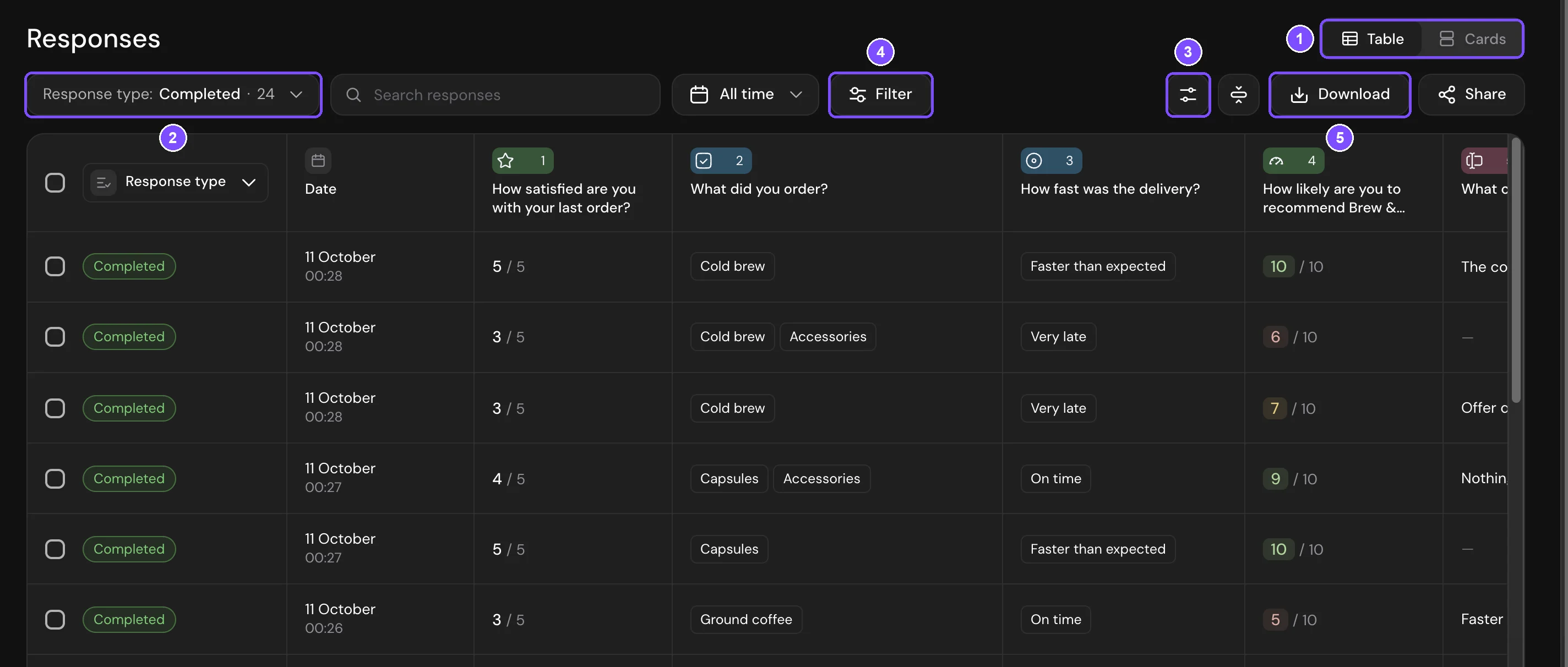
The page opens as a table: one row per response, one column per question. To read responses one at a time, switch from Table to Cards next to the Responses title (1). The page remembers your choice.
Choose which responses to show in the Response type menu (2). The number next to each type shows how many responses it has, or how many the filter found:
- Completed: the respondent finished the survey.
- Incomplete: the respondent started but didn't finish. See Incomplete Responses.
- Disqualified: the respondent was screened out by the survey logic. This type appears if the survey has a disqualification screen or such responses.
- Deleted: responses you deleted. See Deleting Responses.
Incomplete and Disqualified are available on the Standard plan and higher.
Working with the table
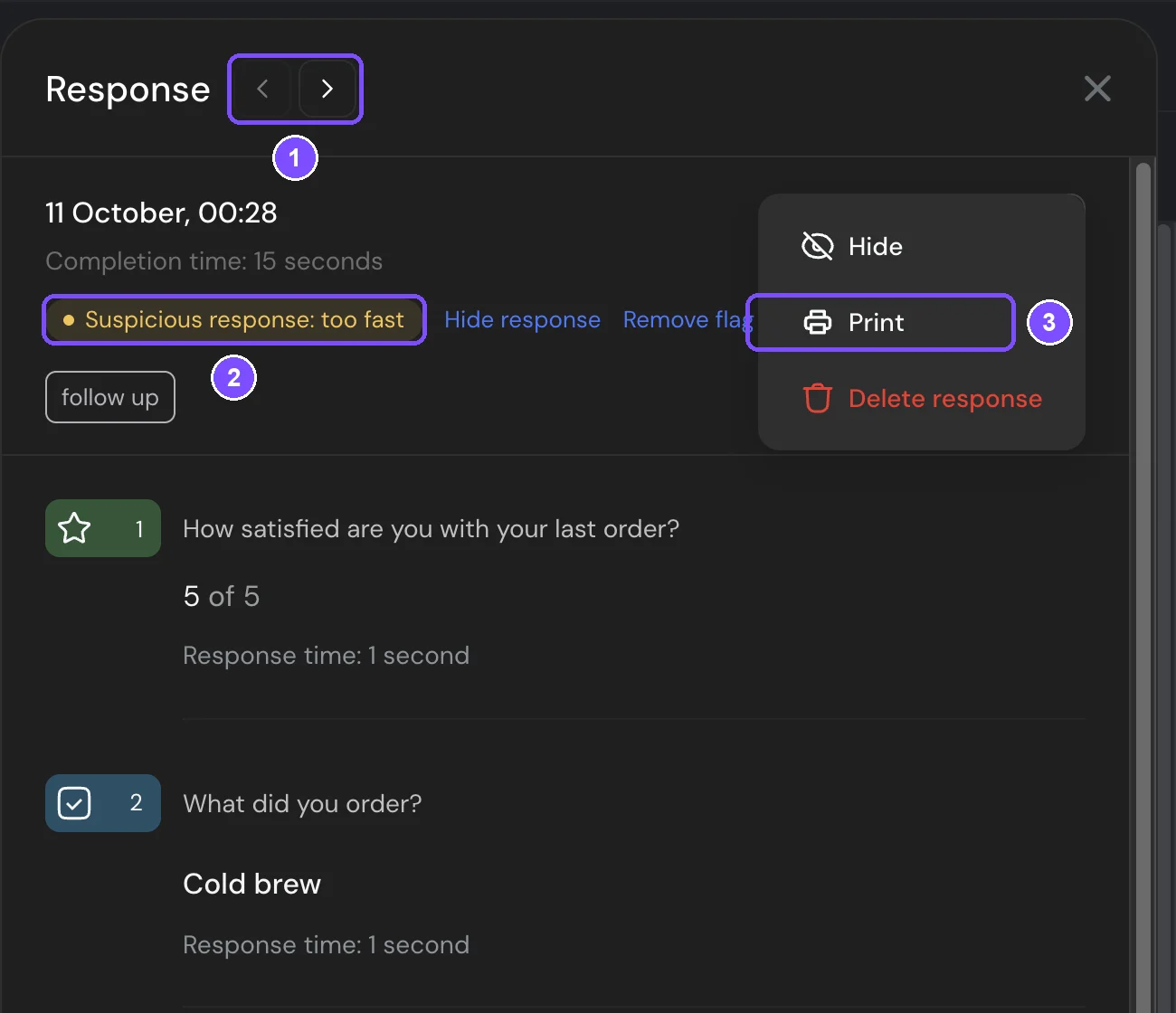
- Open a response. Click a row. The response opens in a panel on the right, with arrows to the Previous response and the Next response.
- Sort. In a column's menu, choose Ascending or Descending. The whole list is sorted, not only the loaded rows.
- First column. It stays in place when the table scrolls sideways. To put another column there, choose Make first in its menu.
- Columns. Choose Hide column in a column's menu, or click the Column settings icon (3) to reorder columns and hide or show them, then Save. Drag the edge of a column to change its width.
- Row height. The icon next to Column settings switches between Spacious rows and Compact rows.
The Email, Language, Country, Browser and IP columns are hidden at first. Your browser remembers the columns for each survey. A blue dot next to the date marks a response nobody has opened yet.
What a response card shows
The card is shown in the Cards view and in the panel of an opened response:
- the date and Completion time;
- the answer to each question, long text answers in full;
- the total score, if the survey uses scoring;
- tags you added to the response with Add tag;
- technical details: browser, respondent email, hidden variables, the unique link the response came from, the issued promo code (if any of these were used).
New responses are marked as unread until you scroll to them in Cards or open them in the table.
If respondents saw the questions in different orders, for example with random order, choose how to show the answers in the Order menu: As the respondent saw it or As in the survey.
The three-dot menu (⋮) at the top right of a card has Hide (removes the response from reports), Print (the whole response, through your browser's print dialog) and Delete response.
Suspicious responses
Under the date of a response that looks unreliable, you see Suspicious response and the reason: Too fast, Identical answers in a matrix or Gibberish text. Hide response removes it from reports. If the response is fine, click Remove flag; Restore puts the flag back. To list flagged responses, use the Suspicious responses filter.
Filtering responses
Filters are available on the Basic plan and higher.
- Click Filter (4).
- Open a filter group and set the conditions: Period, Questions, Suspicious responses, Completion time, IP address, Geography, Browser, Devices and others.
- Click the button at the bottom. It shows how many responses match, for example Show 12 responses.
Applied filters appear above the list. The list, the selection and the downloaded files in every format use them. See Filtering and Tagging Responses.
To find a response by its text, type words into Search responses. In the table, the button next to the search (All time by default) sets the period. In Cards, set it in Filter.
If the survey runs in several languages, responses have a Language column and a Language filter. See Multilingual Surveys.
When you open a response from an answer in the report, the Response via link chip appears above the list. Remove it to see all responses.
Selecting responses
Tick the checkbox on a row or a card. To select all loaded responses, tick the checkbox in the table header or Select all responses in Cards.
A bar appears at the bottom of the page with the number of selected responses. Select all N selects every response the list finds with the current filters and search, not only the loaded ones. The bar's actions are Download, Share, Hide and Delete. With 2 or more responses selected, What they have in common asks Ninja AI what they share. On Deleted, the bar has Download, Restore and Delete.
Downloading responses
- Click the Download icon (5).
- Choose the file format:
Format What you get CSV A table for analytics and importing into other systems. XLSX A table that opens in Excel without any setup. DOC A document with one response at a time. SPSS A .sav file for statistical packages. - For DOC and SPSS, click Download. For CSV and XLSX, click Continue, set up the file and click Download.
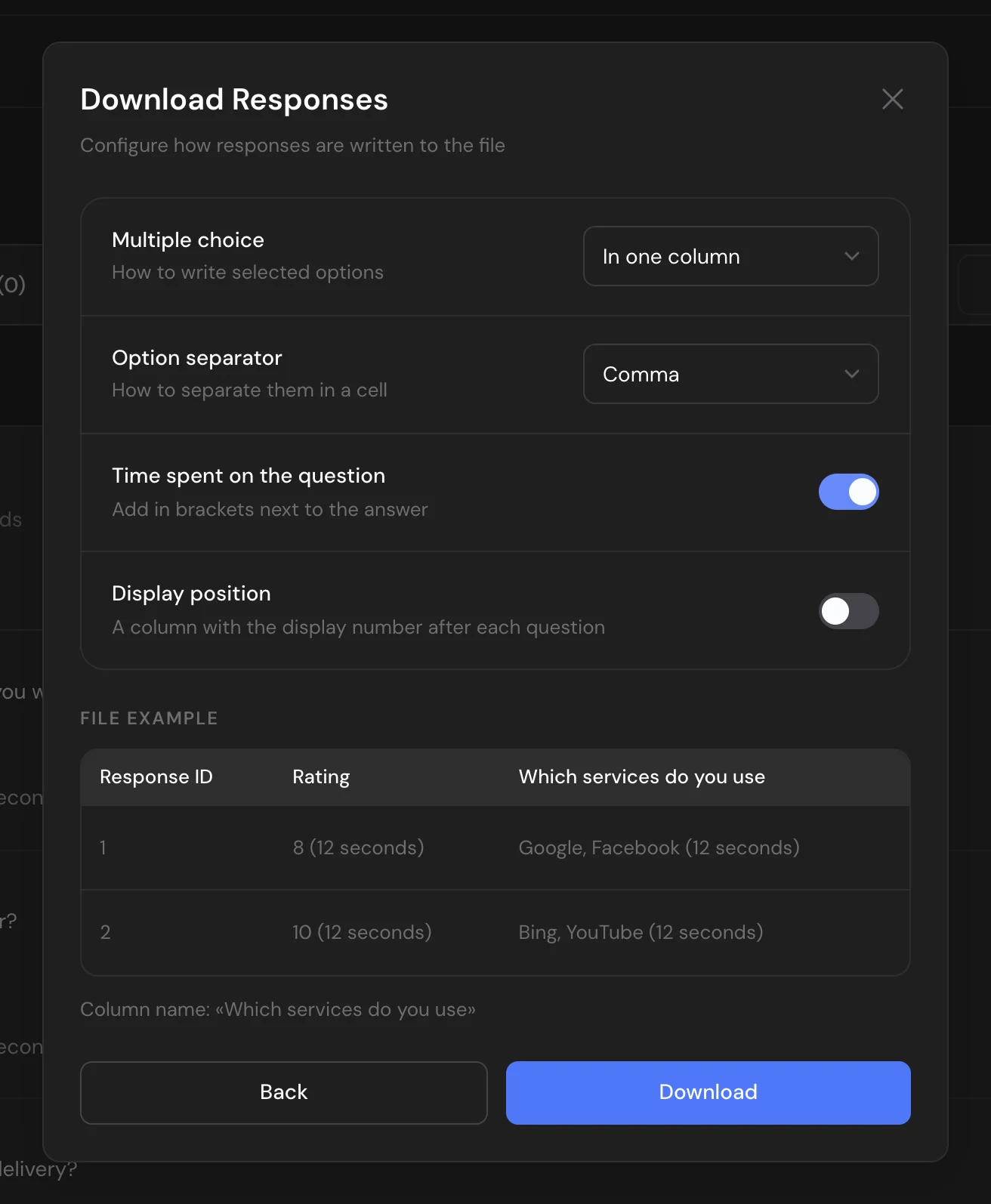
CSV and XLSX settings:
- Multiple choice (if the survey has multiple-choice questions): write the selected options In one column or use A column per option.
- Option separator (for In one column): how to separate options in a cell (Comma, Semicolon, Vertical bar or Line break).
- Unselected options (for A column per option): what to put for an option that wasn't selected, Zero or Empty.
- Time spent on the question: adds the time in brackets next to each answer.
- Display position: adds a column with the display number after each question.
File example at the bottom shows how the table will look. Your browser remembers these settings for the next download.
The file contains the responses of the chosen response type. If you selected responses, only they get into the file.
Note. If the survey collects more responses than your plan allows, the extra responses are hidden. The banner Some responses are hidden shows how many and offers Purchase More Responses. When a tenth of the month's limit is left, Response limit running low warns you in advance. See Why Don't I See All Responses?.
To send responses to someone without a file, use the Share icon. See How to Share Results.
Responses on a phone
On a phone, responses are cards with one row of controls above them: Response type, the search and filter icons, and ⋯ with download and share. A long response shows its first 5 answers. Tap the date to open the whole response, with arrows to the neighbouring ones. Add tag is in the card's ⋮ menu. Responses can't be selected on a phone.