


Question Types
Updated
On this page
A SurveyNinja survey is built from questions and screens. Here are all types grouped by purpose, with links to their articles, how to add a question and which types your plan includes.
Adding a question
- Open the survey in Builder and click + above or below a question. In an empty survey, the + button is in the middle of the page.
- In the window that opens, stay on the Question types tab (1) and click a type. Types that your plan doesn't include have a $ icon. Questions you saved earlier are on the Favorites tab (2).
- The question appears where you clicked +. Type the question and its options, then click the gear icon (Settings) to set it up.
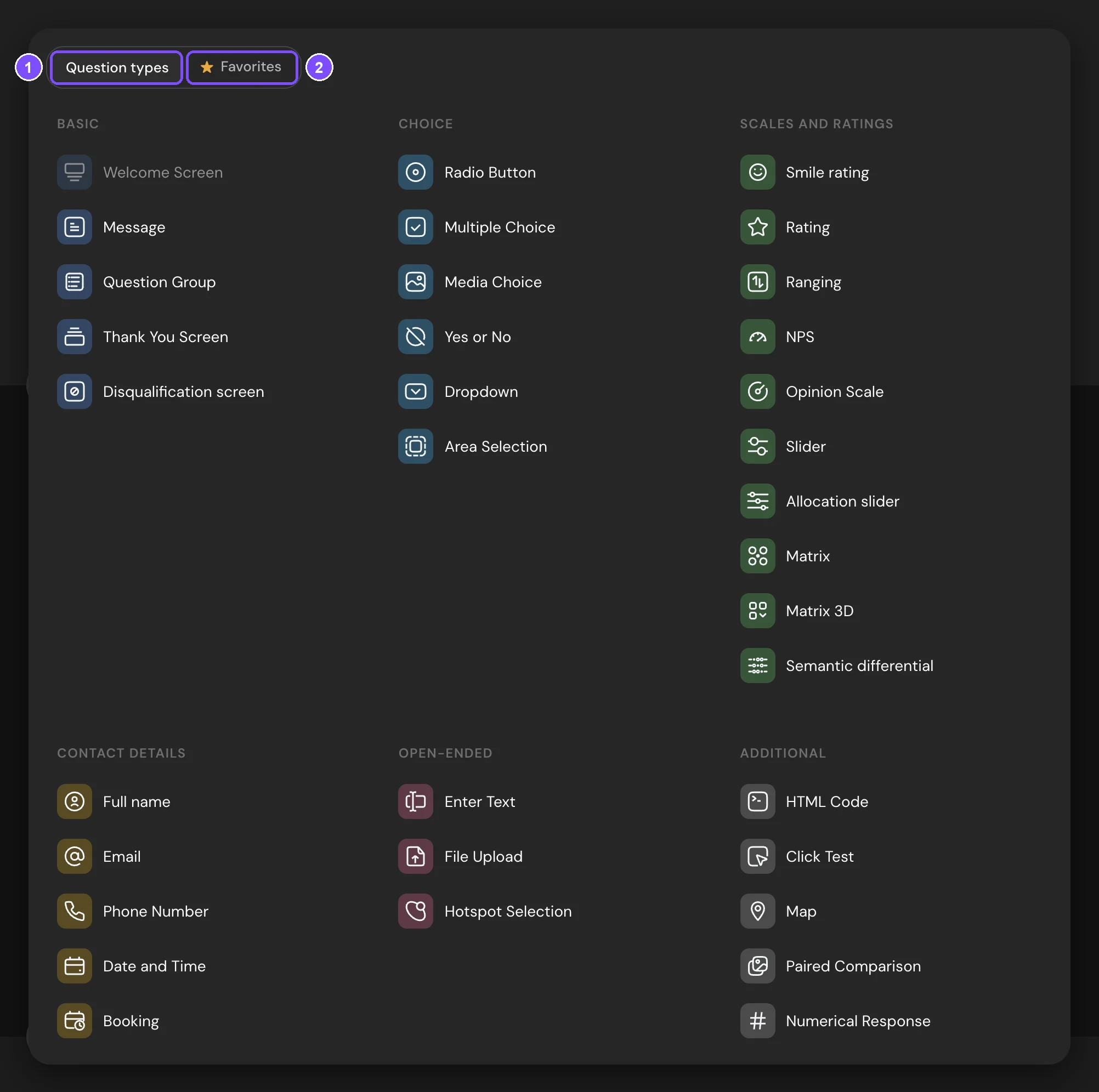
To change a question's type, choose another one at the top of its settings. Common settings, the toolbar and Favorites are described in Question Settings. To add an image, video or audio to a question, see Adding Multimedia.
Note. The + buttons next to a Thank You Screen or a Disqualification screen add only these two screens.
Screens and layout
| Type | What it's for | Article |
|---|---|---|
| Welcome Screen | The first screen, with a start button. | Screens |
| Message | Text between questions, without an answer. | Screens |
| Thank You Screen | The last screen. A survey can have more than one. | Screens |
| Disqualification screen | For respondents who don't fit, reached through a logic jump or a quota. | Screens |
| Submit button | Sends the response. Every survey has one. | Screens |
| Question Group | Several questions on one screen. | Below |
| HTML Code | Your own HTML as a separate step of the survey. | Below |
Question Group
Shows several questions on one screen. Add questions with the + inside the group. Random order shuffles them, Required answers in group makes all of them required. A group can hold Message and any question type except HTML Code and Booking, but not screens or another group.
HTML Code
Shows your HTML as its own step, for example a widget embedded from another service. Scripts in the code run. Button adds a button that leads to the next question (Continue) or to a link (Follow the link).
Choice questions
| Type | What it's for | Article |
|---|---|---|
| Radio Button | One answer from a list, for example "How did you hear about us?" | Choice questions |
| Multiple Choice | Several answers from a list. | Choice questions |
| Dropdown | Answers from a dropdown list, handy for long lists. | Choice questions |
| Yes or No | Two options, such as Yes and No. | Choice questions |
| Media Choice | Answer options are images, videos or audio. | Media Choice |
Scales and ratings
| Type | What it's for | Article |
|---|---|---|
| Rating | Stars, hearts or other icons, 3 to 10 steps. | Rating questions |
| Smile rating | Faces, 2 to 5 steps. | Rating questions |
| Opinion Scale | A row of numbers, for example a 1–5 Likert scale. | Opinion Scale |
| Slider | A number picked with a slider. | Opinion Scale |
| NPS | "How likely are you to recommend us?" on a 0–10 scale. | NPS question |
| Matrix | Several rows rated with the same columns. | Matrix questions |
| Matrix 3D | A matrix with a dropdown list in each cell. | Matrix questions |
| Ranging | Ranking: options put in order of preference. | Ranking |
| Semantic differential | A scale between two opposite words, for example "Cheap — Expensive". | Semantic differential |
| Allocation slider | Constant sum: the respondent splits a set number of points among options. | Allocation Slider |
Contact details
| Type | What it's for | Article |
|---|---|---|
| Full name | First name, last name and patronymic. | Contact fields |
| An email address. | Contact fields | |
| Phone Number | A phone number with a country code. | Contact fields |
| Date and Time | A date, a time or both. | Contact fields |
| Booking | The respondent books a time slot from your schedule. | Online Booking |
Open-ended questions
| Type | What it's for | Article |
|---|---|---|
| Enter Text | A free-text answer. | Below |
| Numerical Response | A number. | Below |
| File Upload | The respondent uploads files from their device. | File Upload |
Enter Text and Numerical Response
Enter Text collects an open-ended answer. Turn on Large field for long answers. Character limit sets the Min and Max number of characters, up to 10,000.
Numerical Response accepts a number. When the question is required, you can set Min and Max. If the number is outside this range, the respondent sees an error.
Research and testing
| Type | What it's for | Article |
|---|---|---|
| Click Test | The respondent clicks points on your image, for example a design mockup. | Image tests |
| Hotspot Selection | The respondent outlines areas on your image. | Image tests |
| Area Selection | You mark regions on an image, and the respondent selects them. | Image tests |
| Map | The respondent marks places on a map. | Map |
| Paired Comparison | The respondent picks one option from each pair. | Paired Comparison |
Limits
- The number of elements in one survey depends on the plan: 10 on Free, 50 on Basic, 100 on Standard, no limit on Premium. The Welcome Screen and the submit button don't count. At the limit, + and Copy open the upgrade offer.
- On the Free plan, these types are available: Radio Button, Multiple Choice, Dropdown, Yes or No, Ranging, NPS, Slider, Enter Text, Phone Number, Date and Time, Message, Question Group and Disqualification screen. All other types need the Basic plan or higher. Compare plans
- HTML Code and Map are available on the Standard plan and higher.
- A survey has one Welcome Screen.
- A micro survey on a website doesn't offer Media Choice, Ranging, Allocation slider, Matrix, Matrix 3D, Semantic differential, Click Test, Hotspot Selection, Area Selection, Map, Paired Comparison, Question Group and Booking.