


Event Surveys: Before, During and After
Useful  Mike Taylor Updated: Aug 26, 2026 Reading time ≈ 29 min
An event is not one survey. It is three, spaced days or hours apart, and each one answers a question the others cannot. Treat them as a single "how did we do" form and you lose the two that mattered most.
The pre-event survey tells you who is coming and what they want, while you can still change the programme. The on-site collection, at the session level, tells you what to re-book and what to cut. The post-event survey tells you whether the whole thing was worth repeating and whether people will come back. Most organisers run only the third one, send it a week late, get a nine percent response rate, and conclude that "attendees don't like giving feedback." They do. They just weren't asked at a moment that still worked.
An event is three surveys, not one
Each of the three waves has a different job, a different window and a different audience state of mind, and confusing them is the most common design mistake in event feedback. Ask a "would you attend again" question two weeks before the event and it is meaningless. Ask a "what sessions interest you" question a week after the event and it is too late to be anything but a debrief note.
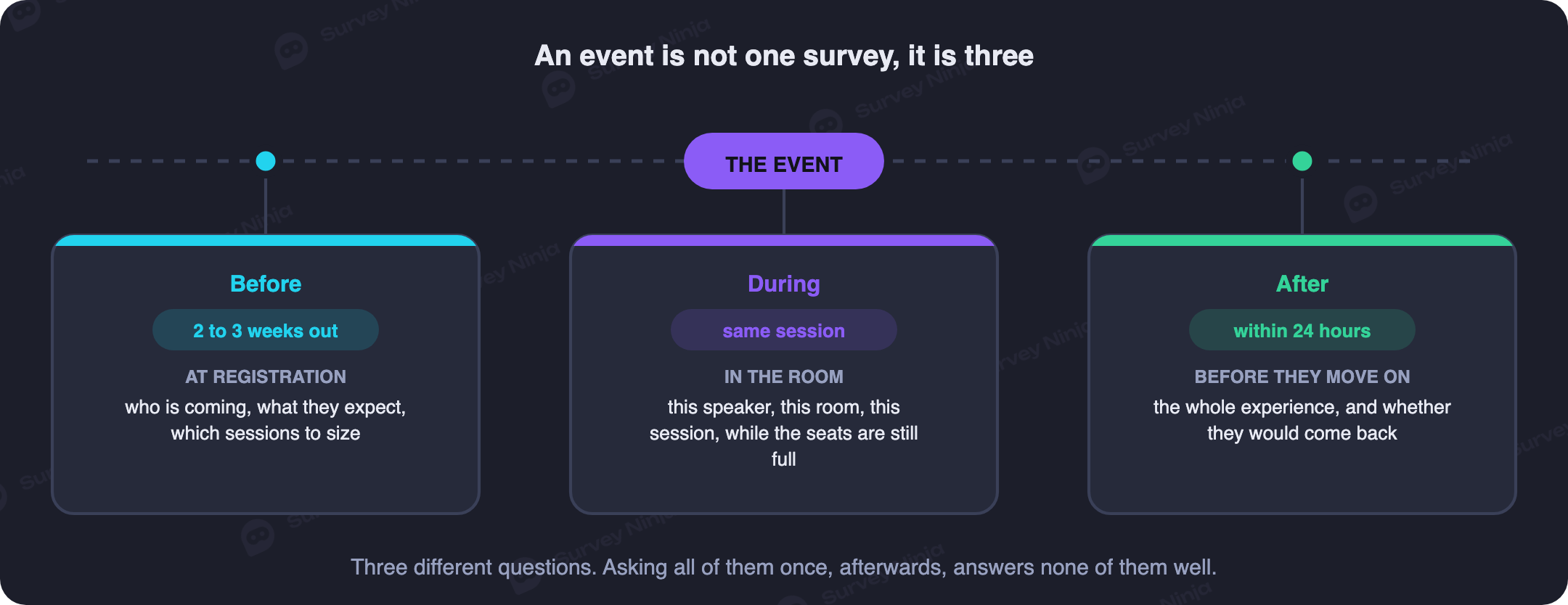
Before the event, the survey is a planning tool, not a feedback tool. It goes out to registrants, not attendees, because at this point nobody has attended anything yet. It asks what they hope to get out of the day, which sessions or topics they would prioritise if forced to choose, and any logistics that change your setup: dietary needs, accessibility, whether they are bringing a plus one. The honest goal is to catch a room-sizing mistake before it happens, not after.
During the event, feedback is collected while the room is still full and the experience is still fresh, at the level of the individual session rather than the event as a whole. This is the only point where you can ask "was this specific talk useful" and get an answer that is not contaminated by memory of six other sessions.
After the event, the survey steps back and asks about the whole experience: the venue, the flow between sessions, the food, the networking, and whether the person intends to come back next year. This is also where you find out if the thing you thought was a highlight actually was one, once people have had a day to reflect rather than answer on adrenaline at the exit door.
What the pre-event survey should actually decide
A pre-event survey earns its place only if the answers change something you do before the doors open. If nothing about the programme, room allocation or catering order can still move, skip it and save the goodwill for later.
Send it two to four weeks before the event, to everyone who has registered, and keep it under six questions. The two that matter most are session interest, phrased as a forced ranking or a "pick your top three" rather than a five-point rating on every single track (a rating lets everyone say every session is a four, which tells you nothing about where to put the big room), and expectations, phrased as an open "what would make this event worth the day off work for you." That single open question routinely surfaces a theme the programme committee had not planned for, and it is cheap to add a slot for it while the schedule is still a spreadsheet rather than a printed booklet.
Everything else in a pre-event survey is logistics: dietary restrictions, accessibility needs, first-time attendee flag (useful for pointing people at an orientation session), and whether they are travelling from out of town, which tells your venue team something about which sessions need a later start. Keep this part as short as the questions honestly need to be, and use a proper online survey rather than a spreadsheet form, since branching on "do you have dietary restrictions" into a follow-up only for the people who said yes keeps the form short for everyone else.
Resist the urge to ask "how likely are you to attend" in the pre-event survey to people who already registered. They are coming. What you actually want to know is why, and whether that reason matches what the programme delivers, which you can only check after the fact.
The decay curve: what response rate actually does after the doors close
Response rate does not decline gently after an event, it falls off a cliff, and almost every event feedback plan is built as if it does not. The single most useful thing you can do before choosing a survey tool or a send time is accept the curve and design around it instead of hoping a nicely worded email will flatten it.
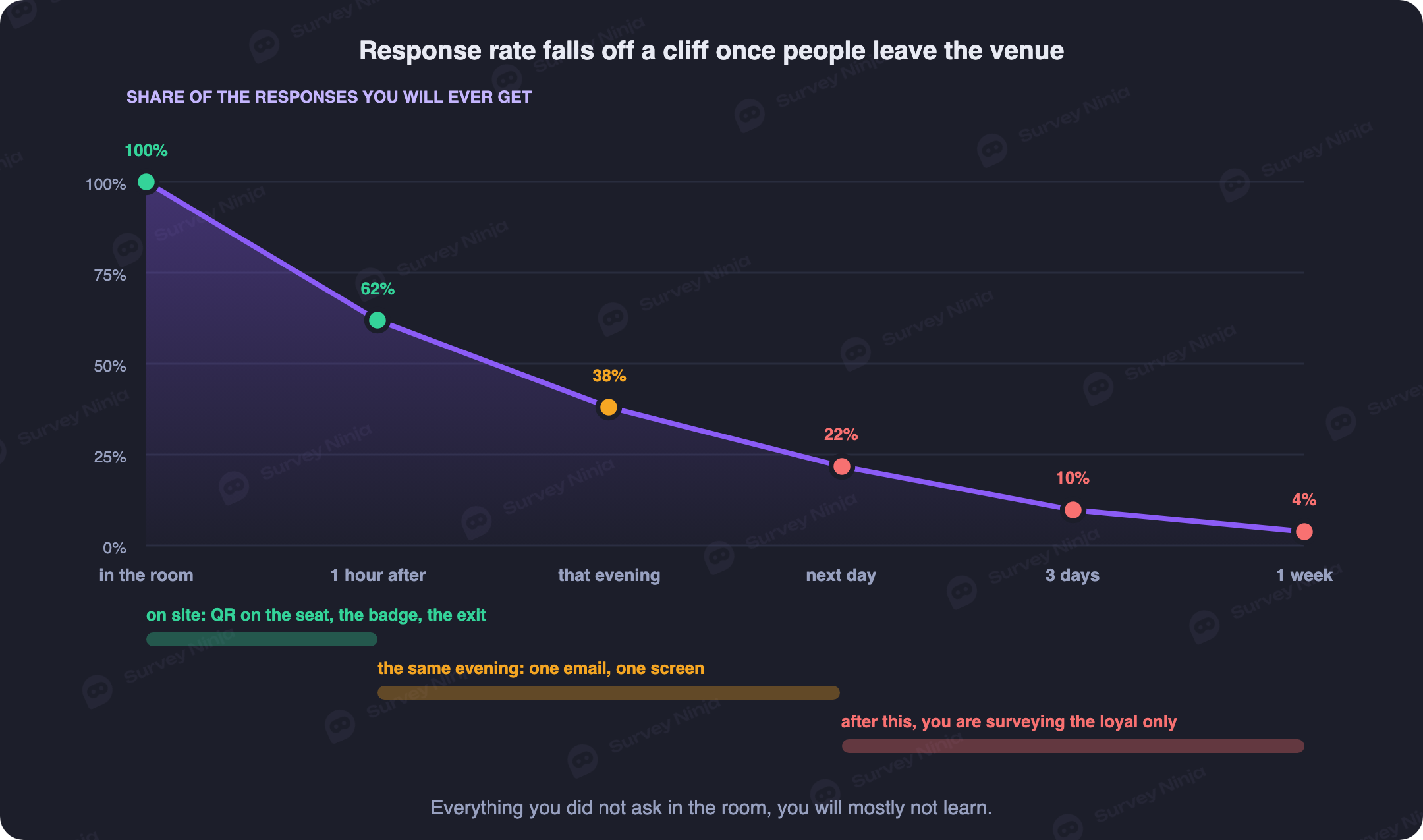
While people are still in the venue, badge and seat, response is as high as it will ever get, because the phone is already out and the experience is seconds old. The moment the last attendee walks out the door, that number starts dropping, and it keeps dropping in a predictable order: a same-day send that evening, while the event is still the most recent thing that happened to them, catches a real second wave. A next-morning reminder catches a smaller third wave, mostly from people who meant to answer and forgot. By the third day, an event has been replaced in most people's heads by whatever happened at work that morning, and a reminder at that point buys you very little for the annoyance it costs. Past a week, treat the survey as closed; anything that trickles in later is not worth keeping the form open for.
| Window | What still works | What to ask |
|---|---|---|
| On site, first hour | QR at the exit, badge scan, staff with a tablet | One overall reaction question, session ratings if not already captured |
| Same evening | Email or SMS with a direct link, no login | The full post-event questionnaire, one screen per topic |
| Next morning | A single reminder to non-responders only | Same survey, no changes |
| Three days out | A final reminder, worth sending once | Same survey, last call framing |
| One week and beyond | Close the survey | Nothing, start analysis instead |
The practical conclusion is not "send more reminders." It is "collect more while people are still in the building." Every response you capture on site is a response you did not need the decay curve to fight for. That is worth designing your entire on-site collection plan around, which is the next section.
Session-level feedback, not one number for the whole event
A single satisfaction score for a two-day, thirty-session conference is close to useless, because it averages a brilliant keynote and a room that emptied out halfway through into one number that describes neither. What you actually need to know is which sessions to re-book, which speakers to invite back, and which topic to drop, and none of that survives an event-level average.
Session-level feedback means a short form tied to each session: one rating question, phrased about that specific talk, plus an optional single line of open text, ideally collected as people leave the room rather than at the end of the day when they can no longer tell you which of six sessions prompted the low score. A five-point "how useful was this session" with a text field for "one thing you'd change" is enough. Do not ask a full satisfaction battery per session; nobody will fill out six four-question forms in one day, and the drop-off you'll see is documented in how to reduce survey dropout.
There is a threshold problem worth knowing about before you trust any session score. In a room of sixty people, a session that gets four ratings and three of them are fours and fives looks identical on a dashboard to a session that got forty ratings averaging the same number, but the four-rating version can be flipped entirely by one annoyed attendee walking in late. As a rule of thumb, treat a session average as directional once you have somewhere around fifteen to twenty responses, and treat anything below that as "not enough signal yet" rather than a verdict on the speaker.
Session-level data is also what makes year-on-year comparison meaningful. "Attendees liked the event" tells the programme committee nothing to act on. "The panel format scored lower than solo talks two years running, and the workshop track scored highest again" is a decision. That is the whole point of collecting at this granularity instead of settling for one closing question.
Collecting on site: badges, seats, slides and the exit
On-site collection is where most of your highest-quality responses come from, precisely because it happens before the decay curve starts working against you. The question is not whether to use a QR code, it is where to put it, and the honest answer is that not every spot performs the same.
The badge lanyard is a weak spot despite being the most obvious one: people wear it all day but rarely look down at it, and scanning your own badge means taking it off, which nobody does mid-conversation. It works better as an identifier a staff member scans than as a self-serve trigger. The seat, a card on the chair or a sticker on the armrest, works well right after a session, when people are seated, have a free hand, and just experienced the thing you're asking about. The session slide, shown by the speaker as the talk closes, has the best timing of all four, appearing while attention is still on the screen, though it depends on the speaker leaving it up for the fifteen seconds people need to scan it rather than jumping straight to "thank you." The exit, a code by the door or a staff member with a tablet, catches everyone who missed the other prompts and is the natural place for one overall-reaction question rather than a session-specific one, since by then nobody remembers which room they were just in.
The physical mechanics of what makes a code scannable at a distance, how big to print it, and how many spots to use per venue without turning the room into wallpaper are covered in QR code surveys, and they apply here without much adjustment. What is specific to events is the sequencing: a seat card asks about the session that just ended, a slide code asks the same question with better timing if the speaker cooperates, and an exit code should never ask a session-specific question, because by then you cannot be sure which session the answer is even about.
A live poll is content. A feedback survey is measurement.
Live in-room polling and on-site feedback surveys look almost identical from the audience's chair: both show up on a phone, both ask a short question, both display during a session. They are not the same tool, and merging them quietly wrecks both.
A live poll is part of the talk. "How many of you have tried this already" or a quick multiple-choice check-in exists to give the speaker material, create a shared moment in the room, and make the audience feel involved. The results are meant to be shown back on the screen within seconds, and nobody expects the answers to be analysed afterward. It is entertainment and pacing, and a genuinely useful one when a speaker uses it to redirect the talk based on what the room actually wants.
A feedback survey is measurement. It exists to be aggregated, compared across sessions, and acted on after the event, and showing its results live on the screen defeats the purpose, because people rate a session that isn't finished yet, and public results influence the next person's answer. Running a "rate this session" survey with a live results screen produces exactly the bias you're trying to avoid: attendees anchor on the number they just saw and stop giving an independent opinion.
The practical rule: if the result is meant to be shown back to the room in real time, it's a poll, and it belongs to the speaker's content. If the result is meant to inform a decision after the event, it's a survey, and it stays private until you're ready to analyse it. Use both in the same session if you like, a poll mid-talk and a feedback question at the end, but keep the two in separate tools and never let one masquerade as the other.
The post-event survey: the window, the length, and the invitation
The post-event survey is the one most organisers actually run, and it is also the one most commonly ruined by a slow send and a form that tries to cover everything at once.
Send it the same day, ideally within a few hours of the event ending, while people are still travelling home or unwinding at the after-party with a phone in hand. Every day you wait costs you real response volume, per the decay curve above, and waiting a week to "let people digest the experience" is a rationalisation for a send that should have gone out already. Keep it to one screen per topic rather than one long scrolling page: a screen for the overall experience, a screen for the venue and logistics, a screen for content and speakers, and a screen for intent to return, each with two or three questions rather than one page carrying twenty. This mirrors the send mechanics covered in email surveys, and the same rule applies here: the invitation decides more than the questionnaire does.
The subject line and the first line of the email matter more than any question you write. "How was [event name]? Two minutes, closes Friday" outperforms "We value your feedback" by naming the event, setting an honest time expectation and giving a real deadline. A vague, corporate invitation trains people to skip it before they've even seen a question, and no amount of clever question design recovers from that first impression.
Structure the questionnaire around a small number of screens using a rating scale for the things you'll track year over year and open text for the things you can't predict, such as "what would make you skip next year's event." Close it within a week, per the decay data, and be honest in the invitation about how long it will actually take. A promise of "two minutes" followed by four screens of ten questions each teaches people to distrust your next invitation, and the mechanics of that trust problem are the same ones covered in how to reduce survey dropout.
Speakers, sponsors and staff: the audiences the attendee survey never reaches
Most event feedback programmes only survey attendees, which means they never hear from the three groups most likely to have specific, actionable operational feedback: the people who ran the sessions, the people who paid for the booth, and the people who worked the floor.
Speakers see the event from the front of the room and notice what attendees never mention: whether the AV worked, whether the room fit the topic, whether the slot competed with a bigger session, and whether the questions suggested the level was pitched right. A short same-day survey on logistics, engagement, and whether they'd speak again routinely surfaces fixes an attendee survey never would, and tells you who wants to come back before planning starts.
Sponsors and exhibitors are paying customers with a different success metric: booth traffic, lead quality, and whether the fee was worth it. Ask about traffic relative to expectation, conversation quality rather than just count, whether exhibitor hours matched attendee patterns, and whether they'd sponsor again at the same tier. This is the survey most likely to decide whether next year's event has a budget, since sponsor renewal usually funds a meaningful share of it.
Staff and volunteers catch operational failures nobody else sees: a registration line that backed up, signage that sent people the wrong way, catering that arrived late. Ask what went wrong logistically, what took longer than planned, and what they'd change about their own role, in a debrief or short form within a day or two while details are fresh, not in a "thanks for volunteering" email three weeks later that nobody opens.
| Audience | What they see that others don't | When to ask |
|---|---|---|
| Speakers | AV, room fit, audience engagement, scheduling conflicts | Same day, short form |
| Sponsors and exhibitors | Lead quality, booth traffic, whether the fee was worth it | Within two to three days |
| Staff and volunteers | Logistics failures, timing, registration and signage issues | Debrief within one to two days |
Each of these questionnaires should be built and sent separately from the attendee survey, using the same platform but a different link, so a sponsor never sees an attendee-phrased question about the coffee and an attendee never gets asked about lead quality. Segmenting by role, rather than trying to write one form flexible enough for everyone, is what makes each version short enough to actually finish; the underlying logic is the same branching you'd use for any audience-specific path.
Questions that earn their place, and the ones that never change anything
Every event survey accumulates questions nobody remembers adding, and a surprising number of them never once influenced a decision. Before adding a question, ask what you would actually do differently depending on the answer. If nothing changes either way, cut it.
Questions that reliably earn their place: "What's one thing we should change next year?" as an open field, because it surfaces specific items a rating never does. "Which session or speaker was most valuable to you?" is the closest thing to a vote for what to re-book, and more honest than rating every session someone may barely remember. "How did you hear about this event?" once a year tracks whether channels are shifting. "What almost made you skip this?" surfaces friction people won't volunteer unprompted, in the spirit of the wording tricks in feedback form questions.
Questions that get asked every year and never change a decision: a satisfaction rating for the venue's Wi-Fi (either it worked or someone already complained loudly on the day), a five-point scale on "was the registration process easy" once you've already fixed it and it stays fixed, and a generic "rate the event overall" once you're also collecting session-level and category-level scores that already contain that information. If a question's answer has been the same for three events running, either something needs fixing that you're not fixing, or the question has stopped earning its slot.
Keep an eye on double-barrelled questions, which show up constantly in event surveys because organisers try to save space: "Was the venue and the catering good?" collects an answer to neither. Split it, and use a proper matrix question if you want to rate several categories, venue, catering, content, networking, on the same scale in one compact screen rather than four separate ones.
NPS and attendance intent: what "would you recommend" hides at an event
Net Promoter Score gets bolted onto event surveys by habit, borrowed from customer feedback programmes without much thought about whether it fits. For a paid B2B conference, it often doesn't, and the reason is structural rather than a matter of wording.
"How likely are you to recommend this event" assumes the person answering controls whether a colleague attends, and often they don't: a manager picks who goes based on budget, not a personal recommendation. The score can look strong while attendance barely moves, because recommending and attending are decided by two different people. NPS also compresses the experience into one number that says nothing about which part drove the score, the same session-level problem described earlier, just at the event level.
"Would you attend again?" is the better question for most events, because it measures the thing you actually care about: return intent from the person who has the most direct say in it. Phrase it as yes, no, or maybe with a required follow-up on "maybe" and "no" asking why, and you get both a number to track and a reason attached to every negative or lukewarm answer. For free or internal events where a recommendation genuinely drives who shows up next time, such as an internal town hall or a community meetup, NPS-style recommendation intent is more appropriate, since the audience really does decide who else comes. The deeper trade-offs between the two metrics, including when each one is measuring something real versus measuring something convenient, are covered in CSAT vs NPS.
Whichever metric you pick, track it consistently rather than switching between NPS one year and attendance intent the next, because the moment you change the metric you lose the ability to compare editions, which is the entire value of asking the same question repeatedly.
A stable core for comparing one edition to the next
A survey that changes every year cannot tell you whether the event is improving, because you're no longer comparing the same thing. The fix is a small set of questions that never change, surrounded by a shell that can.
Keep four to six core questions identical year over year: overall satisfaction or "would you attend again," the single best session or speaker, the single biggest gap, and whether the event was worth the time and cost relative to expectations. These are the numbers your trend line depends on, and touching their wording, even lightly, breaks the comparison, since a rephrased question is a different question no matter how similar it reads. Version everything else freely: if this year introduced a new format, a new venue, or an experimental track, add questions specific to that experiment and retire them once you've learned what you needed.
This is the same discipline used in benchmarking more generally: a stable core lets you compare like with like, while a flexible shell lets you investigate whatever is actually new this cycle. Store both the questions and the raw scores somewhere durable, not just a screenshot in last year's slide deck, because the programme committee two events from now will not remember the exact wording you used, and if it changed without anyone noticing, the trend line becomes noise.
Turning results into next year's programme
A stack of survey results that nobody assigns to a person is a report nobody reads. The route from an answer to a change in next year's event has to exist on paper before results start coming in, not get improvised after the fact.
Session-level scores go to the programme committee, who decide what to re-book, retire, or invite back, ideally within two to three weeks while specifics are still arguable. Logistics feedback, venue, catering, registration, goes to whoever owns operations, and cheap fixes should be decided before next year's venue contract is signed. Sponsor feedback goes to whoever owns that relationship and shapes next year's packages, since renewal decisions often follow within weeks. Open-text comments benefit from grouping into themes with counts attached rather than reacting to each one individually, a process covered in thematic analysis, so the loudest complaint doesn't outrank the most common one.
Close the loop publicly where you can. A short "you asked, we changed" note in next year's opening announcement, even a single line like "we moved registration to open thirty minutes earlier based on last year's feedback," measurably raises response rates on the next survey, because people who see their answers turn into a change are far more likely to answer the next one. This is the same mechanism that makes any feedback programme sustainable rather than a one-off exercise nobody bothers with the second time.
A practical plan for one event, start to finish
Here is how the pieces fit together across a single event's timeline, from registration to the debrief.
- Three to four weeks out: send the pre-event survey to registrants. Six questions or fewer: session interest as a ranked pick, one open expectations question, and logistics.
- Day of, during sessions: seat cards and closing-slide codes for session-level feedback, one rating plus one optional comment per session.
- Day of, at the exit: a single overall-reaction question via QR code or a staff tablet, not session-specific.
- Same evening: send the full post-event survey by email, one screen per topic, a realistic time estimate in the subject line.
- Same day, separately: send the speaker survey and begin the staff and volunteer debrief while details are fresh.
- Next morning: one reminder to attendee non-responders. No changes to the survey itself.
- Two to three days out: send the sponsor and exhibitor survey. Send a final attendee reminder.
- One week out: close the attendee survey. Start triage and thematic grouping of open text.
- Two to three weeks out: present session-level results to the programme committee. Decide what gets re-booked.
- Before the next event's planning starts: archive the stable core questions and scores somewhere durable, and publish one "you asked, we changed" line in the next announcement.
None of this requires custom software. A ready-made event feedback template or a company event survey template covers the post-event structure, and building the pre-event, speaker, sponsor and staff versions from the same account keeps everything in one place for comparison next year. Since the biggest cost of an event feedback programme is usually volume, not features, an unlimited response plan matters more here than almost anywhere else; see the pricing page. Build your first version and run it against the next event on your calendar.
Frequently asked questions
How many surveys should an event actually run?
At minimum three: a pre-event survey to registrants for planning, on-site session-level feedback while the room is full, and a post-event survey for the whole experience and intent to return. Larger events add separate short surveys for speakers, sponsors and staff, since each of those groups sees something the attendee survey never captures.
When should the pre-event survey go out?
Two to four weeks before the event, to everyone already registered, while there is still time to adjust the programme, room sizing or catering based on the answers. Sending it any later turns it into a formality rather than a planning tool.
How fast does survey response drop off after an event ends?
Fast. Response is highest while people are still in the venue, drops noticeably by the same evening, drops again by the next morning, and is close to negligible past three days. Design the send plan around collecting as much as possible on site rather than relying on reminders to recover what the decay curve has already taken.
Should feedback be collected per session or for the whole event?
Both, but they answer different questions. Session-level feedback tells you which specific talks and speakers to re-book. An event-level average tells you almost nothing actionable on its own, since it blends a strong session and a weak one into a number that describes neither.
What is the best way to collect feedback on site?
A QR code on the closing slide of each session has the best timing, since it appears exactly when the talk ends. Seat cards work well right after a session while people are still seated. An exit code or staff tablet catches everyone else, but should ask one overall question rather than anything session-specific.
Is a live poll the same as a feedback survey?
No. A live poll is part of the talk, shown back to the room in real time to create engagement, and its results are not meant to be analysed afterward. A feedback survey is measurement, meant to be aggregated privately and acted on later. Showing feedback results live biases the answers of everyone who hasn't responded yet.
Should speakers and sponsors get their own survey?
Yes. Speakers see logistics and audience engagement issues attendees never mention, sponsors and exhibitors judge the event by lead quality and booth traffic rather than content, and staff or volunteers catch operational failures nobody else notices. Each needs its own short questionnaire, sent separately from the attendee survey.
Is NPS a good metric for events?
Often not for paid events, because the person answering rarely controls whether a colleague attends next year, which is what the question assumes. "Would you attend again?" measures return intent directly and is usually the better core metric, with recommendation-style questions fitting better for free or community events where attendance really does spread by word of mouth.
Updated: Aug 26, 2026 Published: Aug 21, 2026