


Running a Survey for a Thesis or Dissertation
Useful  Mike Taylor Updated: Sep 29, 2026 Reading time ≈ 30 min

A student survey usually fails for one of three reasons: it answers a question nobody asked, it never reaches enough of the right people, or nobody can defend the sample in the viva. All three are avoidable if you plan the survey before you write a single question.
Supervisors see the same mistakes every term, and they are rarely about statistics. A student decides a survey is needed because the last three dissertations in the department had one, writes twenty-five questions in an afternoon, posts the link once in a group chat, and then spends the week before submission explaining in the methodology chapter why forty responses from mostly first-year friends represent "students in general". None of that is a statistics problem. It is a planning problem, fixable at every stage from the research question down to the appendix, and that is the order this guide follows: whether you need a survey at all, turning a question into a questionnaire, being honest about sample size, consent, getting responses, cleaning what comes back, analyzing without overclaiming, and writing it up so the limitations section helps rather than undermines you. Requirements differ by university and country, so treat the specifics here as defaults to check against your own supervisor and ethics body, not as a substitute for either.
When your project actually needs a survey
A survey answers one kind of question well: what a defined group of people think, feel, do or report about themselves, measured across enough of them to compare groups or spot a pattern. If your research question is close to "how do X and Y relate across a population" or "how common is Z among this group", a survey is the right instrument. If it is closer to "why does this happen" or "how does this process unfold", a handful of interviews will usually get you a better answer than two hundred survey responses, because a survey trades depth for breadth and cannot ask a genuine follow-up question.
Before committing, check whether the answer already exists somewhere cheaper. Government statistics, industry reports, a company's own internal data, or a dataset from a previous published study can sometimes answer your research question without you collecting a single response, and a supervisor is generally happier with well-used secondary data than with a thin survey run for its own sake. A survey is not evidence of effort. An examiner does not award marks for the existence of a questionnaire; they award marks for a method that fits the question and is executed competently, and a well-argued case for using existing data can score higher than a rushed survey.
The honest test is this: write down your research question, then write down, in one sentence, what a survey response would need to say for you to answer it. If you cannot finish that sentence, the survey is not ready, and possibly not needed. If you can, move to the next step, because you now have the beginning of your questionnaire.
From a research question to something a questionnaire can answer
Most student surveys go wrong here, before a single question is drafted. The failure is almost always the same: the questionnaire asks what is interesting rather than what the research question needs, so it collects forty items of tangentially related opinion and none of the specific comparison the dissertation actually argues for.
The fix is a short chain, and it is worth writing out explicitly rather than doing in your head. Start with the topic, the broad area you care about. Narrow it to a research question specific enough that a stranger could tell whether a given piece of data answers it. From the research question, list two to four objectives, the concrete things you need to establish to answer it. From each objective, name the variables you actually need to measure, the constructs the objective depends on. Only then do you write questions, and every question should trace back to a named variable, which traces back to a named objective, which serves the research question.
Take a running example. Priya is a final-year business student whose dissertation asks: which factors predict student satisfaction with her university's online learning platform. That is a research question, not yet a survey. Her objectives are to measure perceived ease of use, perceived usefulness, and overall satisfaction, and to test whether satisfaction differs by year of study. Her variables are therefore ease of use, usefulness, satisfaction, and year of study as a grouping variable. Every question in her final questionnaire has to serve one of those four, and if a question does not, it does not belong in the survey, however interesting it might be.
This is also where you decide what a questionnaire can and cannot do for your specific design. If your objectives include comparing two groups, you need enough respondents in each group to compare, which affects your sample size math later. If an objective needs an open-ended reason rather than a rating, that shapes your question type choices before you touch wording.
Who to survey, and the honest math on sample size
Every methods class teaches the same formula, and it is worth knowing even though almost no student dissertation actually satisfies its assumptions. For a large or unknown population, at 95% confidence and a margin of error of plus or minus 5 percentage points, the standard rule of thumb lands at about 384 respondents. As your population shrinks to a defined, countable group, a finite-population correction brings that number down, sometimes a long way.
| Population size | Sample needed at 95% confidence, ±5% |
|---|---|
| 100 | 80 |
| 200 | 132 |
| 500 | 218 |
| 1,000 | 278 |
| 2,000 | 323 |
| 5,000 | 357 |
| 10,000 or more | 370 to 384 |
Run your own population through a sample size calculator rather than reading it off a table, since your margin and confidence level may differ from the 95/5 default. Then add a buffer for non-response: unincentivized student surveys typically return 15% to 30% of the people invited, so a target of 220 completed responses means putting the survey in front of 800 to 1,200 people, not 220.
Now the part almost nobody says out loud in a methods class. That table describes a probability sample, where every member of the population has a known, non-zero chance of selection, usually through a random draw from a proper sampling frame. Almost no undergraduate or master's dissertation actually does this. What actually happens is a convenience sample: you post the survey where you have access, your course, your workplace, your social network, and whoever clicks responds. That is not a defect unique to student research, most applied research runs on convenience samples, but it changes what the number in the table means and what you are allowed to claim afterward.
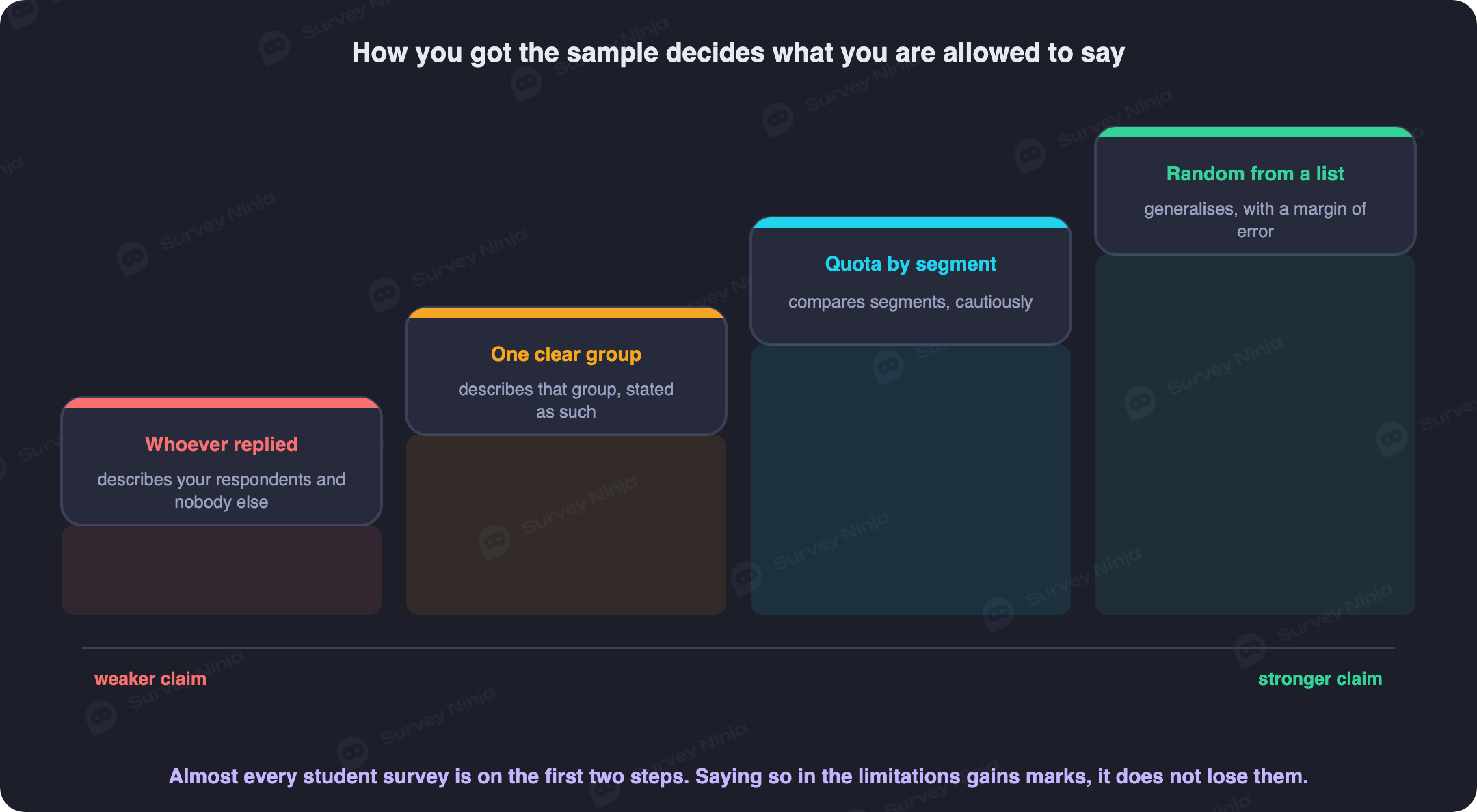
A genuine probability sample of 220 lets you state a margin of error and generalize, with that margin, to the population it was drawn from. A convenience sample of 220 lets you describe that sample precisely and report patterns within it, but it does not license a statement like "students believe X" without a qualifier, because you cannot rule out that your channel systematically reached a particular kind of student. The honest version is "among the students who responded to this survey, largely reached through course pages and university social channels, X was observed", and that sentence, written plainly in your findings and again in your limitations section, is not a weakness confession. It is what makes the rest of your claims credible, because an examiner who spots an unqualified generalization from a convenience sample of 90 will discount everything else in the chapter along with it.
Still calculate the target n from the table. Supervisors expect to see the calculation, it disciplines how many people you invite, and it gives you a defensible answer when someone at the viva asks why you aimed for the number you did, even if the final method section correctly describes what you actually collected as a convenience sample.
Building a questionnaire people will actually finish
Length kills response quality before anything else does. An unpaid respondent with no stake in your dissertation gives you five to eight minutes, which in practice caps you at 15 to 25 questions depending on how many are open-ended. Past that you get rising abandonment partway through and, among those who do finish, the straightlining covered later in this guide.
Order matters almost as much. Open with something short and directly relevant, never a demographic question or a dense scale, since the first question sets the respondent's expectation for the rest. If eligibility matters, put a screening question right after the opener, confirming the respondent is actually in scope, and route anyone ineligible straight to a polite exit rather than on to questions their data cannot support. Group substantive questions by topic, general to specific, and save anything sensitive for later once some trust is established. Demographics go at the end, and only the ones you will actually use: if you will not cross-tabulate by income, do not ask about it, since every field is a small tax on completion and a data protection question with no analytical return. Priya's questionnaire asks only for year of study, the single demographic her objectives actually compare.
Wording does the other half of the damage. A leading question plants the answer inside itself, as in "How much did you enjoy the improved onboarding flow", which assumes the improvement before the respondent has said so. A double-barrelled question asks two things at once, as in "Was the platform easy to use and reliable", and produces an answer nobody can interpret. Read every question aloud and ask what a hostile examiner would say about it; the fuller checklist is in how to write feedback questions, and the choice between letting people pick from options or write freely is unpacked in open versus closed questions.
Where your field already measures the construct you care about, whether that is job satisfaction, usability, trust or anxiety, reuse an existing validated scale instead of inventing your own. A battery you write yourself might look fine, but nobody reading it can tell whether your five items measure one coherent construct or five loosely related ideas; a validated scale carries that evidence already attached, and citing it correctly does more for your methodology chapter than extra respondents would. Two catches: cite the scale to its original source rather than silently rewording items, and check early whether it is licensed, since some require permission or a fee to use.
- One idea per question, consistent scale anchors reused across constructs, and closed questions doing most of the work, since open ones have to be coded by hand.
- Pilot it on five to ten people outside your target sample, using general survey design practice, and time how long it actually takes before sending it wide.
Consent and ethics in practice
Every institution's exact process differs, and some route every student survey through formal review while others let low-risk, anonymous surveys of adults proceed with only supervisor sign-off. What follows is the shape that most processes share; check the specifics against your own university's ethics committee or Institutional Review Board (IRB) before you collect a single response, because a completed survey run without required approval is sometimes simply unusable in the final dissertation, however good the data.
The consent text at the start of the questionnaire, not buried in an attached document nobody opens, should tell a respondent in plain language: who is running the study and for what purpose, roughly how long it will take, that participation is voluntary and can be stopped at any point without a reason or a penalty, what will happen to the data and who will see it, and how to contact you or your supervisor with questions. Two or three short sentences cover most of this; a wall of legal text gets skipped, which defeats the purpose of asking for consent at all.
Be precise about anonymity versus confidentiality, since they are not the same promise. Anonymous means nobody, not even you, can connect a response back to the person who gave it; confidential means you can, but undertake not to disclose it. If you collect an email address for a reminder or a prize draw, or your sample is small enough that a demographic combination could identify someone, you are running a confidential survey, and should say so rather than promising anonymity you cannot deliver. This distinction also governs how carefully you store and eventually delete the raw file.
Two situations need extra care. If any respondent could be under 18, or under 16 in some jurisdictions, check your institution's rules on parental consent, since the standard adult process usually does not apply. And if the questionnaire touches health, mental health or financial hardship, build in an easy way to skip individual questions and withdraw partway through, since your ethics reviewer will ask about exactly this.
Getting responses: the part every student underestimates
The gap between "the questionnaire is ready" and "I have 200 usable responses" is where most dissertation timelines actually slip, and it is almost never a design problem. It is a distribution problem, and it responds to specific tactics rather than to hope.
| Channel | Typical yield | Best for |
|---|---|---|
| Mass email from the central university address | Under 5% | Reach across the whole institution once, not depth |
| Your own course page or class group chat | 20% to 40% | A cohort-specific research question, and fast |
| Your supervisor's own contacts or mailing list | 15% to 30% | Niche professional or industry populations |
| A single post in an open social media group | Under 2% | Rarely worth relying on alone |
| QR code at a lecture, stall or event | 30% to 50% of those who scan | Fast bursts from a captive, in-person audience |
A link posted once, on its own, in a general group is the single most common distribution mistake, and it explains most of the "I only got 30 responses" stories. It works far better paired with an in-person moment: a QR code on a lecture slide or a flyer at a relevant faculty building, where someone hands over thirty seconds of attention they already have. Ask your supervisor for help directly, since a request forwarded from a lecturer to their own students carries far more weight than the identical request from a stranger.
Plan for a reminder. A message sent again after a week, phrased as a nudge rather than a repeat ask, recovers a meaningful share of people who meant to respond and forgot, at the cost of one more message. Whatever the channel, keep the questionnaire short enough to finish on a phone, since a large share of responses arrive that way regardless of where you shared the link; the mechanics are covered in how to reduce survey dropout.
Do not chase raw numbers at the expense of who is answering. A hundred responses from people outside your target population are worth less to your dissertation than sixty from people squarely inside it, because the first group cannot be honestly described as evidence about your research question at all.
Cleaning the data before you touch the analysis
Every real dataset needs a pass before analysis, and skipping it produces results that look more precise than they are. Two problems show up in almost every student dataset: speeders and straightliners.
A speeder is someone whose completion time is implausibly short for the number of questions asked. A workable rule of thumb is to flag anyone under roughly a third of the median completion time for review, since a genuine respondent reading and answering fifteen questions in forty seconds is unlikely. A straightliner picks the same point on a scale for every item in a battery, regardless of whether items are worded positively or negatively, which is the clearest sign nobody was reading. Neither pattern alone proves bad data, but both are worth a manual look before you decide.
Incomplete responses need a rule, decided in advance rather than case by case. A common approach is to keep partial responses if the respondent reached and answered your core measurement questions, and to drop responses that stop before that point, since a partial answer to the wrong half of the questionnaire adds nothing. Whatever threshold you set, apply it uniformly rather than keeping convenient partials and dropping inconvenient ones.
Write down what you removed and why as you go, not from memory afterward. A short table in your methodology chapter, for example "228 responses collected, 31 removed (14 speeders, 12 straightliners, 5 incomplete before the core questions), 197 analyzed", answers the question an examiner will ask before they ask it, and it reads as rigor rather than as a confession.
Analysis you can actually defend
Start with frequencies and cross-tabulations before anything more advanced. They answer most of what a dissertation actually needs, and you should understand your data at this level before a statistical test can tell you anything you would not otherwise notice. What percentage chose each option, and how does that split by the group you are comparing, such as year of study or department. This is also where the comparison your objectives were built around usually shows up first, sometimes clearly enough that a formal test only confirms what the cross-tab already showed.
Be careful with means on ordinal data. A five-point agreement scale is ordered, but the distance between "agree" and "strongly agree" is not guaranteed to equal the distance between "neutral" and "agree", so a mean of 3.4 implies a precision the scale does not have. Reporting the distribution, the median, or a top-two-box figure such as "62% agreed or strongly agreed" is usually more honest and more informative than a single decimal average. Reserve the mean for genuinely interval data, such as a count or an age in years.
Resist the pull toward a statistical test you found in a textbook but cannot fully justify. A test you can explain and defend under a follow-up question beats a more sophisticated one you ran because a classmate mentioned it. And whatever pattern you find, a cross-sectional survey, measuring everyone at a single point in time, cannot establish that one variable causes another, only that they are associated. "Students who rated the platform easier to use also rated it more satisfying" is a defensible finding; "ease of use increases satisfaction" claims a direction your design cannot support. Group open-ended answers into themes with counts attached rather than quoting whichever response was most vivid, a process covered in thematic analysis.
Writing the methodology and limitations sections
The methodology chapter has one job: let a reader reconstruct exactly what you did well enough to judge whether it answers your research question. State the population you defined, the sampling method you actually used, not the one you aspired to, the size and composition of your final sample, the instrument, including any validated scale and its source, how it was distributed and over what period, your response rate, and the ethics approval or exemption that covered the study. A short demographic table of your achieved sample belongs here too, since it lets the reader judge for themselves how representative it plausibly is.
Treat the limitations section as an argument for the credibility of the rest of the dissertation, not an apology tacked on at the end. Naming your sampling method's limits precisely, for instance that a convenience sample drawn largely through university channels likely skews toward more digitally engaged students, shows the reader you understand exactly what your data can and cannot support, which is a stronger position than an unqualified claim that a sharp reader will challenge anyway. The same goes for a cross-sectional design that cannot establish causation, or a single-institution sample that may not generalize to other universities. Naming a limitation you have already accounted for in how you phrased your findings costs you nothing; leaving it for the examiner to find costs you more.
The full questionnaire, exactly as respondents saw it, goes in an appendix, referenced in the text as "see Appendix A", not reproduced inline in the chapter. Many departments also expect a handful of completed responses attached as evidence the survey actually ran, as a separate appendix. Check your own department's format requirements before final formatting, since the order and labelling of appendices is one of the more common places small marks get lost for no good reason.
A worked example, start to finish
Following Priya's dissertation through every stage in one place makes the advice above concrete. Her research question: which factors predict student satisfaction with her university's online learning platform, and does satisfaction differ by year of study. Her population is every undergraduate who uses the platform, roughly 8,500 students, which by the sample size table points to a target of around 370 for a genuine probability sample.
She cannot draw a true random sample, so she is explicit from the start that this will be a convenience sample, and adjusts her target accordingly rather than pretending otherwise. Her questionnaire has 19 questions: three screening and warm-up items, an existing ten-item satisfaction and usability battery adapted from a published instrument with permission, four items she wrote herself to capture platform-specific features her literature review flagged as unmeasured elsewhere, one open-ended question, and a single demographic question on year of study, the only one her objectives actually use. Piloted on eight classmates, it took just under six minutes.
Her supervisor forwards the link to three first-year modules and the student union's newsletter, reaching roughly 1,200 students, and she posts a QR code on a flyer outside the library. Over two weeks she collects 228 responses, a week-one reminder bringing in about a third of that on its own. Cleaning removes 31: 14 speeders, 12 straightliners on the satisfaction battery, and 5 that stopped before the core questions, leaving 197 for analysis.
Cross-tabulated by year of study, first-year respondents rate onboarding noticeably higher than final-year respondents, while overall satisfaction is closer across the two groups, an association she reports as exactly that, in a design that cannot establish why. Her methodology chapter states the population, the convenience sampling method, the response numbers cleaned and analyzed, and the cited source for her satisfaction battery, and her limitations section names the single-institution, convenience-sample design up front. At her viva, the panel's questions about method are answered before they are asked.
A realistic schedule for a dissertation survey
Every stage of a survey takes longer than it looks from the outside, and the collection phase specifically is the one students consistently underestimate, because it depends on other people's schedules rather than your own effort.
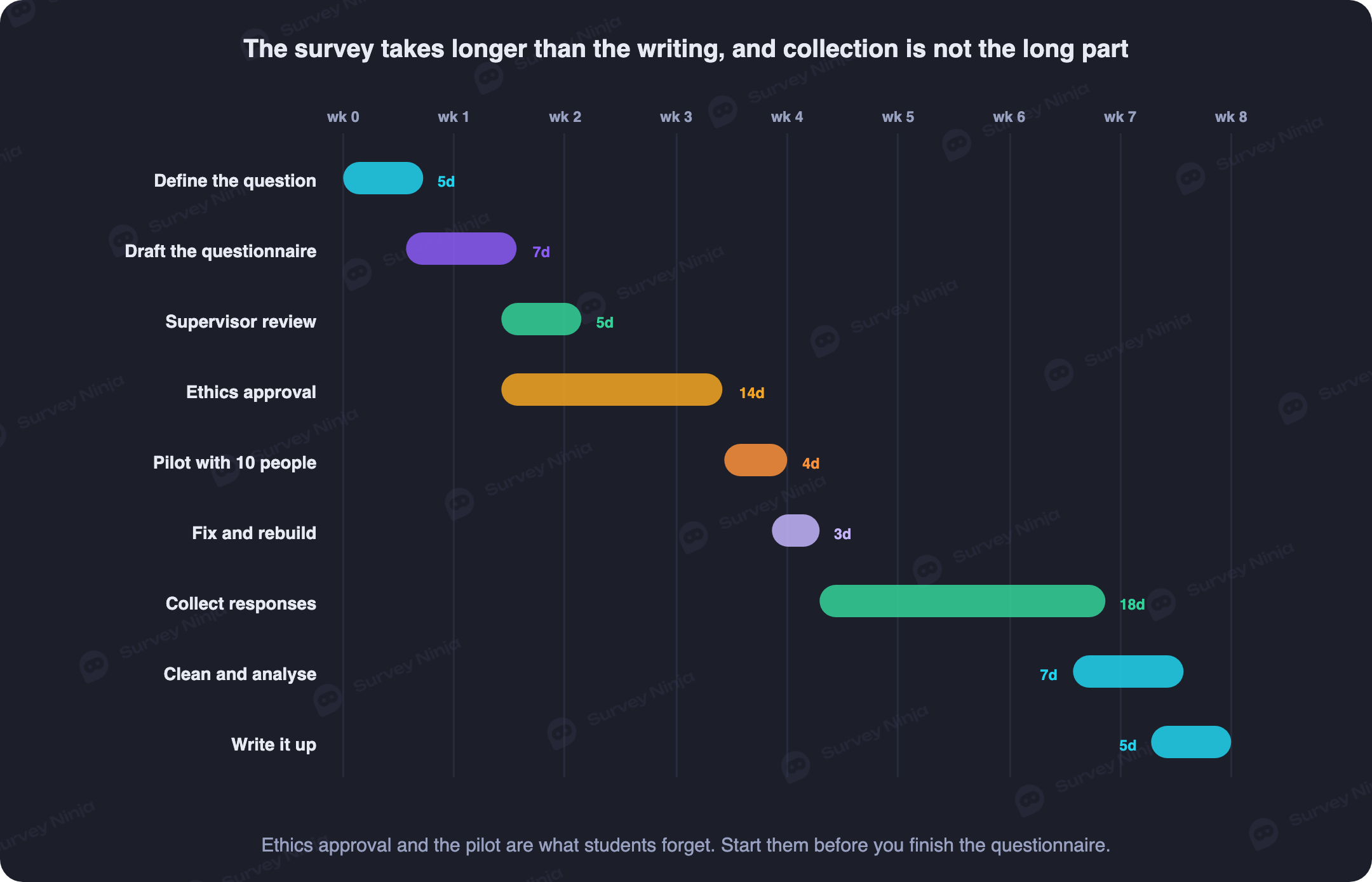
Designing and piloting the questionnaire, including a round of revisions from your supervisor, typically takes three to five working days once your objectives are settled, longer if you are waiting on permission to use a licensed scale. Ethics approval is the least predictable stage: a low-risk anonymous survey with a responsive supervisor can clear in a few days, while a full committee review, especially for anything touching minors or sensitive data, can take two to four weeks and sometimes longer around institutional deadlines, so submit it the moment your instrument is stable rather than waiting for it to be perfect.
Data collection itself needs two to three weeks in almost every realistic case, not the few days a first plan usually allows, because responses arrive in a burst after the initial share and after the reminder, with a slow trickle in between that you cannot accelerate by refreshing the results page. Cleaning and analysis take another three to five days depending on how much open-ended coding is involved, and writing up the methodology, results and limitations sections, once the data itself is settled, is roughly a week of writing for most undergraduate dissertations. Put together, four to six weeks from a finalized research question to a completed results chapter is a realistic minimum, and starting the ethics application in week one rather than week three is the single change that saves the most stress later.
Common mistakes that cost marks
- Running a survey because the last student did, not because the question needs one. An examiner asks why a survey was the right method, and "everyone else did it" is not an answer.
- Writing questions that are interesting rather than questions the objectives require. Every item should trace back to a named variable; if it does not, cut it.
- Generalizing from a convenience sample as if it were a probability sample. State plainly who actually responded and let that scope the claim.
- Skipping ethics approval or starting data collection before it clears. Some departments will not accept the resulting data at all, regardless of quality.
- A questionnaire that takes fifteen minutes for an unpaid respondent. Length is the most common, most fixable cause of low response rates.
- Posting the link once and waiting. Distribution needs a channel, a reminder, and ideally a second channel, not a single post.
- No documented data-cleaning process. "I removed some bad responses" invites the exact follow-up question you have no answer to.
- Reporting a mean on a five-point scale to two decimal places. It signals precision the measurement does not have.
- Claiming causation from a single-point-in-time survey. Report an association as an association.
- A limitations section that reads like an apology instead of a scoped claim. Naming a limitation you already accounted for is a strength, not a weakness.
Building and running it in SurveyNinja
None of the planning above needs specialist software, but the platform you build the questionnaire in affects how much you get for free. In SurveyNinja, screening questions and branching logic route ineligible respondents straight past questions that do not apply to them, a consistent scale is one setting rather than something rebuilt on every page, and a QR code for your printed flyer generates automatically alongside the shareable link. Responses can be collected anonymously by design when your ethics approval requires it, and closed-question results tally into charts and cross-tabs as they arrive, so you can watch data quality while collection is still open.
Start from a template close to your topic rather than a blank page, and export the finished dataset to a spreadsheet for cleaning and analysis once collection closes. The free plan carries no cap on responses, which matters for the burst pattern described above: a supervisor's forwarded email or a well-placed QR code can bring in more responses in one day than the rest of the collection period combined. Build your questionnaire and pilot it on a handful of classmates before it goes anywhere near your real sample.
Frequently asked questions
Do I need a survey for my thesis or dissertation?
Only if your research question asks what a defined group thinks, does or reports about itself, and needs breadth across enough people to compare groups or spot a pattern. If the question is really about why something happens, interviews usually answer it better. Check first whether existing data can already answer it before collecting your own.
How many people do I need to survey for a dissertation?
For a large population at 95% confidence and a ±5% margin, the standard rule of thumb is about 384. For a smaller, defined population such as a single faculty or company, a finite-population correction brings that down, sometimes to under 100. Run your actual numbers through a sample size calculator rather than relying on the round figure alone.
Can I get away with a convenience sample?
Almost every student dissertation uses one, and that is fine as long as you say so plainly. What changes is what you can claim afterward: describe the people who actually responded rather than generalizing to the whole population, and name the sampling method as a limitation rather than presenting it as a probability sample.
Do I need ethics approval to run a student survey?
In most institutions, yes, even for an anonymous survey of adults, though the process can be a fast supervisor sign-off for low-risk studies or a full committee review for anything touching minors or sensitive data. Requirements vary by university, so confirm the exact process with your supervisor and your institution's ethics body before collecting any data.
How long should a dissertation questionnaire be?
Fifteen to twenty-five questions, answerable by an unpaid respondent in five to eight minutes, is a realistic ceiling. Longer questionnaires see rising abandonment partway through and more low-effort, straightlined answers among those who do finish, which costs you more usable data than the extra questions add.
Where can I find respondents for a student survey?
Your own course pages and class groups, your supervisor's contacts, and a QR code at a relevant physical location typically outperform a single social media post by a wide margin. A reminder sent about a week after the first invitation recovers a meaningful share of people who meant to respond and forgot.
What do I do with incomplete or low-quality responses?
Decide your rule before you look at the data: a common approach keeps partial responses that reached your core measurement questions and drops those that stopped earlier, and flags speeders and straightliners for removal. Record exactly how many you removed and why in the methodology chapter, since an examiner will ask.
What goes in the methodology chapter versus the appendix?
The methodology chapter describes the population, sampling method, instrument, distribution, response rate and ethics approval, along with a demographic summary of the achieved sample. The full questionnaire as respondents saw it, and often a few completed examples, go in an appendix referenced as "see Appendix A", not reproduced inline in the chapter.
Updated: Sep 29, 2026 Published: Aug 24, 2026