 25 Questions for a Travel Agency Customer Satisfaction Survey
Anonymous Surveys: A Practical Guide to Doing It Right
Useful  Mike Taylor Updated: Sep 18, 2026 Reading time ≈ 26 min

An anonymous survey is not a form with the name field removed. It is a promise about what gets collected, who can see it, and how small a group can be before you publish a result, and most surveys labeled anonymous keep none of those three.
Ask three people on the same team what "anonymous" means and you get three answers. None of them quite match what a privacy lawyer means, or a security engineer, or the person actually filling out the form. That gap is where anonymous surveys fail. Not from bad intent. From nobody writing down what the promise covers before the first invite went out.
General question design is covered in how to create an online survey and in types of surveys and question types. This guide is about the narrower promise behind an anonymous survey: what it requires technically, where it breaks, and what to do with feedback from someone you cannot answer.
Anonymous, pseudonymous, confidential, identified: four different promises
These four words get used interchangeably in survey invitations, and the mix-up is not cosmetic. Each describes a different technical setup. Each makes a different promise to the respondent, and each leaves the organizer a different amount of room to act on what comes back. Sort them out before you build anything, or you will promise a level of protection you have not built.
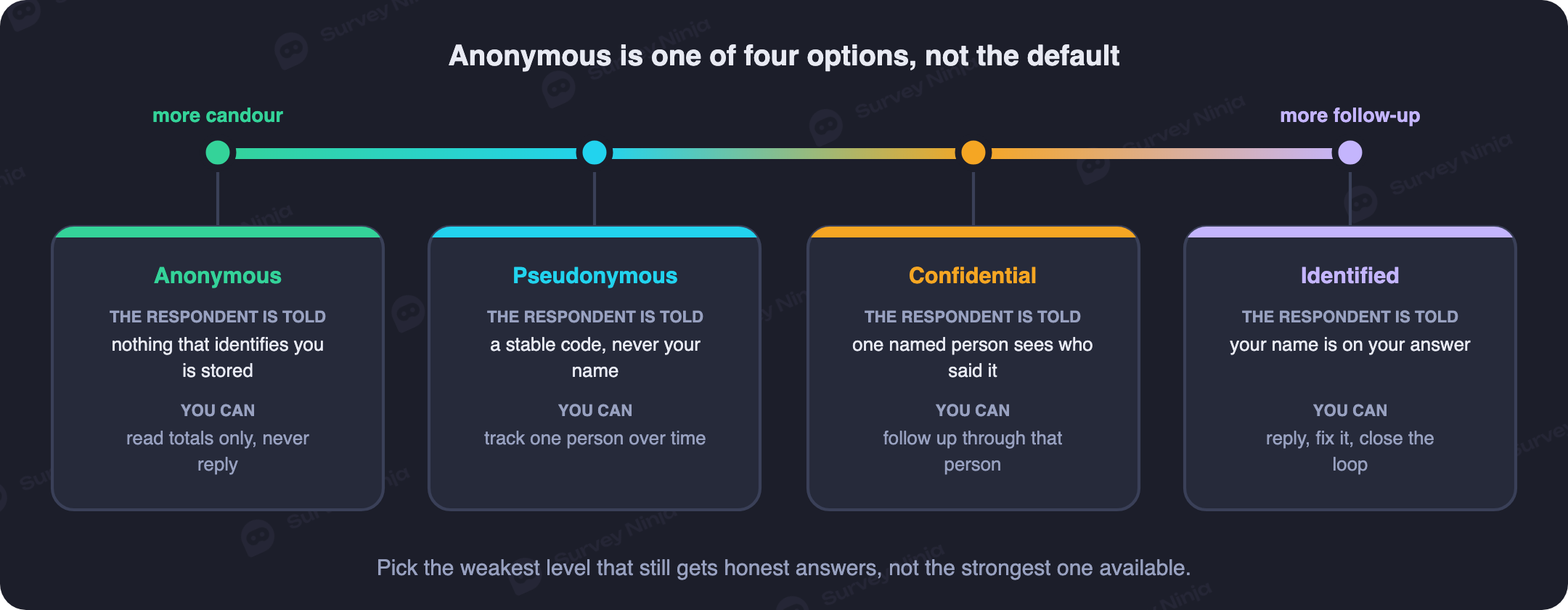
Anonymous means nothing identifying is collected. No name, no email, no IP address, no device fingerprint. Nothing in the response lets anyone work backward to a person, including the person who built the survey, including under pressure to try.
That is the strongest promise on the list and the most expensive to keep. You cannot deduplicate respondents. You cannot match one person's answers across two waves. You can never reply to what any individual told you. True anonymity is right for a subset of feedback and wrong as a default for most of it.
Pseudonymous swaps the identity for a stable token: a respondent ID, a hashed email. Someone holding a separate key can map it back. Anyone looking at the raw export cannot.
This is the setup for a longitudinal study, where you need to match the same person across three quarterly waves without a name ever touching the working file. The promise is narrower than anonymous. Re-identification stays possible in principle. It is just gated behind a key most people looking at the data do not hold.
Confidential is the mode most companies actually run, and the one they describe least accurately. The organizer knows exactly who said what. The response is stored with an identifier attached. What gets protected is not the link between name and answer, but who is allowed to look at that link.
Most employee engagement platforms that print "100% anonymous" on the invitation email are running this mode. HR or the survey admin can open an individual response. Line managers see rollups above a minimum group size. Nobody outside that chain sees a name next to an answer. Calling it anonymous instead of confidential is the most common labeling mistake in this space, and the moment a respondent finds out, they stop trusting the next survey you send.
Identified attaches a visible name or account to the response, on purpose, so someone can follow up: a support ticket, an NPS detractor you want to call before they churn, a bug report you need a device model for. There is nothing wrong with identified feedback. Most of what a product, support or people team collects should be identified, because the value of the channel is being able to answer a specific person.
| Level | What the respondent is told | What the organizer can see | Main cost |
|---|---|---|---|
| Anonymous | Nothing about you is stored, ever | No path back to any individual | No follow-up, no deduplication, no wave-to-wave tracking |
| Pseudonymous | Your identity is replaced by a code | The code, mapped back only via a separate key | The key is a standing security liability |
| Confidential | Only a named few will see your name | Full identity, restricted by role | Trust collapses fast if the boundary leaks |
| Identified | Your name travels with your answer | Full identity, no restriction | Some respondents self-censor knowing they are named |
How anonymity actually breaks in practice
Almost none of these failures involve a hacked database. They come from ordinary survey settings nobody checked, and from response data giving away more than anyone intended. The fixes below are specific because the failures are specific. "Be careful with the data" is not an instruction anyone can act on.
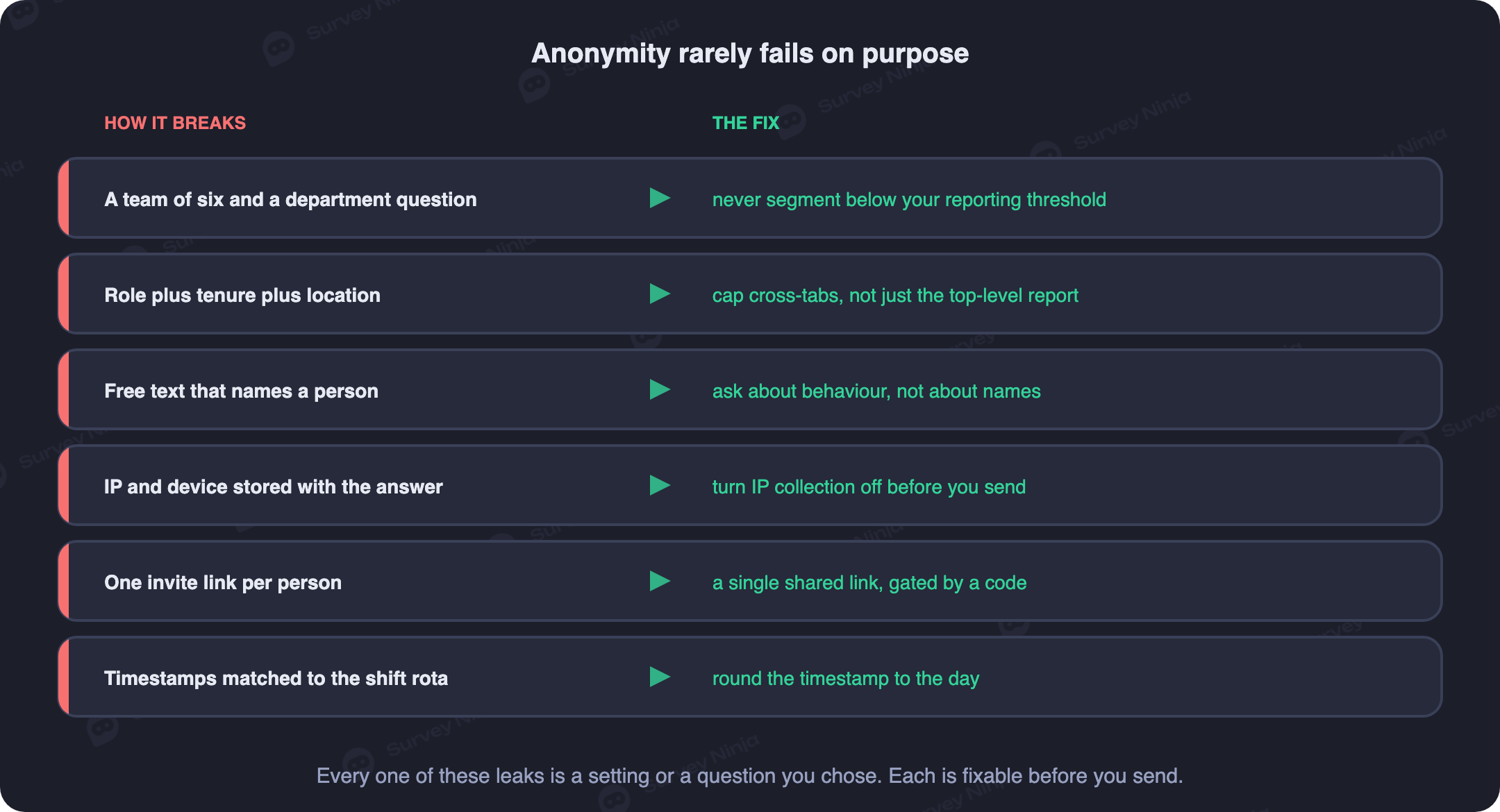
Small teams and small segments. A team of six answering a survey that also asks "which department are you in" does not need a name field to identify everyone. Six is small enough that tenure, role, even writing style narrow it to one. Drop the segmenting question for groups under your reporting threshold. Or fold small departments into something broader, "Operations", before the survey opens rather than after someone notices.
Demographic combinations. No single demographic question is usually the problem. The combination is. Gender, department, tenure and location each look harmless with twenty categories between them. Cross three of them and "female, 8+ years, based in the Manila office" might describe exactly one person on the payroll. Decide before launch which demographics you will actually cross-tabulate, collect only those, then collapse the rare categories. "10+ years" instead of exact tenure. "APAC" instead of city.
Free text that names a person or an incident. This is where most anonymous surveys actually leak. A respondent describing "what my manager said in the Tuesday standup" has identified themselves to everyone who was in that standup, manager included. The fix lives in the prompt, not in cleanup afterward: ask them to describe the situation without using names, and focus on what happened. Any comment that does name someone goes to a restricted reviewer, not verbatim into a report with a wider audience.
IP addresses and device fingerprints. Most survey tools log the respondent's IP by default, for fraud prevention or basic analytics. Under most privacy frameworks an IP address is personal data whether or not you show it to anyone. This one is a setting, not a policy. Turn off IP logging for surveys where you are promising anonymity, and do not run bot-detection or fraud-scoring on the same response set, since those systems work by fingerprinting the device.
Unique per-person invite links. A personalized link, one with a respondent ID in the URL or sent to one address at a time, ties an answer back to a person even when the response carries no name. The join happens quietly in your email platform's send log rather than in the survey data. Use one shared link, distributed to the whole group at once, through a mailing list or a QR code on a poster. Then opening the survey never passes through a system that knows who clicked.
Timestamps correlated with a schedule. Three people worked the night shift on a given Tuesday. One response lands at 2:14am. The roster does the re-identification for you, without a single extra data point in the survey itself. Strip precise timestamps from anything you share beyond the raw dataset, bucket responses by week rather than by minute, and delay reporting until well after the shift pattern that would make one answer stand out.
Open, live-updating result dashboards. A counter that ticks up as responses land lets anyone watching guess who just answered, based on who they last saw walk away from their desk. It is a more effective re-identification method than something that simple has any right to be. Batch the results. Publish after the survey closes, never as a running total a manager can watch during collection.
The minimum group size rule for reporting
One rule prevents most of the leaks above from mattering: a floor on how small a reported group can be. Five to seven responses is a common working threshold. If a breakdown by team, tenure band or location would show a result for fewer people than that, you do not publish that breakdown. Below the floor, a report is not protecting anonymity. It is printing a name with extra steps.
The part teams get wrong is applying the threshold to the top-level report and forgetting it once someone starts slicing. A survey of two hundred people looks perfectly safe in aggregate. Then a manager asks for "the same breakdown, just for my team", or filters by department and tenure at once, and the cell size drops from two hundred to four with nobody re-checking the count after the filter. The threshold has to live in the reporting process, checked on every cross-tab and every filtered view. If you build filtered reports in a tool that supports segmentation, make the minimum group size a hard gate on the filter rather than a footnote people skip.
This is also why sample size matters for more than statistical confidence. A survey can reach a healthy overall sample size and still fail the group-size rule on every interesting cross-tab, if the population is small or spread unevenly across the categories you care about. A team of forty split six ways by department averages under seven people per department, before anyone adds tenure or location on top.
Setting anonymity up technically
Anonymity is a setup, not a checkbox. Most of it gets decided before the first response arrives, and almost none of it can be fixed afterward.
The same care applies to integrations: a CRM that receives the answer next to the sender address undoes the anonymity the form itself protects.Use one shared link, not one link per person. Distribute it once: by email list, by QR code on a poster, through a channel post. Opening the survey then never touches a system that logs who received which URL. Compare that to personalized invite emails, which are excellent for tracking response rate per recipient and completely wrong for anything you are calling anonymous. The tracking is the leak.
Turn off IP and email collection at the survey level, not just at the question level. Most builders log the IP as infrastructure whether or not you ask for an email in the questionnaire, so removing the email question changes nothing if the underlying request is still logged. Find the setting and confirm it in the survey's access and privacy settings.
Do not ask for demographics you will not use. Every optional field is re-identification risk taken on for a chart nobody will open. Not going to report tenure by year? Do not collect exact tenure. Collect a wide band.
Control who can answer without identifying who did. A password or access code printed on a flyer, a link limited to a company network, a code distributed once through a channel that is not logged against the response: all of these gate the survey to the right population without attaching a name to an answer. The distinction that matters is between controlling access, which is compatible with anonymity, and tracking access, which is not.
The promise you make to respondents
A vague anonymity statement is worse than none. It makes a promise without saying what the promise covers, and a respondent who has been burned once reads every vague promise afterward as a lie. "Your responses are confidential and will only be used to improve the workplace" tells the reader nothing. Not who sees the raw text. Not what gets stored. Not how small a group has to be before a result gets shared.
A statement worth trusting answers four questions in plain language, on the intro screen, before the first question:
- Who sees the raw answers. Name the role, not a department. "Only the external research firm we hired sees individual responses" is verifiable. "HR" is not, because HR is made of people with names.
- What is stored. State that no name, email or IP address is collected, if that is true. Say it even when it feels obvious. Respondents cannot see your settings screen.
- What the minimum reporting group is. "We will not publish any breakdown that would show results for fewer than five people" is a sentence a skeptical respondent can hold you to.
- What happens with the results. Say when a summary will be shared, with whom, and in what form, so the promise has an end date instead of disappearing into a system nobody hears from again.
Write it once and reuse it on every survey that makes the same promise. Never copy an anonymity statement from a template without checking that every sentence is still true of the survey you are running.
Question design for anonymous surveys
An anonymous questionnaire does more work per question than an identified one. Two of the usual repair tools are gone: you cannot ask a clarifying follow-up, and you cannot go back to the person for detail. You promised not to know who they are.
Free text needs a prompt that steers away from naming individuals, not a warning after the fact. "What would make this team work better?" invites specifics about a person by default. "Describe the situation you'd like to see change, without naming anyone" gets closer to usable feedback without asking the respondent to self-censor from scratch.
This matters more here than in an identified survey. In an identified thread, a stray name can be quietly redacted by a human who knows the context. In an anonymous one, by the time anyone reads it, redacting is the only option left, and the useful part of the comment usually goes with it. The broader checklist for wording open and closed items is in feedback form questions and in open-ended questions. The anonymous case raises the stakes on getting it right the first time.
Conditional probes are out too. No "can you say more about that", because there is no channel back to whoever wrote the comment. Every question has to stand alone: ask for the context inside the question rather than planning to ask later. "What happened, when, and what would you have wanted instead" in one open field outperforms three short follow-ups you will never send. Watch your leading question instincts as well, since a nudge toward the answer you expect is harder to correct for when nobody can ask what the respondent meant. And keep the whole thing short. The guidance in how to reduce survey dropout applies double, because an anonymous respondent who abandons midway leaves a partial answer you cannot go back and complete.
Closing the loop without being able to reply
The hardest part of an anonymous survey is not collecting the data. It is answering people you cannot reach. Skip this step and the second survey gets a lower response rate than the first, for the obvious reason: people who felt unheard do not bother again.
Publish a summary, not a data dump. A short readout of three to five themes with rough proportions, "about a third of comments mentioned scheduling", does more for trust than a raw export nobody has time to read. It also respects the group-size rule by construction, since you are reporting themes rather than quotes traceable to a headcount.
Name what will change and what will not. Specifically. "We're adjusting the on-call rotation starting next month" closes the loop. So does "we heard the concern about compensation but cannot act on it this cycle". A vague "we're looking into it" reopens the trust gap you were trying to close. Group the free-text comments into named themes with counts instead of reacting to the loudest quote, which is the same discipline covered in thematic analysis.
Re-run it and show the same chart next to the old one. A single anonymous survey is a snapshot. What builds trust is watching a number move after you said you would act, which is the logic behind a recurring pulse survey rather than a one-off. This is where the loop genuinely closes. Publishing what people told you, then publishing what changed because of it, is what makes the feedback feel two-way even when no individual reply was ever possible.
When not to make it anonymous
Anonymity is a tool for one job: surfacing opinions people would otherwise suppress out of fear of consequences. It is the wrong default for anything whose value lies in reaching back to whoever answered.
Bug reports need a device, an OS version, often a screenshot. Anonymize one and you have traded a fixable ticket for an unfixable one. Feature requests need an account attached so you can tell the requester when it ships, which is also what turns a request into a retained customer. Support follow-ups are, by definition, about resuming contact with a specific person. Triggered surveys fired right after one of these events almost always belong in the identified column.
NPS and CSAT tied to a transaction fall in the same bucket. A detractor score attached to an order number is worth a phone call before that customer churns. The same score collected anonymously is a statistic you cannot act on for the one person who gave it to you. The same logic applies to in-app feedback and short microsurveys fired after a specific action: the advantage of asking inside your own product is knowing who just did what, and anonymizing that throws away the one thing that made the channel worth building.
What anonymity actually costs
None of the above holds up if the costs go unsaid. So here they are, without softening.
You lose follow-up on everything, including the responses that most need it. A comment describing a serious problem gets exactly the same non-reply as a comment about the office coffee, because once submission closes you have no way to tell them apart. You lose clarification entirely: an ambiguous answer stays ambiguous forever instead of getting resolved in one message.
Accountability drops too. Knowing a response cannot be traced removes a real constraint on what people are willing to write. Mostly that constraint suppresses honest complaints, which is the point. Occasionally it also lets an unfounded accusation through carrying the same weight as a well-founded one, and there is no mechanism inside an anonymous channel to tell which is which.
There is a harder truth the case for anonymous surveys likes to skip. A workplace that relies on anonymity to get honest feedback usually has a problem a survey cannot fix. If people only speak up when guaranteed nobody will know it was them, then speaking up under your own name currently carries a real cost, and anonymizing the survey treats the symptom while leaving that cost exactly where it was. Anonymous responses also skew toward the extremes, since a strong grievance or a strong compliment motivates writing when there is no comeback. That is the same response bias that shows up whenever a channel selects for who bothers to answer.
Some cases call for confidential-but-attributed instead. A skip-level conversation where the goal is a working relationship rather than a data point. A performance concern that will eventually need a name attached to go anywhere. A small team where true anonymity is structurally impossible, so promising it only creates false confidence. In those cases, say the survey is confidential rather than anonymous, and mean it: identity known, access restricted. That is a real and useful promise without borrowing a stronger word it cannot back up.
Set one up this week
A working anonymous survey needs a few focused decisions, made in the right order.
- Pick the questions first, the anonymity setup second. Start from a relevant template and cut anything that is not self-contained, since you will not get to ask a follow-up.
- Turn off IP and email logging for this survey specifically. Confirm it rather than assuming the default matches what you promised.
- Cut identifying demographics to the ones you will actually cross-tabulate, and widen the bands on whatever you keep.
- Generate one shared link. Distribute it through a channel, a list or a QR code, never through individually addressed invitations.
- Decide the access control separately from the identity question. A password or access code keeps the wrong people out without telling you who the right people were.
- Write the anonymity statement using the four questions above, and put it on the intro screen, not in a linked policy document nobody opens.
- Set your minimum reporting group in writing before the first response arrives. Five to seven as a working floor, applied to every cross-tab you plan to run.
- Block out time to publish a summary within two weeks of closing. Decide now what you will say about the themes you cannot act on this cycle.
None of this needs custom infrastructure. A shared link, a password field, disabled IP logging and a filtered report with a group-size floor are configuration, not development. The free plan on SurveyNinja's pricing page carries no response cap, which matters here: an anonymous survey with a visible response limit quietly tells people their answer might not count. Build the survey, write the statement first, and only then open the link.
Common mistakes
- Calling a confidential survey anonymous. The moment anyone with access finds a name attached to an answer, every future "anonymous" label reads as a lie.
- Publishing a cross-tab under the group-size floor. The top-level report can be safe while a filtered view of the same data identifies someone.
- Sending personalized invite links on an "anonymous" survey. The re-identification happens in the send log, not in the response.
- Asking demographics you will never analyze. Every unused field is pure re-identification risk with no analytical return.
- A vague anonymity statement. "Your data is confidential" answers none of the four questions a skeptical respondent actually has.
- Planning to ask a follow-up. There is no channel back to an anonymous respondent, so every question has to stand alone.
- Going silent after collection. No published summary is the single biggest reason response rates fall on the next anonymous survey.
- Anonymizing feedback you need to act on for that person. Bug reports, feature requests and transaction-linked scores lose their entire value when you cannot reach back.
Frequently asked questions
What is the difference between an anonymous and a confidential survey?
Anonymous means no identifying information is collected at all, so nobody can trace a response back to a person even if they wanted to. Confidential means the organizer knows exactly who gave which answer, but access to that link is restricted, and only aggregated results are shared more widely. Most workplace surveys that advertise themselves as anonymous are actually confidential.
How small can a team be before an anonymous survey stops working?
There is no fixed number, but once a segment drops below roughly five to seven people, a demographic question or two is usually enough to narrow a response down to one or two possible people. Below that size, either drop the segmenting questions or fold the group into a larger category before you report anything.
What is the minimum group size rule?
A working rule is to never publish a result, in any report or filtered view, for a group of fewer than five to seven respondents. The rule has to be applied to every cross-tab you run, not just the headline numbers, because a filtered breakdown can drop well below a safe size even when the overall survey had plenty of responses.
Does turning off the name field make a survey anonymous?
No. IP addresses, device fingerprints, unique invite links, timestamps correlated with a schedule, and free-text answers that name a person or incident can all re-identify a respondent even when no name field exists. True anonymity requires turning off IP and email logging, using a single shared link, and designing questions and reports with re-identification in mind.
How do you control who can answer an anonymous survey without identifying them?
Gate access, not identity. A password or access code shared through a flyer or channel post, a link restricted to a specific network, or a one-time code distributed out of band all limit who can respond without attaching any of that control information to the response itself.
How do you close the loop with people you cannot reply to individually?
Publish a summary of the themes rather than a raw data export, state plainly what will change and what will not this cycle, and re-run the survey later so people can see whether the number actually moved. That sequence is what builds trust in a channel with no individual reply.
When should a survey not be anonymous?
Whenever you need to act on the specific response from the specific person: bug reports, feature requests, support follow-ups, and NPS or CSAT scores tied to a transaction you might want to recover. Anonymizing any of these removes the one thing that made collecting the feedback worthwhile.
What does a good anonymity statement include?
It names who sees the raw answers, states plainly what is and is not stored, gives the minimum group size below which nothing gets published, and says what will happen with the results and when. A vague line like "your responses are confidential" answers none of those and is worse than saying nothing.
Updated: Sep 18, 2026 Published: Aug 18, 2026