 25 Questions for a Travel Agency Customer Satisfaction Survey
Types of Surveys and Question Types: A Full Classification With Examples
Useful  Mike Taylor Updated: Aug 26, 2026 Reading time ≈ 15 min
A survey is a way of collecting data: you put a set of prepared questions to a group of people and then analyze their answers. That one word, though, covers tools that have very little in common. A loyalty score sent out right after a purchase and an anonymous read on how a team is feeling are both surveys, yet they are built, run and analyzed in completely different ways.
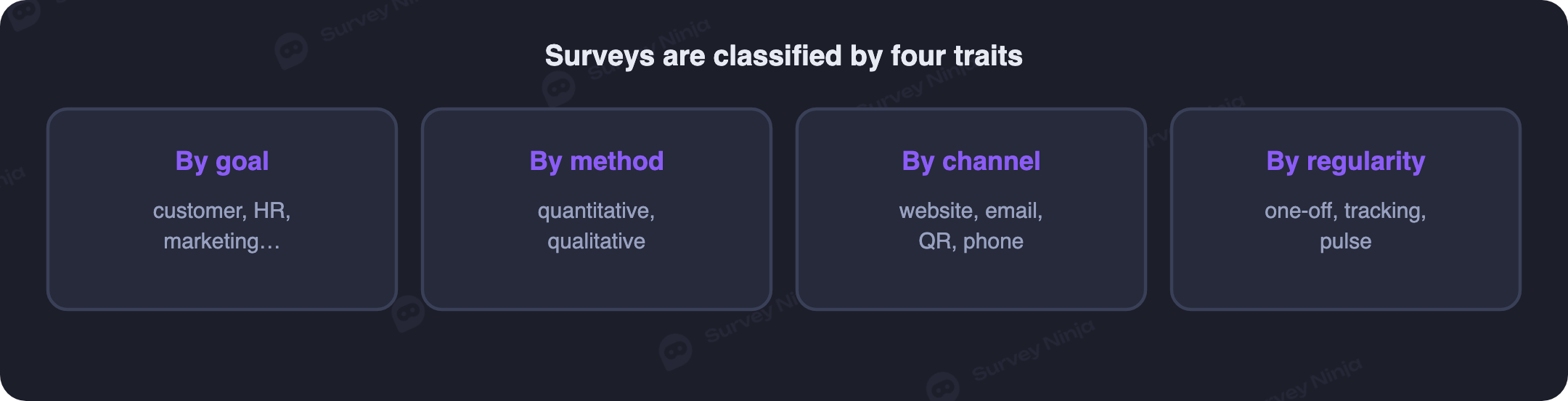
To pick the right tool, it helps to sort surveys along a few axes: by their goal, by the method behind them, by the channel you send them through, and by how often you run them. Below we walk through each of those classifications, then move on to what a survey is actually made of in practice, its question types, and finish with a worked example that goes from a goal all the way to a finished set of questions.
Types of surveys by goal
This is the classification that matters most, because the goal is what decides which metric you will track and which questions you will ask. In practice, five families of surveys come up again and again, and most real projects sit inside one of them.
Customer surveys measure how people feel about a product or a company. This is where loyalty scoring with NPS lives, along with CSAT for satisfaction with a specific interaction and CES for the effort a customer had to put in. You run them after a purchase, after a support ticket, or on a rolling basis across your base, so you can watch the trend rather than a single snapshot in time.
Product surveys help product teams make decisions: which feature to add next, what gets in the way of using the product, whether a new interface actually reads clearly. These often pair rating scales with open questions, so you come away with both the numbers and the reasons behind them. They tend to be tightly targeted, going out to the people who have actually touched the feature in question rather than the whole customer base.
HR surveys point inward, at the company itself. Engagement studies, quick pulse checks on mood, employee loyalty scoring (eNPS), and exit interviews when someone leaves all belong here. What sets them apart is how sensitive the subject matter is, which makes anonymity non-negotiable rather than a nice-to-have; the moment people suspect answers can be traced back to them, the honesty drains out of the data.
Market research studies the market and the audience: demand for a new product, customer segments, how a brand is perceived. For work like this a representative sample matters more than anywhere else, because the whole point is to generalize from the people you asked to the wider audience, and a skewed sample quietly breaks that logic without ever announcing itself.
Public opinion polls look at what groups of people think about social, political or civic questions. What separates them from the rest is the sheer weight they put on methodology and sampling; get either wrong and the headline number is worthless, however confident it looks in a chart.
In the real world these families overlap. A product survey can carry an NPS question inside it, and a piece of market research can be built on a carefully drawn sample. The useful habit is not to file a survey neatly onto one shelf, but to keep asking what decision you will actually make once the answers are in.
Quantitative and qualitative surveys
The second classification worth knowing is by method, meaning which question you are really answering: "how many" or "why".
Quantitative surveys answer "how many". What share of customers are unhappy with delivery, what the average satisfaction score is, how many percent would switch to a new plan. That calls for a lot of responses and mostly closed questions, because only then can the results be counted and compared. This is the classic online survey sent to a large list, and there is more on the method in our guide to quantitative research.
Qualitative surveys answer "why". What sits behind a low score, the exact words people use to describe a problem, the motives driving a choice. Here you have few participants, but each answer goes deep: open questions, interviews, focus groups. Even a single open question at the end of a quantitative survey, "why did you give that score?", is already a qualitative element bolted onto a quantitative form.
In practice the two complement each other. A quantitative survey shows where a problem shows up and how widespread it is, while a qualitative one explains why it happens, and the strongest projects run them in sequence rather than treating them as rivals. To see how these fit into the wider map of research approaches, take a look at the difference between primary and secondary research.
Types of surveys by channel
The channel decides who you reach and at what moment, and it quietly shapes your response rate too. The main options:
- A direct link. The all-purpose route: you drop the link into an email, a chat, a community or a social post. It fits almost any task.
- An on-site survey. A popup or a widget embedded in the page. This is also home to triggered surveys that fire on an event, for example right after an order is placed.
- An email campaign. A survey sent to your own list of customers or employees, when you already have their contact details and their consent to write to them.
- A QR code. The bridge from offline to online: the code goes on a receipt, a cafe table, packaging or a printed ad.
- Phone and in-person surveys. Used where the audience is hard to reach online, or where a live interviewer genuinely adds something a form cannot.
Channels are not mutually exclusive. You can put the same survey on your site, send it by email and close it behind a QR code in a physical location all at once, then compare the response you get from each source and lean on whichever pulls its weight.
Types of surveys by cadence
The last classification is about how often you come back to the measurement, and it changes how you read the numbers as much as how you collect them.
- One-off surveys are run for a specific job: to test a hypothesis, to rate an event, to gather feedback on a new feature. You ask once, act on it, and move on.
- Tracking surveys repeat at fixed intervals so you can see movement over time. A single NPS reading tells you very little; the meaning appears when you set it next to last quarter's number and watch which way it is heading.
- Pulse surveys are frequent and very short, three to five questions. They are typical in HR, where the aim is to catch the team's mood regularly without wearing people down with long questionnaires.
Question types in a survey
Whatever family a survey belongs to, it is assembled from questions of different types. Choosing a type is not a formatting decision; it decides what, and how, you will be able to count afterwards, so it is worth getting right before you write a single line.
The broadest split is into closed and open questions. Closed questions offer ready-made answer options, which makes them easy to aggregate and report as percentages. Open questions ask for an answer in the respondent's own words: they give you depth and phrasing you would never have guessed, but they need manual review, or help from AI, to make sense of at scale. For most surveys the working ratio is mostly closed questions plus one or two open ones, and there is more on getting that balance right in our piece on open and closed questions.
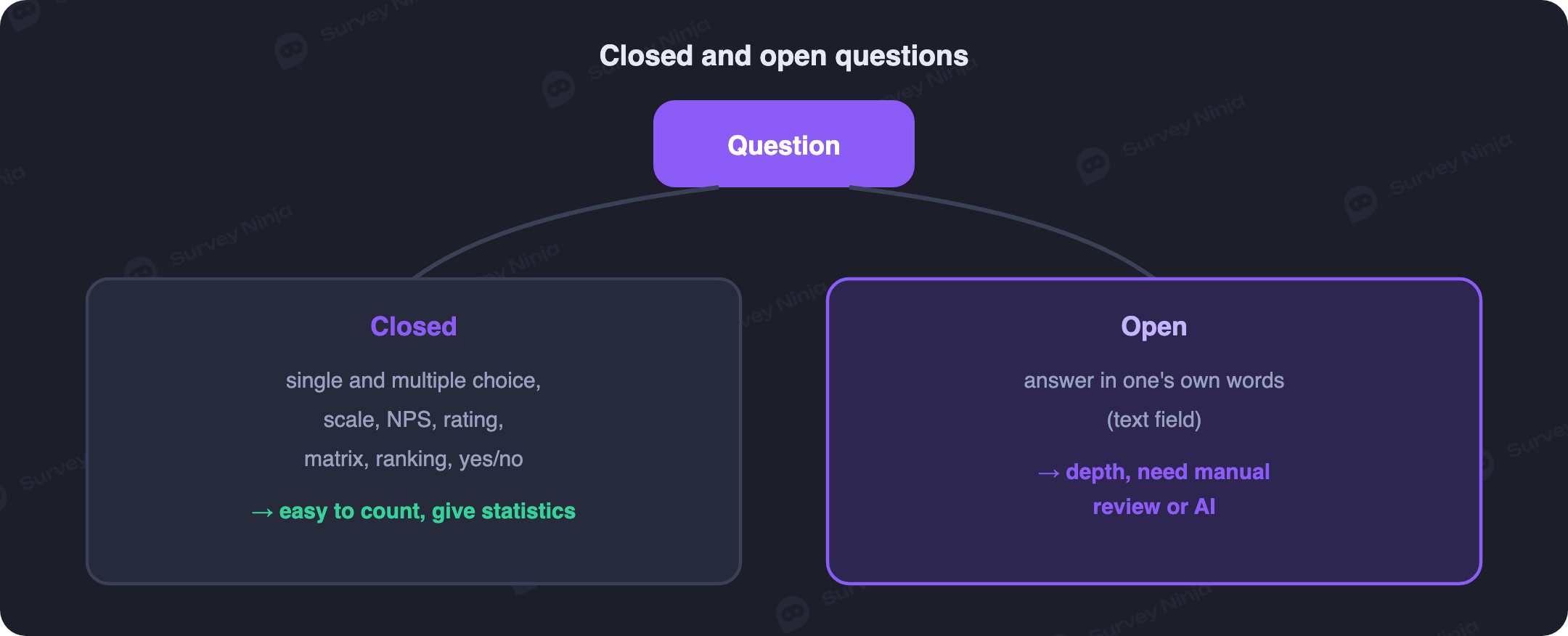
Within those two groups there are a handful of core types, and each maps to a different kind of answer you can work with later:
| Question type | What it gives you | Example |
|---|---|---|
| Single choice | One answer from a list | "How did you hear about us?" |
| Multiple choice | Several answers at once | "Which features do you use?" |
| Dichotomous | A yes or no answer | "Did you contact support?" |
| Scale (Likert) | Degree of agreement | "Rate from 1 to 5 how much you agree" |
| NPS scale | Willingness to recommend | "0 to 10: would you recommend us?" |
| Rating (stars, emoji) | A quick emotional read | Service rated in stars |
| Matrix | Several statements on one scale | A "statement by rating" grid |
| Ranking | Order by importance | "Rank these criteria by priority" |
| Open-ended | Answer in their own words | "What should we improve?" |
Each type has its quirks. Dichotomous questions work well as a filter at the start of a survey and for driving branching logic, but they flatten opinion: someone who half-agrees is forced into a plain yes or no. Scales, including the widely used Likert scale, must always have their ends labelled, "1 = didn't like it at all, 5 = excellent", or every respondent reads the numbers their own way. Star or emoji ratings feel friendlier than a bare scale and tend to lift the response rate, which is why they are common in quick satisfaction checks. Matrices save space but are hard to read on a phone, so long matrices are better broken into a series of separate questions. If you are unsure how to phrase a set of questions from a blank page, an AI question generator can hand you a solid first draft to edit down.
How to choose a survey type and question types
The choice always runs down the same chain, from the general to the specific:
- Goal. What decision will you make once the results are in? That sets the type of survey.
- Metric. Loyalty points to NPS, satisfaction to CSAT, customer effort to CES, or simply open feedback if you do not need an index at all.
- Method. If you need figures and shares, run a quantitative survey across a large base; if you need to understand causes, add qualitative, open questions.
- Question types. Mostly closed, so you can count, plus one or two open, so you can understand.
Here is how that plays out. Say an online store notices that repeat purchases have dropped and wants to work out what to fix first. The goal is to decide where to put its effort, so this is a customer survey. The metric is NPS, to gauge overall loyalty, plus an open question about the reason for the score. The method is quantitative, across everyone who bought in the last three months. The channel is email, sent a week after delivery. The question types are an NPS scale, then a closed question about the reason with clear options, and one open question, "what should we improve?". The result is a short survey of four or five questions that shows you both a number and the reason sitting behind it, which is exactly what you need to decide where to act.
Once that is settled, all that is left is to build the survey, which takes a few minutes. If a structured questionnaire format suits you better, see our guide to what a questionnaire is and how to put one together, and to make sure a "how many" claim holds up, check how big your sample needs to be before you read too much into the results.
Common mistakes when choosing
A few situations come up over and over, where the wrong survey or question type quietly spoils the data long before you get to the analysis:
- An open question where a closed one would have done: instead of tidy statistics you get a wall of text no one has time to read through.
- A scale with unlabelled ends: the answers cannot be compared properly, because "7 out of 10" means something different to everyone.
- A long matrix in a mobile survey: people abandon it before they reach the bottom, and you lose the responses you already paid to collect.
- Quantitative conclusions drawn from too small a sample: the number looks convincing but is not statistically reliable.
- A metric for the sake of a metric: dropping in an NPS question just because it is the done thing makes no sense if you have no plan to act on it.
Key takeaways
Surveys are sorted by goal (customer, product, HR, market, public opinion), by method (quantitative and qualitative), by channel (link, on-site, email, QR, phone) and by cadence (one-off, tracking, pulse). They are assembled from question types, from single choice and scales through to matrices and open answers. The right choice never starts with the questions; it starts with the goal, with what you are going to do with the results.
You can build a survey of any of these types in SurveyNinja, with every question type and branching logic covered, ready-made templates to start from, and a free plan with no limit on responses. So you can create your first survey and gather real answers without paying, then use the classification above to make sure the type, the method and the questions all point at the same decision.
Frequently asked questions
What types of surveys are there?
Surveys are sorted by goal (customer, product, HR, market and public opinion), by method (quantitative and qualitative), by channel (online link, email, on-site, phone, or offline via a QR code) and by cadence (one-off, tracking and pulse surveys).
How does a quantitative survey differ from a qualitative one?
A quantitative survey gathers a lot of responses and answers "how many": closed questions and statistics. A qualitative one gathers few responses but goes deep, and answers "why": open questions, interviews and focus groups.
What question types can a survey use?
The main types are single and multiple choice, dichotomous (yes/no), scales (including the Likert scale), the 0 to 10 NPS scale, ratings (stars or emoji), matrices, ranking and open text questions.
What is a dichotomous question?
It is a question with two mutually exclusive answers, usually yes or no. It works well as a filter at the start of a survey and for setting up branching logic, but it flattens opinion.
How is a Likert scale different from NPS?
A Likert scale measures how strongly someone agrees with a statement, for example from 1 to 5. NPS is a separate 0 to 10 scale strictly about willingness to recommend, from which the loyalty index is calculated.
Open or closed questions: which should you use?
Closed questions (choice, scales) are easy to count and give you statistics. Open questions give explanations but have to be reviewed by hand or with AI. A healthy survey is mostly closed questions plus one or two open ones.
Which type of survey should you choose for customers?
For loyalty, NPS; for satisfaction with a specific interaction, CSAT; for how much effort a customer had to make, CES. The choice depends on the decision you will make from the results.
Updated: Aug 26, 2026 Published: Jul 8, 2026