


Where to Find Survey Respondents (and How to Pick the Right Method)
Useful  Mike Taylor Aug 26, 2026 Reading time ≈ 30 min

The question is never really where to find respondents. It is which recruitment method fits your question, because the method decides who answers, and that decides what you are allowed to conclude from what they say.
Search "where to find survey respondents" and most results hand you a list of vendors, which answers the wrong question. A market research panel and your own customer list are not two doors into the same room, they are two different studies wearing the same questionnaire. One tells you what your paying customers think; the other tells you what a purchased sample of strangers, screened by a question you wrote, thinks. Confusing the two is how a team ships a finding that collapses the moment someone asks who actually answered.
Who You Actually Need, and Whether You Already Have Them
Before anyone opens a panel vendor's site, write down the actual target population the study needs: a role, a behavior, a stage in the relationship with your product, sometimes a demographic, rarely all of these at once. Most briefs default to "general population" or "our customers" without checking whether the real question is narrower, and a narrower population is both cheaper to reach and easier to reach well.
Then check three places you already own before paying anyone for access to strangers. Your CRM contains people who already did the thing you are asking about, cancelled, upgraded, referred a friend, reachable for the cost of an email. Your product contains people doing the behavior right now, a stronger signal than anyone's stated intention. Your support queue and sales notes already hold verbatim complaints and objections that a screener would take weeks to surface for money. A panel answers "what do people who match this profile think"; your own list, product and support queue can often answer "what do the people who actually did this think," faster and for nothing.
The test is simple. If the question is about your existing customers, users or applicants, look inward first. If it is about people who have never heard of you, a market you have not entered, or a population no internal list will ever reach, you need an external method, and the rest of this guide is about choosing the right one.
Recruiting From an Audience You Already Have
These five methods share one property: the people are already yours, as customers, users, visitors or followers, which makes them fast and cheap and also the boundary of what they can tell you.
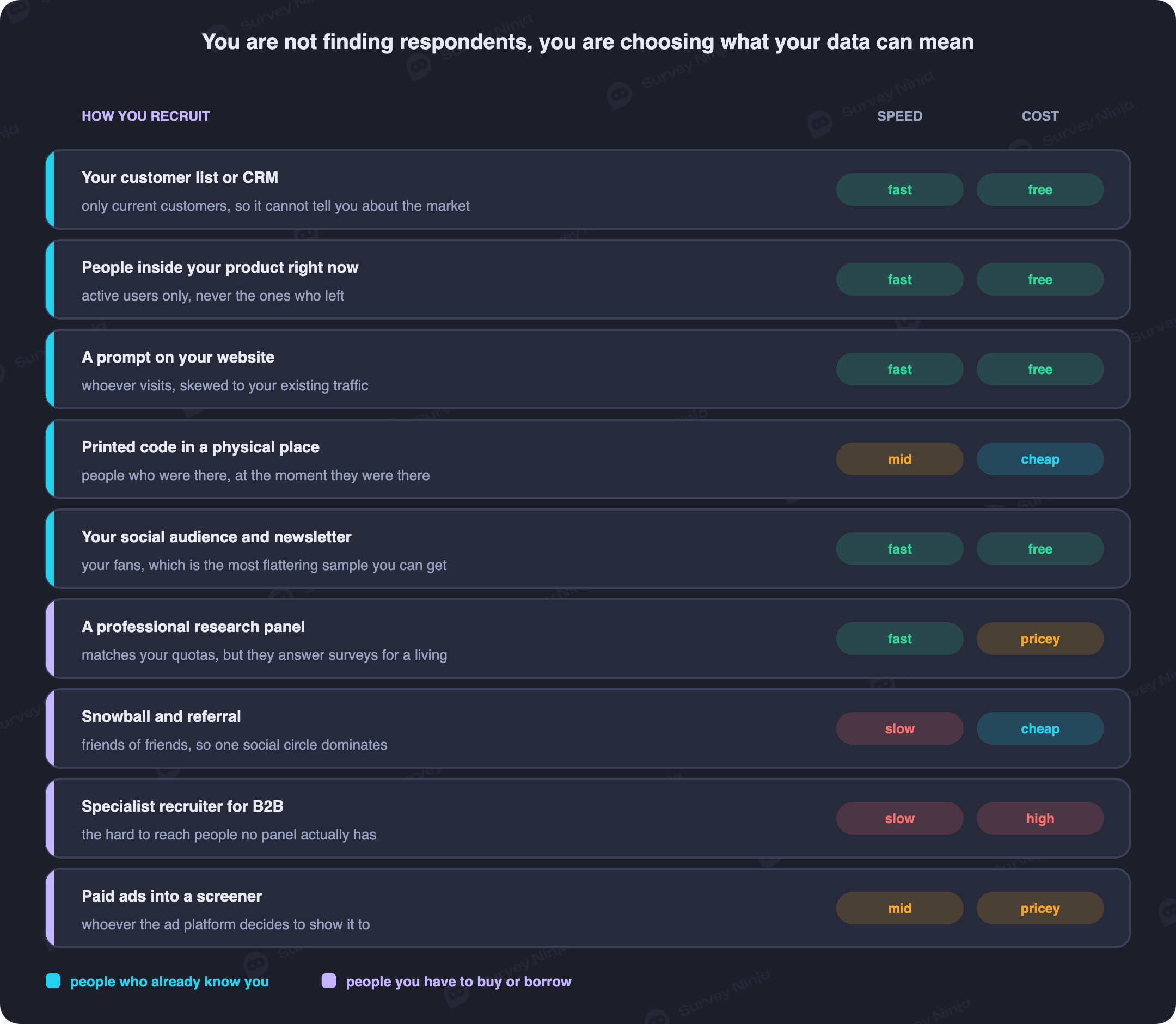
Your CRM reaches exactly the people you already sell to, close to free since you already have permission to contact them, and it moves in hours. The risk is a sample that skews toward whoever is engaged enough to open your email, so a churn study run only against active subscribers misses the people who left quietly. What it lets you claim is precise: how this list of customers feels, not how the market feels.
People using your product right now, intercepted inside the interface, give you the behavior and the opinion in the same moment. A prompt triggered by a real event, covered in triggered surveys, or a short question dropped into the flow as a micro survey, costs nothing beyond the engineering and runs continuously once built. The trade is a sample of people active enough to be in the product that day, which overweights heavy users and says nothing about people who quietly stopped logging in; timing and rate limiting for this channel are in in-app feedback.
Visitors to your site, intercepted by a popup survey form, reach further than your customer list because they include people who have never bought anything, useful for questions like why a cart was abandoned. It is live within a day and free beyond the tool, but only visitors motivated enough to answer an unsolicited prompt do, so the sample is self-selected twice over and tells you little about the much larger group who left without a word.
Offline intercept, a printed code posted where people already are, a receipt, a table tent, a conference badge, works when your audience is physically concentrated. QR code surveys and a well-timed guest feedback invitation cover the mechanics, extending naturally to event surveys at a conference. The cost is printing and staff time, and it is a convenience sample of whoever notices the code and has the phone and patience to scan it.
Your social audience, newsletter and community reach people who chose to follow you, a real advantage for product feedback and a real liability for market research, since they are fans by definition. An email survey to a subscriber list is the fastest and cheapest of the five to launch, but it is convenience sampling in its purest form. Treating community sentiment as market sentiment is one of the most common misreads on this list.
Reaching People Outside Your Own Audience
When the population you need does not already follow, buy from or use your product, you have to go get it, which costs real money and introduces real quality risk in exchange for reach you cannot get any other way.
Professional research panels, providers like Prolific, CloudResearch, Dynata, Qualtrics Panels, SurveyMonkey Audience, Toluna and Amazon Mechanical Turk among others, maintain a standing pool of people who signed up to take surveys for pay. They are the fastest way to reach a broad or specific demographic you have no other access to, often returning completes within days since the pool is already opted in. You pay per completed, qualified response, and that price moves with how rare your target is and how long your questionnaire runs. Panel quality varies enormously between vendors, and what the sample lets you claim depends on how tightly you screened and quota controlled it, not the panel's size.
Snowball and referral recruitment asks each respondent to refer people like them, often the only way into a genuinely hard-to-reach population: caregivers of a rare condition, members of a niche profession, participants in a market with no membership list anywhere. Snowball sampling is slow, cheap in cash but expensive in time, and referrals cluster around a few well-connected people, so the sample is not independent the way a probability sample is and you cannot honestly compute a margin of error on top of it. Treat what comes back as directional insight, not a number you defend in a boardroom.
Specialist recruiters exist for exactly the populations panels are bad at: senior professionals, narrow job functions, people meeting a rare criterion. Firms and marketplaces such as User Interviews, Respondent.io and expert networks like GLG vet by hand rather than by self-report, which is why they cost more per interview than a general panel. Academic and thesis research leans on the same channels when the population is narrow. What you get is a small number of genuinely qualified respondents rather than a large number of self-reported ones.
Paid ads pointing at a screener put your budget behind a platform's targeting instead of a panel's pre-built pool. It launches in an afternoon, but the traffic arriving is unqualified until your screener says otherwise, so a rare target population means paying for clicks that get screened out before a single question is answered. It sidesteps the professional-respondent problem below, at the cost of a screener that has to work harder because nothing upstream has already filtered anyone.
University, association and community pools give access to a population that already trusts the organization convening it: alumni, licensed professionals, hobbyist forum members. Reaching them means asking the organization to distribute your survey, slower to arrange but fast once approved, and it often costs nothing beyond an honorarium. The sample reflects that specific membership and skews toward whoever the organization typically activates, the right method when your question is about that population and the wrong one as a cheap stand in for a broader market.
| Method | Best for reaching | Speed | Cost shape | Main quality risk |
|---|---|---|---|---|
| CRM or customer list | Existing customers | Hours to days | Near zero, your time | Skews to the engaged |
| In-product intercept | Active users, in context | Continuous | Engineering time only | Overweights heavy users |
| Site intercept | Visitors, incl. prospects | Days | Free beyond the tool | Doubly self-selected |
| Offline intercept | People at a physical place | While the location is active | Printing and staff time | Undercounts the rushed |
| Social, newsletter, community | Followers and subscribers | One send | Free to low cost | Pure convenience sample |
| Professional panels | Broad or targeted demographics | Days | Per qualified complete | Professional respondents, fraud |
| Snowball and referral | Networks with no public list | Weeks | Cheap cash, costly time | Clustering, no valid margin of error |
| Specialist recruiters | Senior, technical, rare profiles | Days to weeks | High per interview | Small n, limited reach |
| Paid ads to a screener | Whoever the platform targets | Hours to launch | Per click, high screen-out waste | Unqualified traffic, bots on some platforms |
| University, association, community pools | A specific trusted membership | Slow to arrange, fast once live | Often free or an honorarium | Only reflects that membership |
How Many Responses You Need, and From Whom
Teams ask "how many responses do we need" as if the number were the hard part. It rarely is. A sample size calculator gives a defensible number in thirty seconds once you know your population, your desired margin of error and your confidence interval, and the logic of why that number only works under probability sampling is worth reading once so you know what the calculator is promising you.
The trade the calculator cannot make for you is who those responses come from. A biased sample of a thousand is worse than an honest sample of two hundred, not marginally but categorically, because the honest two hundred tells you something true about a narrower question and the biased thousand tells you something false with a spurious appearance of precision attached. Sample size reduces random error; it does nothing for response bias, and no amount of extra volume fixes a sample recruited from the wrong place.
In practice, decide recruitment method before response count, not after. If the method only reaches your newsletter subscribers, a larger number of responses from that list still only describes your newsletter subscribers, more precisely. Spend the marginal budget on a better method before spending it on more responses from a method you already know is skewed.
Writing a Screener That Doesn't Give Away the Answer
Most of the actual work in respondent recruitment happens in the screener, not the choice of channel, and it is the part teams rush the most.
A screening question must never make the correct answer obvious. "Do you manage a team of five or more people" tells anyone who wants in exactly what to type, and on a paid panel a meaningful share will type it whether or not it is true, because being screened out costs them nothing and being screened in pays. Ask for the same fact indirectly: list team sizes as one option among several, ask for job title and infer seniority afterward, or ask a behavioral question only a genuine match could answer correctly. Never state a qualifying criterion as a yes or no question when multiple choice can establish the same fact without announcing it, the same principle behind leading questions: any question that reveals what response you want gets that response.
Decide what qualifies before you write a single screening question, and never disclose it anywhere the respondent can see it, not in the invite, not in the question text, not in a progress bar that behaves differently for someone screened out. Panel professionals learn a platform's patterns quickly, and any tell becomes shared knowledge fast in the communities where they compare notes.
Quotas solve a different problem: even a good screener still lets through whichever qualifying group is easiest to reach. Without quotas, a study meant to represent five job functions in roughly equal numbers can come back eighty percent one function, simply because that function clicks through a panel invite fastest. Set a target count per segment; most panel and survey tools will hard stop a segment once its quota fills. Stratified sampling names the same problem from the sampling side rather than the recruitment side. Screener wording follows the same rules as any question on the instrument, covered in feedback form questions, and closed questions keep a screener fast and consistent across thousands of respondents in a way open text cannot.
Panel Fraud and the Data Quality Problem Most Articles Skip
Panel fraud is the topic most guides skip entirely, which is strange, because on an unscreened panel sample it is common for a meaningful share of raw completes to be unusable, and nobody who has run a real study for money is surprised by that.
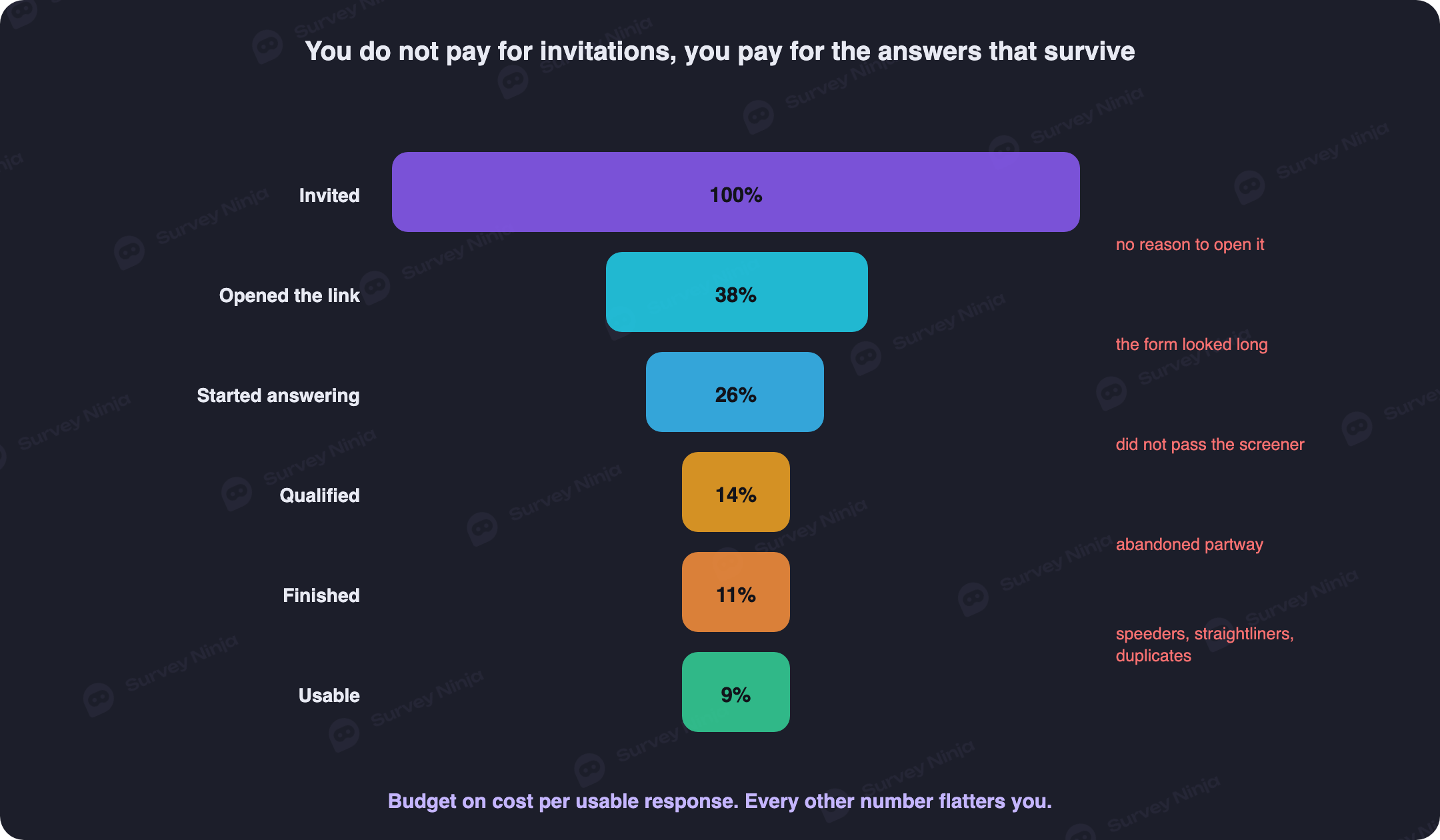
Name the failure modes, since each has a different defense. Professional respondents take surveys as income, optimizing for completing as many as possible, so they qualify for almost anything and answer fast without engaging. Duplicate identities let one person hold multiple panel accounts to be paid multiple times for the same opinion. Bots and VPN farms automate completion, or route a small number of real operators through many apparent locations to defeat geographic screening. Speeders finish in a fraction of the time a careful reader needs. Straightliners pick the same column down a rating grid without reading it. And open text increasingly arrives copy-pasted or AI-generated: fluent, clean, and empty of anything the respondent actually experienced.
The defenses cost little to add. An attention check instructs the respondent to do something specific inside an otherwise normal question, worded so a careless respondent fails without anyone attentive noticing it was a test. A minimum completion time, set from your own pilot rather than guessed, flags anyone who finished faster than a careful human plausibly could. A consistency check asks the same fact two different ways in two places; a single mismatch does not mean fraud, but a pattern across a respondent's whole set of answers usually does. Open text screening flags responses that are suspiciously fluent relative to that respondent's other answers, generic enough to fit any question, or repeated word for word from another respondent.
What actually protects a study is deciding removal rules before you look at the data. Write down which combination of failed checks, implausible time and inconsistent answers gets a response removed, and apply it uniformly, including to responses that support the conclusion you were hoping for. Decide after seeing results and you will keep the convenient failures and cut the inconvenient ones, a worse bias than anything the panel introduced on its own.
Incentives, and the Danger of Paying for Speed
What you offer shapes who shows up as much as any targeting criterion. A small cash or points incentive draws a wide cross-section; a prize draw draws people willing to gamble a minute of time on a small chance of a large reward, skewing younger and more casual about accuracy; a charity donation in place of payment draws people who care enough about the cause to accept a lower personal payoff, its own bias worth knowing rather than avoiding entirely.
The mechanism that damages data quality is not the amount, it is what the incentive is attached to. Pay for completing the survey and you have paid for speed, since the fastest route to the reward is clicking through without reading. The fix is not to remove incentives, which shrinks response rate and skews the remainder toward the unusually motivated. It is to decouple payout from raw completion: pay a flat amount for a genuine, timed attempt regardless of where someone screens out, and treat a suspiciously fast completion as ineligible for payment rather than paying it and hoping fraud checks catch it downstream. Gamified elements, points, progress, unlocked content, raise engagement without paying for speed the way cash does, covered in survey gamification. Disclose the incentive before the first question, since one discovered partway through changes how the rest gets answered.
B2B Respondents Are a Different Game
Everything above gets harder when the respondent is a director of IT procurement or a plant manager rather than a general consumer, and B2B research deserves its own treatment rather than a footnote.
Senior and technical professionals are scarce, protective of their time, and reasonably skeptical of anyone reaching them cold. General consumer panels are weak here structurally: they recruit broadly and screen down, and a self-reported title on a mass panel is among the easiest facts to fake, since the reward for qualifying is the same regardless of whether the claim is true. A study needing fifty genuine VP-level respondents on a general panel will attract far more people willing to claim the title than people who hold it.
Recruitment that verifies rather than merely asks works better. Your own customers and their known contacts are verified by the fact they bought from you in that role. Your sales team's contacts reach real decision makers who already have a reason to talk to you. Professional communities and associations carry implicit verification, since membership itself is a filter. Specialist B2B recruiters and expert networks verify employment directly, by phone or a work email, before anyone reaches your questionnaire.
Budget accordingly. Recruiting a genuine, verified B2B respondent typically costs several times a consumer panel complete, because the cost structure is verification and scarcity rather than volume. Teams that plan a B2B study on consumer-panel economics either run out of budget or end up with a sample that does not survive the first question about whether the claimed title actually checks out.
Rare and Sensitive Populations
Some populations are rare in the statistical sense before you even get to sensitivity: people managing a specific chronic condition, users of a niche professional tool. The math is unforgiving. If your target is one percent of the general population and your screener has to process a thousand contacts to find ten qualified respondents, the cost of every complete embeds the cost of the nine hundred and ninety screened out for nothing or for a token amount. That single number, the target's share of whoever you are screening, is usually the biggest lever on cost, more than sample size, more than length, more than the channel itself.
Sensitivity compounds it, because a population that is both rare and reluctant to self-identify, people with a stigmatized condition, survivors of a specific experience, will not be found reliably by broadening a general panel screener no matter the budget. The people who would answer honestly are exactly the people least likely to disclose the qualifying fact to a stranger's question.
The method that works better here is partnership over purchase: find the organization, clinic or support group that already has that population's trust, and ask them to distribute the study or vouch for it. That relationship does more for response rate and honesty than any amount of panel targeting, because the barrier was never technical, it was trust, and trust is not something you buy per complete.
What Respondents Actually Cost
Ask a panel vendor what a response costs and the honest answer is "it depends." The number worth tracking is cost per completed, qualified response, not cost per invite and not cost per click, since those upstream numbers hide most of the real spend inside the people who never finish or never qualified.
Two variables move that number most. Incidence rate, the share of whoever you screen who actually qualifies, sets a floor: a target that is one in twenty of the people you can reach costs meaningfully more per complete than one that is one in three, since you pay to screen out the rest either way, just at very different volumes. Questionnaire length is the second lever, because a longer survey means lower completion among people who started and often a higher per-respondent rate on panels that price partly by expected time. A short screener into a short survey against a common population is close to the cheapest research gets; a long survey against a rare, senior or sensitive population is close to the most expensive.
Model it before committing budget. Estimate incidence rate from what you already know, estimate length in minutes, and price a small pilot batch, fifty to a hundred completes, before the full run. The pilot tells you the true incidence rate rather than your guess, usually the biggest source of a budget running over, and gives the completion-time data the minimum time check needs.
The Legal and Ethical Floor
A handful of baseline obligations apply regardless of method, though the specific rules that implement them differ by country, industry and regulation, so verify what actually governs your situation rather than treating anything below as legal advice.
Do not buy or scrape a list of contacts who never agreed to be contacted by you specifically; a panel respondent opted into that panel, not into every buyer of a dataset built from public profiles. Get real informed consent before the questionnaire starts, meaning the respondent understands what the study is about, how long it takes and what happens to their answers. Allow withdrawal at any point without penalty. Say plainly who you are and why, since an unnamed sender reads as phishing as often as it reads as research. Honor every unsubscribe immediately and permanently.
If part of your promise is anonymity, keep that promise in fact, not only in the invitation text; what the word requires, including how a survey quietly stops being anonymous through small sample sizes or identifying combinations of demographic questions, is covered in anonymous surveys. Treat data protection as something to check for your respondents' actual locations, since rules on consent, storage and deletion rights differ between jurisdictions and change more often than teams expect. When a study crosses borders, check the rules where the respondents actually live, not just where your company is based.
Which Method to Reach for First
Put a budget, a deadline and a target population against each other and the right first move usually becomes obvious.
Population is your existing customers, deadline short: start inward, your CRM, an in-product prompt or a support queue will beat any external method on speed and cost. Population is broad and general with real volume needed against a tight timeline: a professional panel with a carefully written screener and quotas is the fastest external route, provided you budget for the fraud defenses above rather than trusting a panel's own quality claims. Population is narrow, senior or technical, meaning any B2B study: skip general panels and go straight to your network, sales contacts, relevant communities and a specialist recruiter, since money saved on a cheaper channel gets spent twice over on a sample that does not hold up. Population is rare or sensitive: price an early pilot, and look at a partnership with a trusted organization before assuming a bigger budget solves reach. Study genuinely needs to represent the general population with defensible precision: read probability sampling before choosing a channel, since most methods here, panels included, are convenience samples dressed up with quotas.
Rule out a method as readily as you choose one. Rule out your social audience the moment the question is about anyone who is not already a fan. Rule out a general panel the moment the respondent needs to be senior or verified in a way self-report cannot establish. Rule out snowball recruitment the moment you need a number you can defend statistically rather than interviews to learn from. Rule out any method, however cheap, the moment you cannot describe in one sentence what the sample will let you claim.
Wherever the respondents come from, the questionnaire itself still has to be built well: screener logic that branches without revealing itself, hidden fields that carry quota and source data, a place for the answers to land in a report you can read. That is what SurveyNinja's features are for, from a ready screener template through quota-aware branching to filtered reporting, on a plan with no cap on responses so a panel returning faster than expected never hits a wall mid fielding. Build the questionnaire first, then decide where the answers come from.
Common Mistakes
- Reaching for a panel before checking your own list. A question about your customers has a faster, cheaper answer in your CRM.
- Writing a screener that gives away the right answer. Any yes or no qualifying question gets answered yes by anyone motivated to qualify.
- Skipping quotas. A well-screened sample can still come back eighty percent one segment because that segment was easiest to reach.
- Treating a large N as a substitute for a good sample. A biased thousand is worse than an honest two hundred, not better.
- Deciding removal rules after seeing the data. That is how convenient fraud gets kept and inconvenient answers get cut.
- Paying per completion with no time floor. That pays for speed, the opposite of what you wanted to measure.
- Running a B2B study on consumer panel economics. Verified senior respondents cost several times more, and budgeting otherwise means running out of budget.
- Confusing your community's opinion with the market's. Your most engaged followers represent only themselves.
- Skipping the pilot. A small batch is the only reliable way to learn real incidence rate and completion time before the full budget commits.
Frequently Asked Questions
Where is the best place to find survey respondents?
Not a place. It is whichever recruitment method actually reaches the population your question is about: your own customer list and product for questions about existing customers, a professional panel for a broad population you have no other access to, and a specialist recruiter or your own network for senior or rare respondents. The method decides who answers, so choose it before you choose a vendor.
What is the difference between a survey panel and your own customer list?
Your customer list reaches people who already chose your product, for close to nothing, and only tells you what that group thinks. A panel reaches a broader or more specific population you do not otherwise have access to, at a real cost per response, and only represents that population as accurately as your screening and quotas make it. Neither substitutes for the other.
How many survey responses do I need?
Less than most teams assume, and the number matters far less than who the responses come from. A sample size calculator gives a defensible count from your margin of error and confidence interval in under a minute, but that count only holds under proper probability sampling; a large sample from the wrong place is still the wrong sample, just with more confident-looking decimals.
How do I write a screening question that people cannot game?
Never state the qualifying criterion as a direct yes or no question, since anyone motivated to qualify will simply say yes. Ask for the underlying fact indirectly, through a multiple choice list, a job title, or a behavioral question only a genuine match could answer correctly, and never reveal anywhere in the invite or interface what the correct answer is.
What is panel fraud and how do I catch it?
Professional respondents who answer everything, duplicate accounts, bots and VPN farms, speeders, straightlining, and copy-pasted or AI-generated open text. Catch it with an attention check worded so a careless reader fails it, a minimum completion time set from your own pilot data, a consistency check that asks one fact two different ways, and open-text screening, then apply removal rules written down before you look at the results.
Should I pay respondents to complete a survey?
Yes, but pay for a genuine timed attempt rather than for raw completion, or the incentive rewards speed over thought. Disclose the incentive before the first question, and treat a suspiciously fast completion as ineligible for payment rather than paying it automatically and hoping fraud checks catch it later.
Why is B2B respondent recruitment so much more expensive?
Senior and technical professionals are scarce, guard their time, and are easy to fake on a self-report panel where claiming a title costs nothing. Recruiting real ones means verification, through your own customers, sales contacts, professional communities or a specialist recruiter that confirms employment directly, and that verification drives the cost several times above a general consumer panel complete.
Is it legal to buy a list of people to survey?
Do not buy or scrape a list of people who never agreed to be contacted by you specifically. Get informed consent before the questionnaire starts, allow withdrawal at any time, identify yourself clearly, and honor every opt-out. Rules on consent and data handling differ by country and regulation, so verify what applies to your respondents' actual locations rather than assume.
Published: Aug 26, 2026