


25 Questions for a Construction Customer Satisfaction Survey
Useful  Mike Taylor Oct 16, 2026 Reading time ≈ 15 min

A construction customer satisfaction survey records how clients experience a building project: the scope, communication, changes, workmanship and handover. This guide provides 25 questions to choose from at different stages, a worked example with missing answers, and a process for turning feedback into follow-up.
A finished building and a satisfied client are different outcomes. A homeowner may like the finish yet feel that nobody explained delays, while a commercial client may accept the work and still remain unhappy about how additional costs were approved, so the survey needs to separate the result from the experience. The next conversation needs a specific subject.
The questions below are an original, editable bank, not a validated construction assessment or a technical inspection checklist. Select the relevant module for the project. SurveyNinja's page for construction companies describes the broader use case; this guide supplies the questions and a way to interpret them.
Decide whose experience the survey should represent
For a small builder, the simplest unit is one client response per project at each checkpoint. Agree who represents the client: a homeowner, the person commissioning a renovation, or the buyer's nominated project contact. Asking five people on one project and one on another gives the first project more influence. If several roles need separate questionnaires, report them separately.
Keep the project stage alongside the response. A midway score and a handover score describe different moments, even when they come from the same person. Repeated answers from that client do not become several independent projects. Likewise, a developer managing multiple sites may provide several project-level responses but still represents one business relationship.
Before collecting feedback, explain who will read the answers and how a concern will be followed up, because a project code that helps the coordinator contact the right client also means the response can be linked back to a person. That is a confidential survey. Avoid promising anonymity when the project, comments or small client list make the person obvious. Removing the name field is not enough; the guide to anonymous surveys explores it further.
Ask at checkpoints where an answer can change something
Before work starts, ask about clarity. Once construction is underway, focus on the recent experience and unresolved concerns, saving questions about the finished work and the explanation of what happens next for the handover stage, when the client has enough information to judge those aspects. On a long project, repeat a short check at a meaningful milestone. The full questionnaire is rarely needed every week.
Timing affects what the client can judge. The UK national new-homes survey, described by NHQB, uses an eight-week check after moving in and another nine months after completion. Those are programme-specific timings, not a universal schedule for every contractor.
For a renovation, a check shortly after the agreed handover discussion may fit better. Later, ask about the handling of reported issues once there has been time to experience it. Choose the timing in advance and include clients with difficult projects as well as smooth ones.
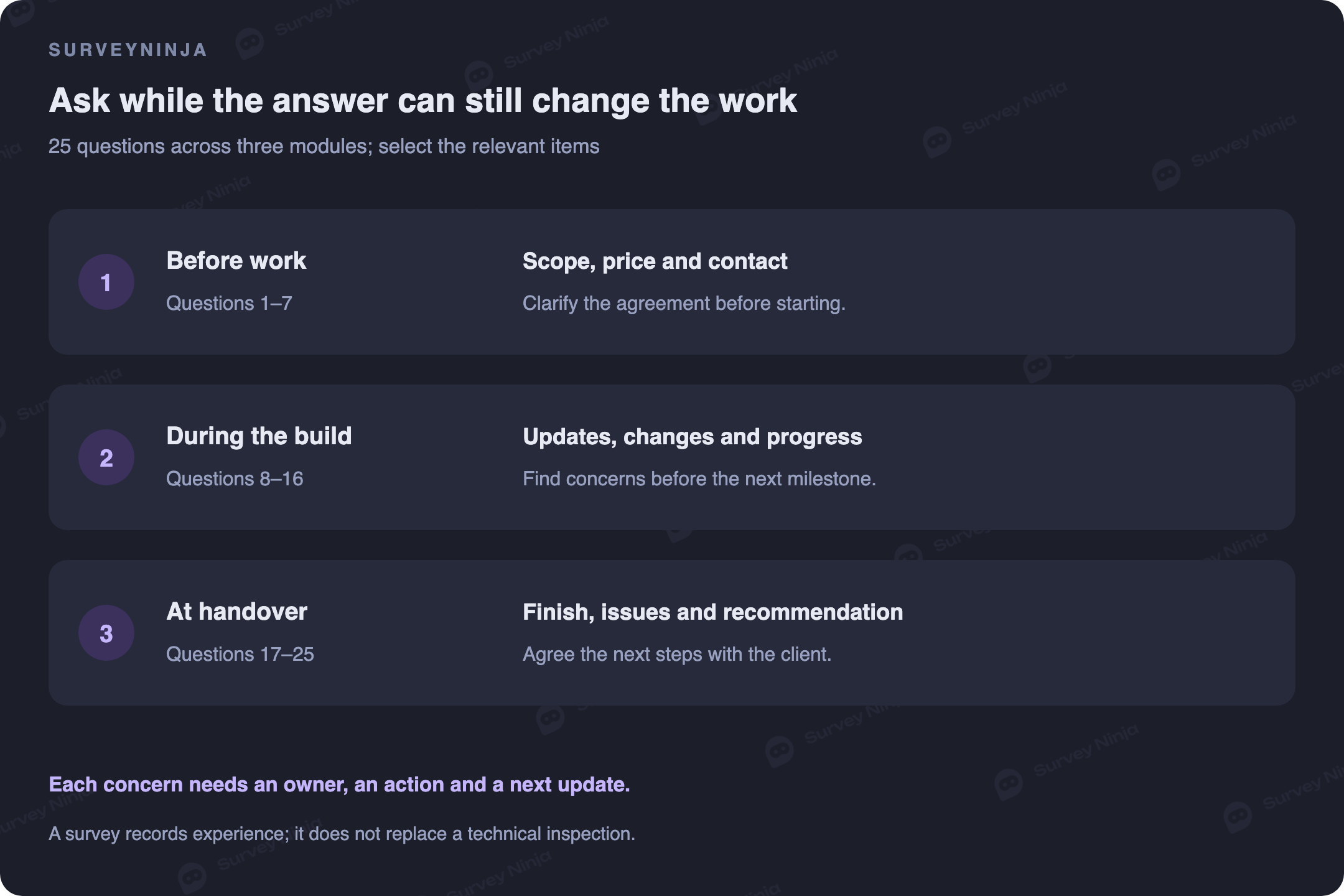
25 construction client survey questions
The bank contains seven questions for the start, nine for the build and nine for handover, allowing the coordinator to select the items a client can answer at the current stage and remove topics that do not apply to a straightforward job. Sending all 25 three times is unnecessary.
For clarity items, label all five choices: not at all clear, slightly clear, moderately clear, very clear, completely clear. For satisfaction items, use very dissatisfied, dissatisfied, neither satisfied nor dissatisfied, satisfied, very satisfied. Both run from 1 to 5, but they measure different things. Keep the labels visible; do not combine the two into one score. See the rating scale examples for other labelled options.
Before construction: clarify the agreement
Questions 1–6 use the clarity scale. Question 7 is optional free text. A low clarity rating should prompt an explanation while the plan can still be adjusted.
- How clear is the scope of work described in our proposal?
- How clear is which work is excluded from the project?
- How clear is what the quoted price covers?
- How clear is the process for approving additional work?
- How clear are the main milestones in the proposed schedule?
- How clear is who to contact with a question about your project?
- What should we explain more clearly before work begins?
These questions check understanding, not agreement with every term. A client can understand a price and dislike it. If the aim is to investigate that distinction, discuss the concern directly rather than treating a clarity score as approval of the quote.
During the project: find concerns while they can be addressed
Questions 8–15 use the satisfaction scale. Add “not applicable” where an event has not occurred, particularly for schedule or price changes. State the reference period, such as the period since the previous milestone.
- Overall, how satisfied are you with the project so far?
- How satisfied are you with how often you receive progress updates?
- How satisfied are you with how clearly those updates explain progress?
- How satisfied are you with the response to questions you have raised?
- How satisfied are you with the notice given about schedule changes?
- How satisfied are you with the explanation of proposed price changes before you decide?
- How satisfied are you with the care taken around your existing property?
- How satisfied are you with progress against the current agreed schedule?
- What needs attention before the next project milestone?
Questions about update frequency and clarity are separate on purpose. Daily messages may still leave the client confused. Asking whether communication is “frequent and clear” would hide which part needs work. For a vacant new-build site, the question about existing property may be irrelevant and should be omitted.
At handover: review the result and the next steps
Questions 17–21 use the satisfaction scale. Question 22 uses the clarity scale, question 23 uses a separate recommendation scale, and the final two are optional comments. Offer “not applicable” for issues the client has not reported.
- Overall, how satisfied are you with the completed project?
- How satisfied are you with the visible finish and workmanship?
- How satisfied are you with the communication during handover?
- How satisfied are you with the maintenance information provided?
- How satisfied are you with how the issues you reported have been handled?
- How clear is how to report a problem after handover?
- How likely are you to recommend our company to someone planning a similar project?
- What should we keep doing on future projects?
- What one thing should we improve?
For question 23, use 0, not at all likely, through 10, extremely likely. Keep that answer separate from the 1–5 satisfaction items. None of these questions replaces a professional inspection, a defect record or the agreed acceptance process. They record the client's experience.
Invite clients without turning feedback into a favour
Use the same invitation rule for all eligible projects, including jobs with delays, disputed changes or open concerns, so the results do not simply reflect the clients a site manager feels most comfortable asking or those expected to leave a high score. Attention must not depend on the rating. Where possible, let the client answer without the person being evaluated watching.
A straightforward invitation is enough: “We would like your feedback on the project so far. The questions concern communication, progress and anything needing attention. Participation is optional. The project coordinator will review your answers and explain the next steps if you request a follow-up.” Adapt the role and reference period to the actual process.
Send a reminder to people who have not answered if the collection method allows that distinction. Stop when they decline. Keep a direct route for urgent concerns outside the survey, and do not ask the client to wait for a reporting cycle. A survey is a listening channel, not a replacement for contact.
Read the answers with their denominators
In this invented handover example, invitations go to 12 eligible projects and nine forms come back, giving a 75% project return rate, while the blank rating fields within those nine forms mean that each individual question needs a separate valid base. The other three clients' views remain unknown.
| Item | Valid | 4 or 5 | Share |
|---|---|---|---|
| Overall satisfaction | 8 | 5 | 62.5% |
| Finish and workmanship | 8 | 6 | 75.0% |
| Communication | 7 | 2 | 28.6% |
Communication here means the handover communication in question 19, so all three rows concern the same stage. “Satisfied” means a rating of 4 or 5: five divided by eight for overall satisfaction, six divided by eight for workmanship, and two divided by seven for communication. Exclude missing and not-applicable answers from that item's denominator; neither is a dissatisfied rating.
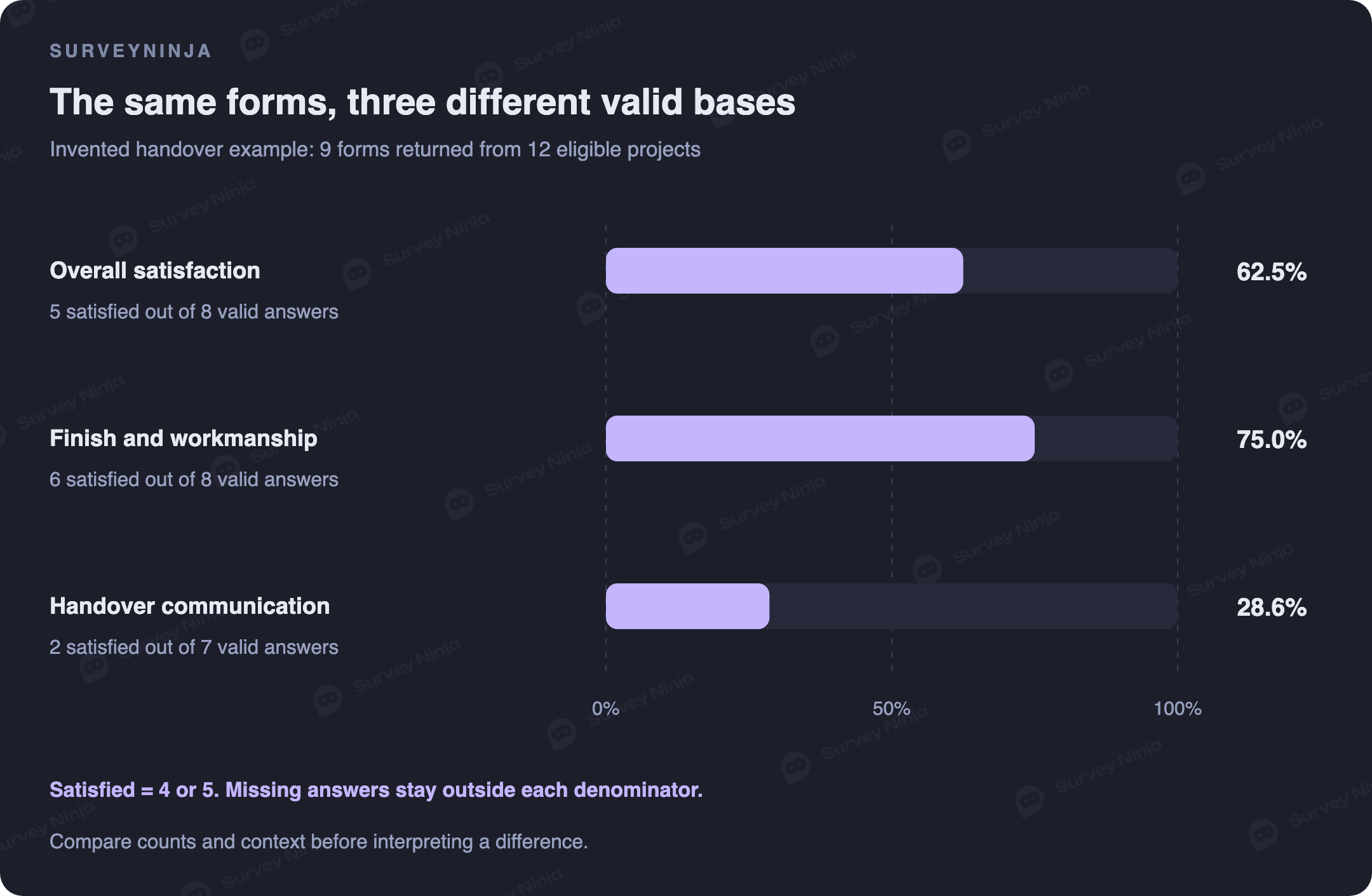
Communication deserves a closer look, but the table does not prove it caused the overall score. Ask what happened and check the update records. A study by Forsythe (2015) followed service experiences during a single Australian housing case. It offers useful context for looking during construction, not a universal performance benchmark.
Keep counts beside percentages. If one existing overall rating changes from 3 to 4, the satisfied share moves from 5/8 to 6/8, or 62.5% to 75%, without any change in the other seven ratings or any new evidence about the wider client base. One answer creates that movement. Pool comparable projects over time when necessary. Keep the stage and wording consistent.
Reproduce the example
The following CSV contains nine fictional project records. Blank cells mean missing answers. Overall, quality and communication run from 1 to 5; recommendation runs from 0 to 10. These are teaching data, not SurveyNinja customer results.
project,overall,quality,communication,nps
P01,5,5,5,10
P02,5,5,4,9
P03,4,4,3,9
P04,4,4,3,8
P05,4,4,2,8
P06,3,4,2,7
P07,2,3,1,6
P08,1,,,4
P09,,2,,
The eight recommendation answers contain three promoters, three passives and two detractors. NPS is therefore (3/8 − 2/8) × 100 = +12.5, about +13 when rounded to a whole number. Report the base of eight alongside it. One passive moving to promoter would add 12.5 points, so this is a conversation starter rather than evidence of an industry-leading score. The NPS guide explains the categories.
Turn an answer into a visible next step
For each concern, record an owner, the next action and an agreed update date. If a client cannot understand a proposed change, explain its scope and price before requesting a decision. If progress messages arrive late, agree who sends them and when. A low rating alone does not identify the remedy.
Keep the response process separate from public reviews. Do not route only satisfied clients to a review site while sending everyone else into a private channel. Ask for honest feedback consistently, and obtain separate permission before publishing a testimonial or identifiable comment.
An internal report should show the period, project stage, invitations, returned forms and valid counts, particularly when a manager wants to compare teams whose projects differ in complexity, client expectations or the amount of work already completed when the survey was sent. One or two jobs cannot establish a reliable league table. Use the answers to guide follow-up.
Build the questionnaire in SurveyNinja
Start with a blank survey and name the project stage in the introduction. The public feature overview lists single-choice questions, scales, text fields, direct links and response filters. These cover a simple version of the questionnaire; a specialist construction template is not required.
Add the selected questions in their intended order. Use separate choices for “not applicable” instead of making it the numeric midpoint. Keep comments optional. If project-level follow-up is needed, explain the project identifier and who can see it. Use a separate, optional contact request only where the collection process actually needs one.
Before inviting clients, test the finished form on a phone and submit a clearly marked internal test response that checks the scale labels, questions without a relevant answer and the instructions a client would follow to raise a concern about the project. Exclude that test from the client results. Then share the survey link through the agreed project communication channel.
When reading results, separate stages and calculate the valid base for each item. The worked CSV above can be checked in a spreadsheet without assuming a particular export button or plan. For the general setup process, see how to create an online survey, or start building a survey.
Frequently asked questions
What should a construction customer satisfaction survey measure?
Measure the client's experience of scope clarity, communication, changes, progress, visible workmanship and handover. Keep satisfaction separate from professional inspection results and contractual acceptance.
Should all 25 questions be sent at once?
No. They are a question bank: seven before construction, nine during the project and nine at handover. Choose the relevant module and remove questions the client cannot yet answer.
Who should answer the questionnaire?
Nominate one client contact per project and checkpoint for a simple project-level report. If several stakeholders respond, keep their roles visible and avoid counting their answers as separate projects.
Can the survey be anonymous?
Only if the collection and reporting process genuinely prevent identification. Project codes, detailed comments and a small client list can reveal a person even without a name field. Describe an identifiable survey as confidential.
How should missing or not-applicable answers be counted?
Exclude them from the valid denominator for that item. Report the number of valid answers and the number rated 4 or 5 alongside the percentage. Do not turn an unanswered question into a zero.
What is a good satisfaction score for a contractor?
There is no universal target in this guide. Compare the same questions at the same stage across comparable projects and show the counts. A handful of responses is too unstable for a confident industry ranking.
Does a low score prove the work is technically defective?
No. It records the client's experience and warrants investigation. Technical inspections, issue records and the agreed process for resolving defects remain separate sources of evidence.
Can this questionnaire be built in SurveyNinja?
The simple questionnaire uses question formats and link sharing described in SurveyNinja's public feature guide. Select a project-stage module, test the form and check the current account settings before collecting client answers.
Published: Oct 16, 2026