


HOA Survey: Questions for Homeowners, Response Rates and Budget Priorities
Useful  Mike Taylor Oct 14, 2026 Reading time ≈ 15 min

An HOA survey asks homeowners how their community is run: maintenance, common areas, communication, fees and what the association should spend on next. Below are 29 ready questions, the national numbers to compare with, and a way to turn the answers into a short list of priorities before the board sets next year's budget.
The board decides, the community manager or management company carries the decisions out, and homeowners pay for both through their assessments. A survey is the one channel where every household gets the same questions, not just the people who come to meetings or write long emails. If you would rather start from a ready form, the HOA survey template can be edited to match the questions below.
What homeowners think of their associations: the national numbers
Community associations are not a niche. According to the Foundation for Community Association Research, the United States had about 373,000 of them in 2025, covering 29.6 million homes and 78.1 million residents. Homeowners associations make up roughly 58 to 63 percent of them, condominiums 35 to 40 percent and cooperatives the rest.
The same foundation commissions a national homeowner satisfaction survey every two years. The 2026 edition, run by Zogby Analytics among 3,000 respondents from February 26 to March 14 with a margin of error of plus or minus 1.8 points, found that 86% rate their overall association experience as positive or neutral. 82% say their board serves the best interests of the community, and 75% say their community manager provides value and support. The 2024 edition added two findings that matter for surveys. 70% of respondents said they attend board meetings, and 62% would attend more often if remote options were consistently available. 63% said the rules in their community protect and enhance property values.
These are national averages. They tell you what is normal, not how your own community is doing, and that second question is what your survey answers.
What an HOA survey is for, and what it is not
A good HOA survey does three jobs. It ranks what homeowners want the association to spend on, it checks how well the manager and contractors deliver, and it shows whether the board's decisions are understood. The first job is the reason to run it every year, because the answers feed straight into the budget.
It is not a vote. Formal decisions follow your governing documents and state law, and a survey result does not replace a ballot, however lopsided it is. It is not a maintenance queue either. A homeowner who reports a leaking roof in a survey comment will wait weeks for anyone to read it, so point people to the normal request channel. And it is not a way to find out who complains. The moment residents suspect that, honest answers stop.
HOA survey questions
Most statements below use a five-point agreement scale from strongly disagree to strongly agree, with a word on every point. Our page of rating scale examples has the labels ready. Cut any block that does not apply to your community, and keep the rest in this order.
1. Overall experience
- Overall, how satisfied are you with living in this community? Very dissatisfied to very satisfied.
- How well is the association run? Very poorly to very well.
- How likely are you to recommend this community to a friend looking for a home? 0 to 10.
The last question uses the Net Promoter Score format, so the NPS calculator can turn the answers into one number you can track from year to year.
2. Board and communication
- I know how to reach the board and the community manager.
- The board explains the reasons behind its decisions.
- Meeting notices and minutes reach me in good time.
- The board serves the best interests of the community as a whole.
3. Management and maintenance
- When I report a problem, I get a reply within a reasonable time.
- Repairs in common areas are done right the first time.
- I know whom to contact for each kind of problem.
- Staff and contractors are courteous to residents.
4. Services and amenities: importance and satisfaction
- How important is each of the following to you? Not at all important to extremely important, for each item.
- How satisfied are you with each of the following? Very dissatisfied to very satisfied, for the same items.
Use one list for both questions: security and access control, roads and parking, communication from the board, cleanliness of common areas, landscaping, the pool, the clubhouse and events, plus anything else your community maintains. Put the importance question early and the satisfaction question later in the survey. John Martilla and John James, who introduced this pairing in 1977, recommended exactly that separation, because answering both in one breath lets the first answer color the second.
5. Safety
- I feel safe walking in the community after dark.
- Gates, key fobs and visitor entry work as they should.
6. Fees and finances
- I understand what my assessments pay for.
- The assessments are fair for the services we receive.
- The financial reports are clear enough for me to follow.
7. Rules
- The community rules are clear.
- Rules are enforced fairly and consistently.
- The rules help protect property values.
8. Community life and meetings
- I feel part of this community.
- I would attend more board meetings if I could join online.
- I would join a committee if asked.
9. Priorities
- Rank these projects in the order you would fund them. For example: road resurfacing, security cameras, pool renovation, landscaping, clubhouse upgrade, a bigger reserve fund.
10. Open questions
- What is the one thing the association should improve next year?
- Is there anything else the board should know?
11. About you
- Do you own or rent your home?
- How long have you lived in the community? Less than a year, 1 to 3 years, 4 to 10 years, more than 10 years.
Keep the profile block short. Every extra question about the respondent makes the answers easier to trace back to a household.
Who should answer: owners, renters and households
Decide this before you send anything. Owners pay the assessments and vote, so priority and fee questions are theirs. Renters live with the landscaping, the parking and the noise rules every day, and in some communities they are a large share of residents. A sound compromise is to invite both and add the own-or-rent question, so you can read owners' priorities separately and still hear from everyone. Our guide to cross-tabulation in surveys shows how to compare the two groups side by side.
Count households, not people. If a family of four answers four times, their priorities count four times against a single neighbour's. For the budget questions, one response per household is the fair rule, and the survey setup should enforce it rather than rely on good manners.
How to get homeowners to respond
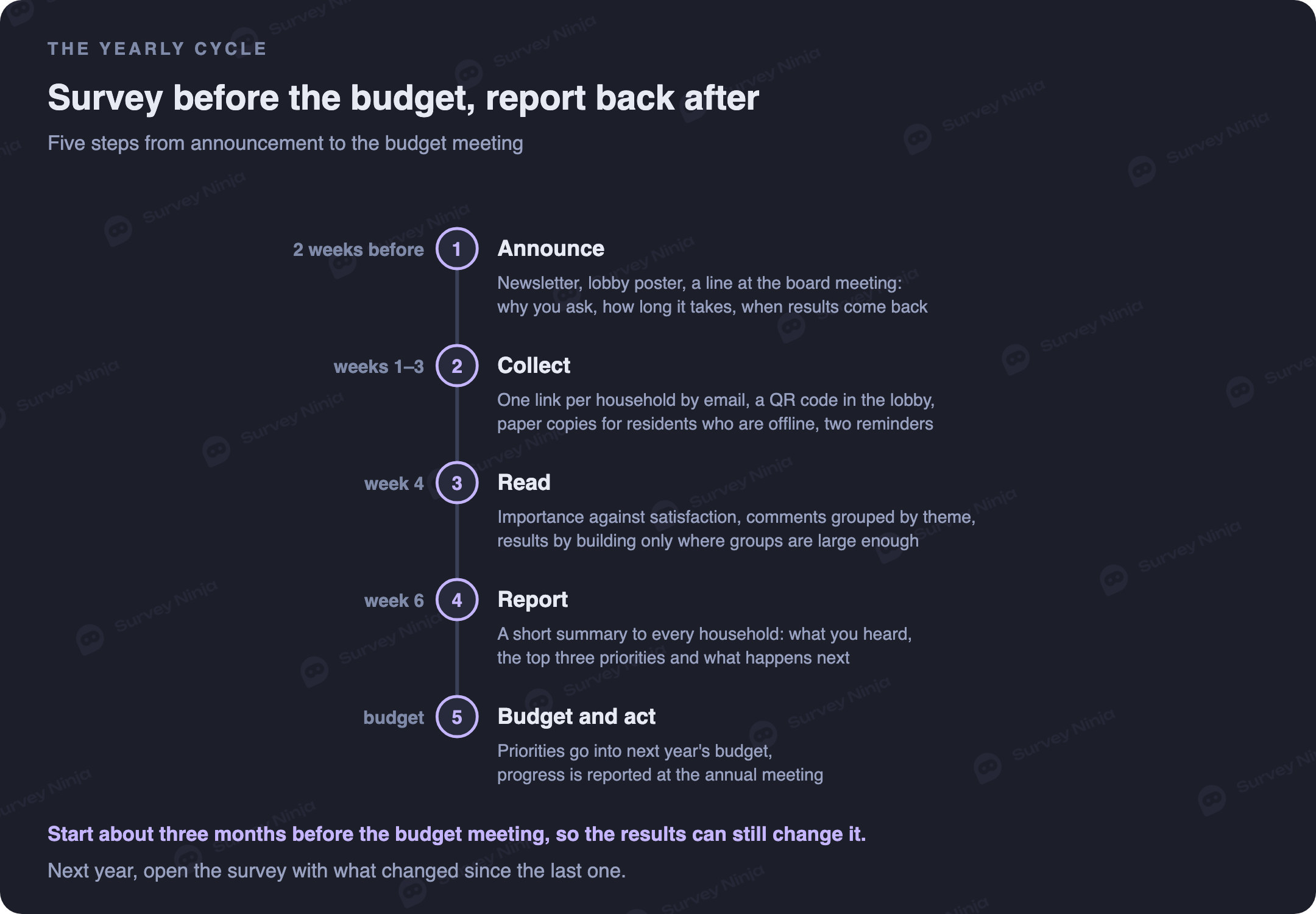
Residents answer when they believe the survey changes something. Say why you are asking, how long it takes and when results come back, and say it before the survey opens. Then make the survey impossible to miss.
- Email with a personal link for every household that has an address on file. Our note on email surveys covers subject lines and timing.
- A QR code on the lobby notice board, in the mailroom and in elevators. Our guide to QR code surveys explains placement.
- Paper copies for residents who do not use email, entered by the manager afterwards.
- A line at the board meeting and in the newsletter, with the closing date.
Three weeks with two reminders is a reasonable window. Keep the survey short enough to finish in one sitting; our article on reducing survey dropout lists what makes people quit halfway. The timing matters as much as the channels. Run the survey well before the budget meeting, or the results arrive after the decisions they should have shaped.
Anonymous or confidential: be honest about which
In a community, a unit number is a name. That leaves two honest options, and you should tell residents which one you chose.
An anonymous survey uses one open link or QR code and collects nothing that identifies a home. People speak more freely, but you cannot guarantee one answer per household, and you cannot follow up on a specific problem. A confidential survey sends each household its own link. That enforces one response per home and lets the manager check which households have not answered yet, but someone can technically connect answers to a unit, so the promise becomes "only the manager sees individual answers, and the board sees totals". Calling the second kind anonymous is the fastest way to lose residents' trust. Our guide to anonymous surveys explains the difference in detail.
Either way, apply a minimum group size. Five to seven responses is a common working floor. Results by building or street below that size point at specific households, so merge small groups or leave them out of the report.
How to read the results: importance against satisfaction
Start with the importance and satisfaction pair from block 4. For each item, take the share of households that called it very or extremely important, and the share that answered 4 or 5 on satisfaction. Plot one against the other and draw a line through the average of each axis. Here is an invented community of 300 homes where 126 households answered, a response rate of 42%.
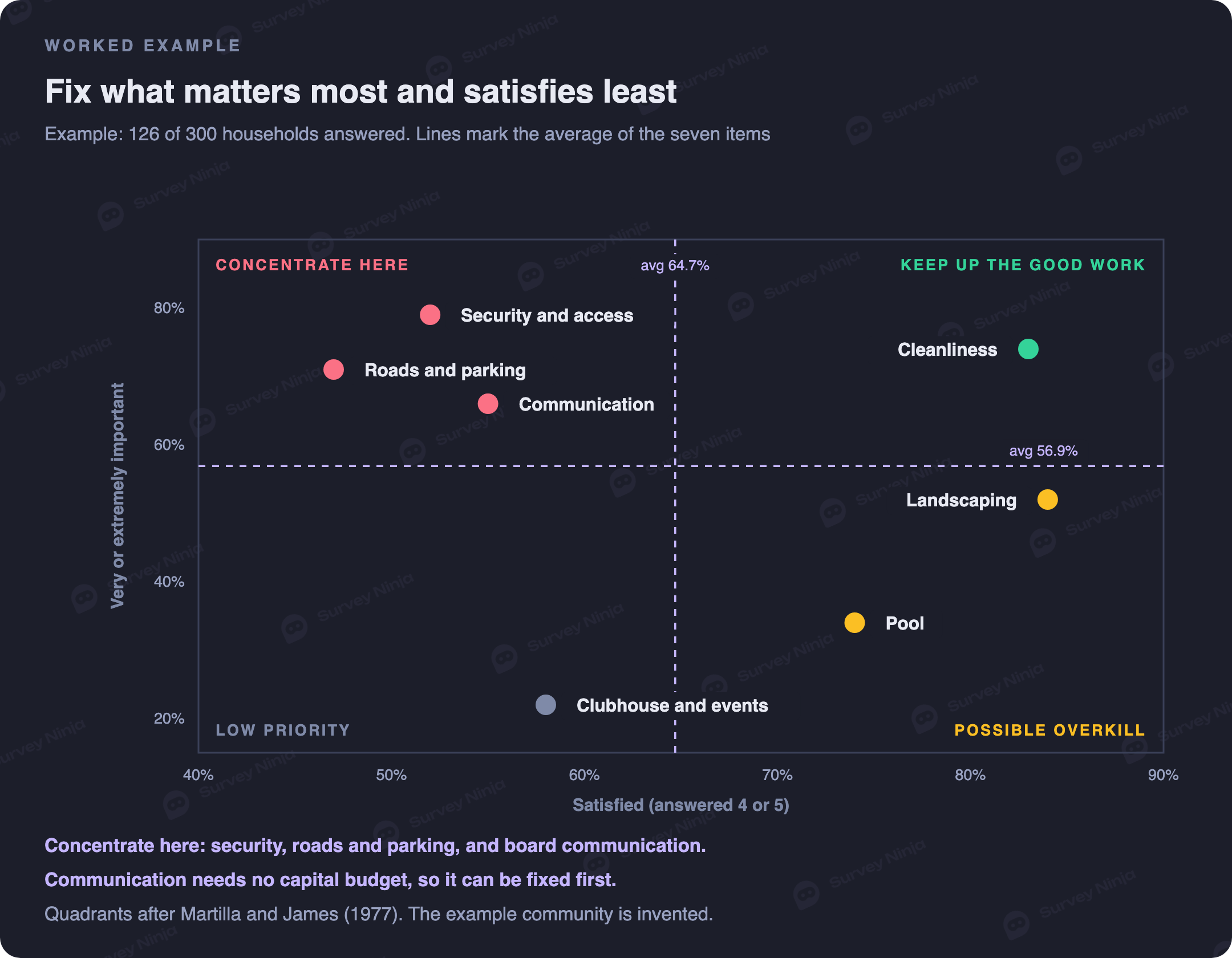
Martilla and James called the top left corner "concentrate here": high importance, low satisfaction. In this example it holds security and access (79% very important, 52% satisfied), roads and parking (71% and 47%) and board communication (66% and 55%). Cleanliness sits in "keep up the good work" at 74% and 83%. Landscaping and the pool land in "possible overkill", well liked but less important, which is a reason not to add spending there, not a reason to cut it. The clubhouse is "low priority" at 22% important.
Read the corner with judgment. The original paper says where to put the dividing lines is itself a judgment call, and that the method shows relative rather than absolute levels. Here the lines sit at the averages of the seven items, 56.9% for importance and 64.7% for satisfaction. Then add cost. Communication sits in the same corner as roads, yet it needs a better newsletter and a meeting summary, not a capital project, so it can be fixed this month.
Finish with the open answers. Group them by theme, and our note on open and closed questions shows a simple way to do it. Count how many households raised each theme, and use the comments to explain the numbers in the report, never to identify who wrote them.
Report back to every household
Send a one-page summary within a month. Say how many households answered, what scored best and worst, which three priorities came out on top and what the board will do about each one. Present the same page at the annual meeting. A year later, open the next survey with what changed since the last one. Residents who see their answers turn into a repaved road answer the next survey too.
How often to survey homeowners
Once a year is the core rhythm, timed a few months before the budget meeting. Between annual surveys, two short formats help. One is a single question after a repair is closed, asking whether it was fixed right. The other is a short pulse after a big project, such as a pool renovation or a new security contractor. Keep the annual questions identical from year to year, or the trend lines mean nothing.
Common mistakes
- Running the survey after the budget is already set.
- Calling a survey anonymous while sending personal links.
- Letting one household answer several times on the spending questions.
- Treating a survey result as a vote.
- Asking about amenities the community does not have.
- Publishing results for a building with four households.
- Never reporting back, then wondering why next year's response rate fell.
How to run an HOA survey in SurveyNinja
Start from the HOA survey template or build the survey from the questions above. Use the Scale element for the statements, a ranking question for the projects and open text at the end. For a confidential survey with one answer per household, pass a household code in a hidden variable in each personal link and turn on repeat protection by that variable. For an anonymous survey, generate a QR code from the published link and post it in the lobby. Report filters split results by owners and renters or by section, and the export goes straight into the board packet. Managers who run several communities can see more on our page for property management companies. You can start building for free.
Frequently asked questions
What is an HOA survey?
It is a questionnaire that a homeowners association sends to residents about how the community is run: maintenance, common areas, communication, fees, rules and spending priorities. The results help the board set the budget and check how well the manager and contractors deliver.
What questions should an HOA survey ask?
Start with overall satisfaction, then ask about the board and communication, management and maintenance, the importance and quality of each service, safety, fees, rules and community life. Add a ranking of possible projects, two open questions and a short block about the respondent.
How do you get homeowners to respond to an HOA survey?
Announce it in advance and say how the results will be used. Send each household a personal link, post a QR code in common areas, offer paper copies and send two reminders over about three weeks. Report the results back, because that is what brings people back next year.
Should an HOA survey be anonymous?
It can be anonymous or confidential, as long as you say which. An anonymous survey uses an open link and collects nothing that identifies a home. A confidential one uses personal links, enforces one answer per household and lets only the manager see individual answers.
Can an HOA survey replace a vote?
No. Formal decisions follow the association's governing documents and state law. A survey shows what homeowners think and helps the board prepare a proposal, but it does not replace a ballot.
How often should an HOA survey be conducted?
Once a year, a few months before the budget meeting, with the same questions each time. Short follow-ups after repairs or big projects can fill the gaps between annual surveys.
Published: Oct 14, 2026