 25 Questions for a Travel Agency Customer Satisfaction Survey
Hotel Guest Satisfaction Survey: What to Ask, When to Send It and How to Use the Answers
Useful  Mike Taylor Oct 2, 2026 Reading time ≈ 13 min
A hotel guest satisfaction survey shows what guests liked and what went wrong during their stay. The most useful version is not one long questionnaire after checkout. It is three short touches: a question on the first evening, while you can still fix things, a survey after checkout and an invitation to leave a public review.
Below you will find 35 questions grouped by stage of the stay, a ready 10-question post-stay survey, the timing and channel for each survey and the rules for asking for reviews on Google, Tripadvisor and Booking.com. For questions that fit any type of business, see our list of 50 customer satisfaction survey questions.
Three surveys for one stay
Each survey has a different job, so each one is short and arrives at a different moment.
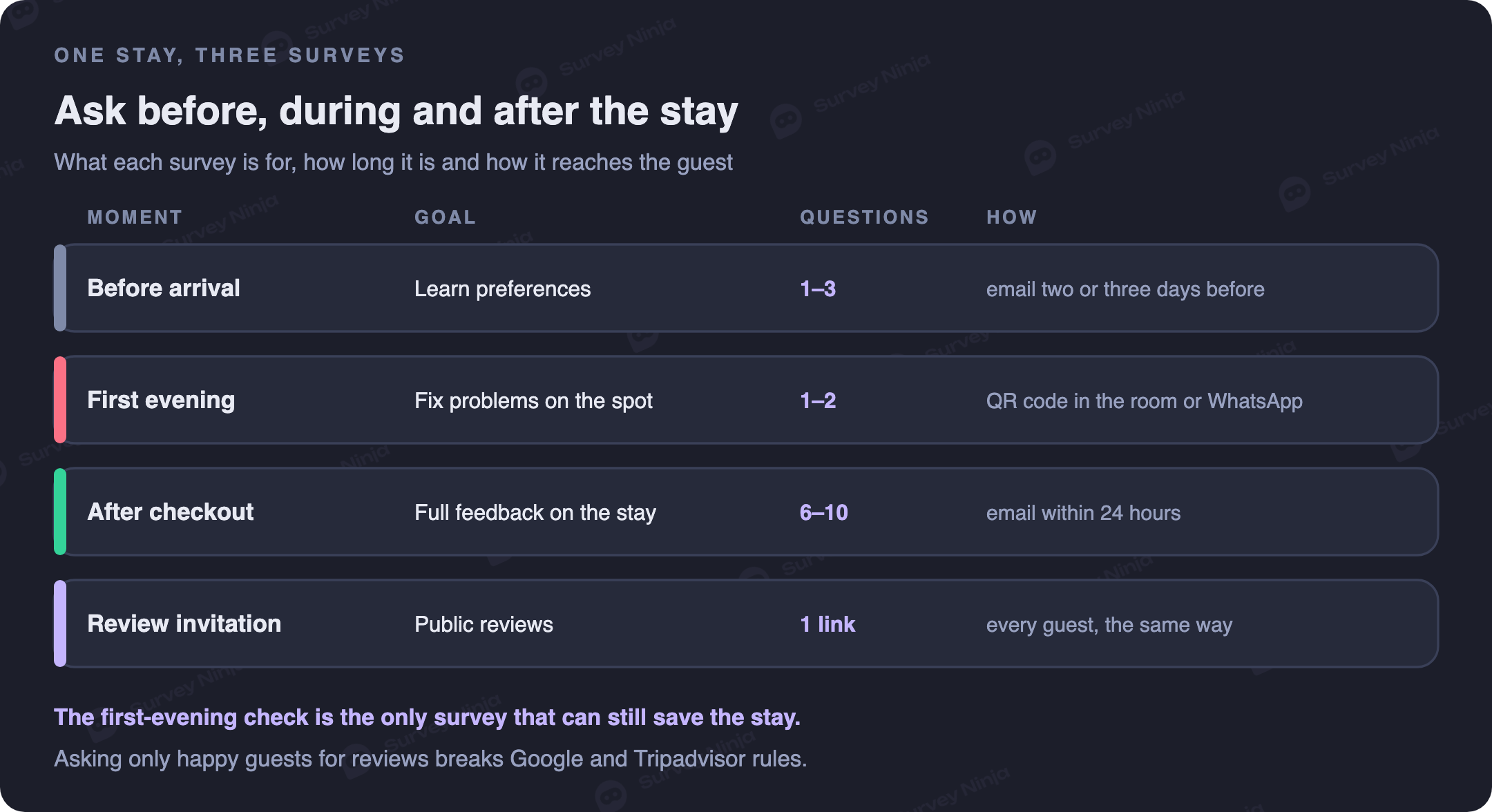
The pre-arrival survey is optional: one to three questions about arrival time, bed type or a special occasion, sent by email two or three days before the stay. It is less about satisfaction than about getting the first impression right.
The first-evening check is the one most hotels skip, and the most valuable. One or two questions on the first evening or the next morning, through a QR code in the room or a WhatsApp message, catch a broken air conditioner or a noisy room while the guest is still in the hotel. A problem fixed on day one is a problem the guest no longer has to write about. One you only hear about after checkout can no longer be fixed.
The post-stay survey collects the full feedback: six to ten questions by email within 24 hours of checkout, while the details are still fresh. The review invitation goes to every guest in the same way, for reasons covered further down.
Questions for the first-evening check
Keep it to two questions and a box for details, and route every low answer to the front desk at once.
- How is your stay so far? (1–5, from "very poor" to "excellent")
- Is everything in your room working as it should? (yes or no, with a text box for no)
- Is there anything we can do to make your stay better? (open answer, with a field for the room number)
The value of this survey is in the reaction, not in the report. If a guest answers 1 or 2, someone from reception should call or knock within the hour. Set up an alert so the answer reaches the duty manager right away.
Post-stay survey: 32 questions by area
Pick eight to ten of these for your survey. The ready set below shows one combination. "1–5" means a labeled five-point scale from "very dissatisfied" to "very satisfied". Add a "did not use" option to every service that not every guest uses, such as breakfast, parking or the spa.
Overall
- Overall, how satisfied are you with your stay? (1–5)
- How likely are you to stay with us again? (1–5, from "very unlikely" to "very likely")
- How likely are you to recommend our hotel to a friend or colleague? (0–10, the NPS question)
Booking and arrival
- How easy was it to book your stay? (1–5)
- Where did you book? (our website, Booking.com, Expedia, a travel agency, by phone, other)
- Did the hotel match the photos and description you saw when booking? (yes, partly, no)
- How satisfied are you with the check-in? (1–5)
- Was your room ready when you arrived? (yes, no)
Room
- How satisfied are you with the cleanliness of your room? (1–5)
- How comfortable was your bed? (1–5)
- How quiet was your room at night? (1–5, from "very noisy" to "very quiet")
- Did the air conditioning or heating work as you needed? (yes, partly, no)
- How satisfied are you with the bathroom? (1–5)
Staff and service
- How friendly and helpful was our staff? (1–5)
- Did you ask the staff for anything during your stay? (yes, no)
- Was your request handled to your satisfaction? (yes, partly, no; shown only after a yes to question 18)
Food and drink
- How satisfied are you with the breakfast? (1–5 or "did not have breakfast")
- How satisfied are you with the choice of food at breakfast? (1–5 or "did not have breakfast")
- How satisfied are you with the restaurant or bar? (1–5 or "did not use")
Amenities and location
- How satisfied are you with the Wi-Fi? (1–5 or "did not use")
- How satisfied are you with the pool, gym or spa? (1–5 or "did not use")
- How satisfied are you with the parking? (1–5 or "did not use")
- How satisfied are you with the hotel's location? (1–5)
Value and checkout
- How satisfied are you with the value for money? (1–5)
- How satisfied are you with the checkout? (1–5)
- Was there anything on your bill you did not expect? (yes or no, with a text box for yes)
About your trip
- What was the main purpose of your trip? (leisure, business, event or wedding, other)
- Who did you travel with? (alone, partner, family with children, friends, colleagues)
- Was this your first stay with us? (yes, no)
Open questions
- What did you like most about your stay? (open answer)
- What one thing should we improve before your next visit? (open answer)
- May we contact you about your answers? (yes, with a contact field, or no)
A ready 10-question post-stay survey
If you want one survey to send tomorrow, take these ten: 4 (overall satisfaction), 12 (cleanliness), 13 (bed), 17 (staff), 20 (breakfast), 23 (Wi-Fi), 27 (value for money), 6 (NPS), 34 (what to improve) and 35 (permission to contact). Ten questions is about the limit for a post-stay email, and this set covers the main parts of a stay.
Leave out what you already know. The booking channel, room type and stay dates are in your booking system, so pass them into the survey automatically instead of asking question 8. The templates on our hotel surveys page give you a starting point you can edit.
How to ask for reviews without breaking the rules
A survey is private feedback, and a review is public. Hotels often try to connect the two by sending only happy guests on to Google or Tripadvisor and keeping unhappy ones in an internal form. That practice, known as review gating, breaks the rules of the main platforms:
- Google. Its Maps content policy forbids businesses to selectively ask satisfied customers for reviews or to discourage negative ones. It also forbids offering discounts, free goods or services in exchange for a review, and asks businesses not to pressure customers to leave reviews while on the premises.
- Tripadvisor. Its guidelines forbid selectively soliciting positive reviews and offering or promising anything in exchange for a review, whatever its rating.
- Booking.com. Only guests who booked through Booking.com can review a property there, within three months of checkout, and properties may not post on behalf of guests or offer incentives. A survey cannot turn a direct booking into a Booking.com review.
The safe pattern is simple. Send the same review invitation to every guest, whatever they answered in your survey, or send it separately from the survey. Solve problems during the stay through the first-evening check, so fewer guests leave unhappy in the first place.
When and how to send each survey
- QR code in the room or on the key card holder for the first-evening check. Our guide to QR code surveys covers placement and design.
- Email within 24 hours of checkout for the post-stay survey, with one reminder a few days later. Our guide to email surveys covers subject lines and timing.
- WhatsApp or SMS with a survey link, where guests are more likely to read a message than an email.
If your guests come from different countries, prepare the survey in each of your main guest languages and send each guest the link in their language. A guest who struggles with the language of the survey may skip it or answer less precisely.
How to read the results
Look at each area as the share of guests who rated it 4 or 5, which is the CSAT for that area.
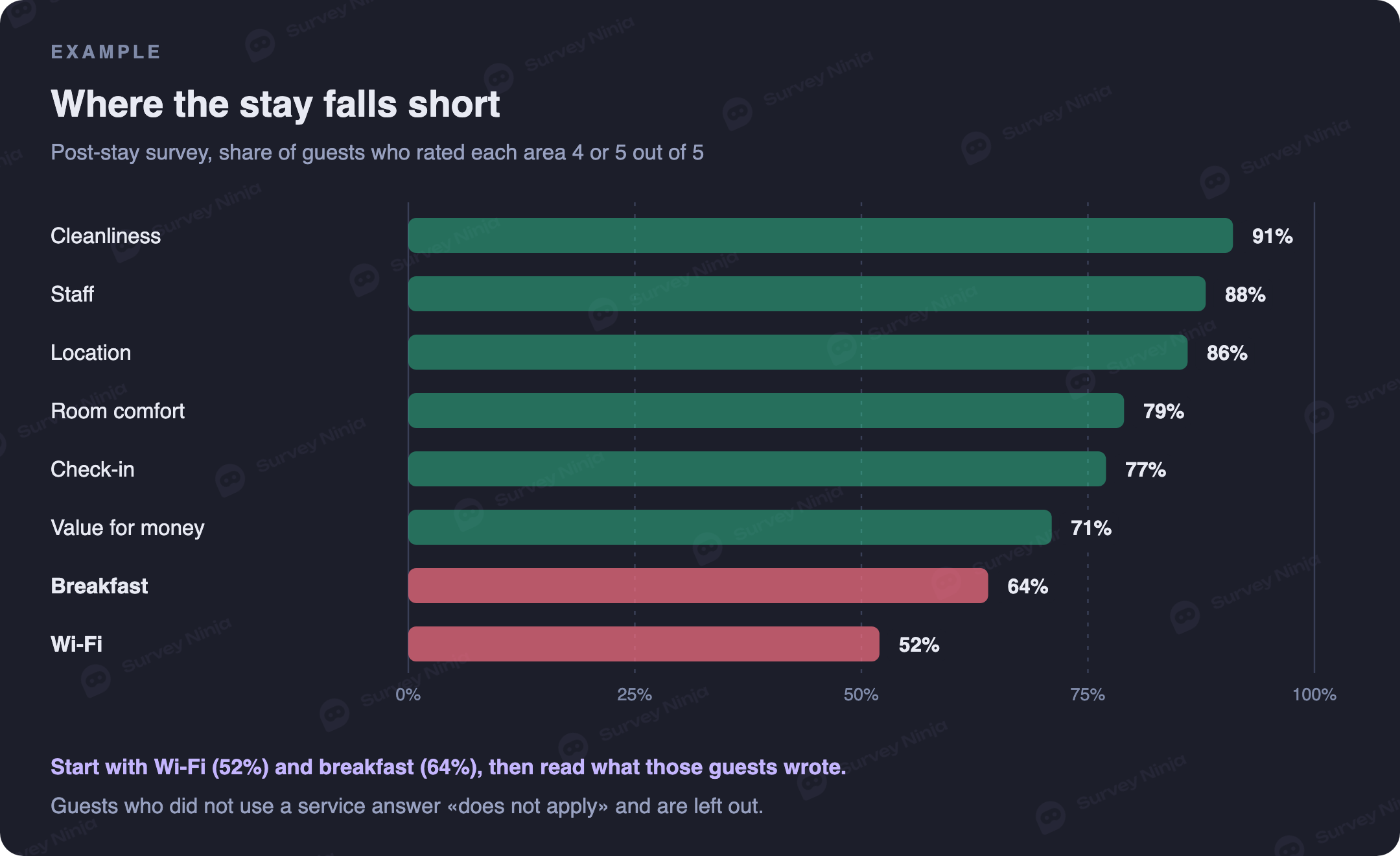
In this example, Wi-Fi at 52% and breakfast at 64% trail everything else. Start there, and read what those guests wrote before deciding what to change. A low Wi-Fi score can mean a weak signal on one floor or a password nobody could find, and the fix is different for each.
Then split the results by room type, floor, season, booking channel and purpose of the trip. Business travelers and families notice different things, and one average across both hides it. Track the same questions month by month and treat small changes with caution, since a few points up or down can be noise. The CSAT calculator and the NPS calculator turn raw answers into scores. If you want one index that weighs the areas by importance, see our guide to the customer satisfaction index. To sort open answers into themes, use our guide to thematic analysis.
Close the loop with guests and staff
A survey that changes nothing teaches guests to stop answering. Three habits keep it useful:
- Reply to unhappy guests. Contact every guest who gave a low score and agreed to be contacted in question 35. A personal reply from the manager within a day or two shows the answer was read, and it can bring out details the survey missed.
- Share the results every week. Show housekeeping, reception and the kitchen the scores for their area and two or three comments, good and bad. Staff who see guest comments know what to fix without waiting for a manager's summary.
- Tell guests what changed. If you replaced the breakfast coffee machine or boosted the Wi-Fi on the third floor after complaints, say so in the pre-arrival email. Returning guests notice, and it gives everyone a reason to answer the next survey.
Common mistakes in hotel guest surveys
- Only one long survey after checkout, when nothing can be fixed any more.
- No "did not use" option, so guests rate a spa they never visited.
- Asking for the booking channel or stay dates instead of passing them automatically.
- Sending only happy guests on to review sites.
- Offering a discount or an upgrade for a review.
- Looking at the average score instead of the weakest areas.
- Never telling the staff what guests said, good or bad.
How to run hotel guest surveys in SurveyNinja
Build the first-evening check and the post-stay survey from the questions above or from the templates on our hotel surveys page. Generate a QR code for the rooms and send the post-stay link by email or messenger. Hidden fields pass the room number, room type, stay dates and booking channel with every answer, so guests never have to type them. A low score from the first-evening check can trigger an alert in Slack or Telegram for the duty manager. Reports show CSAT and NPS automatically, filters and crosstabs split them by room type or season, and the answers export to XLSX or CSV. The service quality use case shows the same setup for other touchpoints, and you can start building for free.
Frequently asked questions
What questions should a hotel guest satisfaction survey include?
Start with overall satisfaction and the likelihood to return, then rate the areas guests care about most: cleanliness, bed comfort, staff, breakfast, Wi-Fi and value for money. Finish with one open question about what to improve. Eight to ten questions are enough for a post-stay survey.
When should a hotel send a guest satisfaction survey?
Send a one- or two-question check on the first evening of the stay, so problems can be fixed while the guest is still there, and the full survey by email within 24 hours of checkout.
How many questions should a hotel survey have?
One or two for the in-stay check and six to ten for the post-stay survey. Leave out questions about data you already have, such as the booking channel or the stay dates.
Can a hotel ask guests for reviews on Google and Tripadvisor?
Yes, as long as every guest gets the same invitation. Both platforms forbid asking only satisfied guests for reviews and offering anything, such as a discount or an upgrade, in exchange for one.
Can a hotel send guests to review it on Booking.com?
Only guests who booked through Booking.com can review a property there, within three months of checkout. A survey cannot turn a direct booking into a Booking.com review.
How do you measure hotel guest satisfaction?
Use the share of guests who answer 4 or 5 on a five-point scale, the CSAT, for the stay overall and for each area. Add NPS for loyalty, and compare the results by room type, season and booking channel.
Published: Oct 2, 2026