
In-Store Customer Survey: Questions for Clothing, Grocery and Other Retail Stores
Useful  Mike Taylor Oct 21, 2026 Reading time ≈ 13 min
A retail store survey asks shoppers about the visit they just made: whether they found what they came for, how the staff helped, how long they waited at the checkout and whether they will come back. Below are 27 ready questions, a three-question version for the counter, and a way to read the answers by stock and by hour of the day.
The questions work for clothing stores, supermarkets, pharmacies, electronics and most shops where people walk in, choose and pay. Store-specific blocks for clothing and grocery come after the core set. If you want a starting point, we have pages for clothing store surveys and grocery store surveys, and a ready supermarket satisfaction survey template.
What shoppers rate highest and lowest in stores
The American Customer Satisfaction Index publishes the largest public benchmark for US retail. Its 2026 retail study is based on 31,293 surveys of customers contacted at random by email during 2025. On its 0 to 100 scale, supermarkets scored 78, general merchandise retailers 79 and specialty retailers 80.
The breakdown for supermarkets is more useful than the headline. Convenience of store hours scored 85, layout and cleanliness of the store 83, availability of merchandise 82 and courtesy and helpfulness of staff 81. Speed of checkout tied for the lowest score, 79. General merchandise stores rated checkout speed 79 too, below staff courtesy at 81. In the national data, the checkout is one of the weakest parts of a store visit, so it gets its own block in the survey below. Treat these numbers as context. Your own survey tells you which part of the visit fails in your store.
Follow the shopper: what to ask at each step
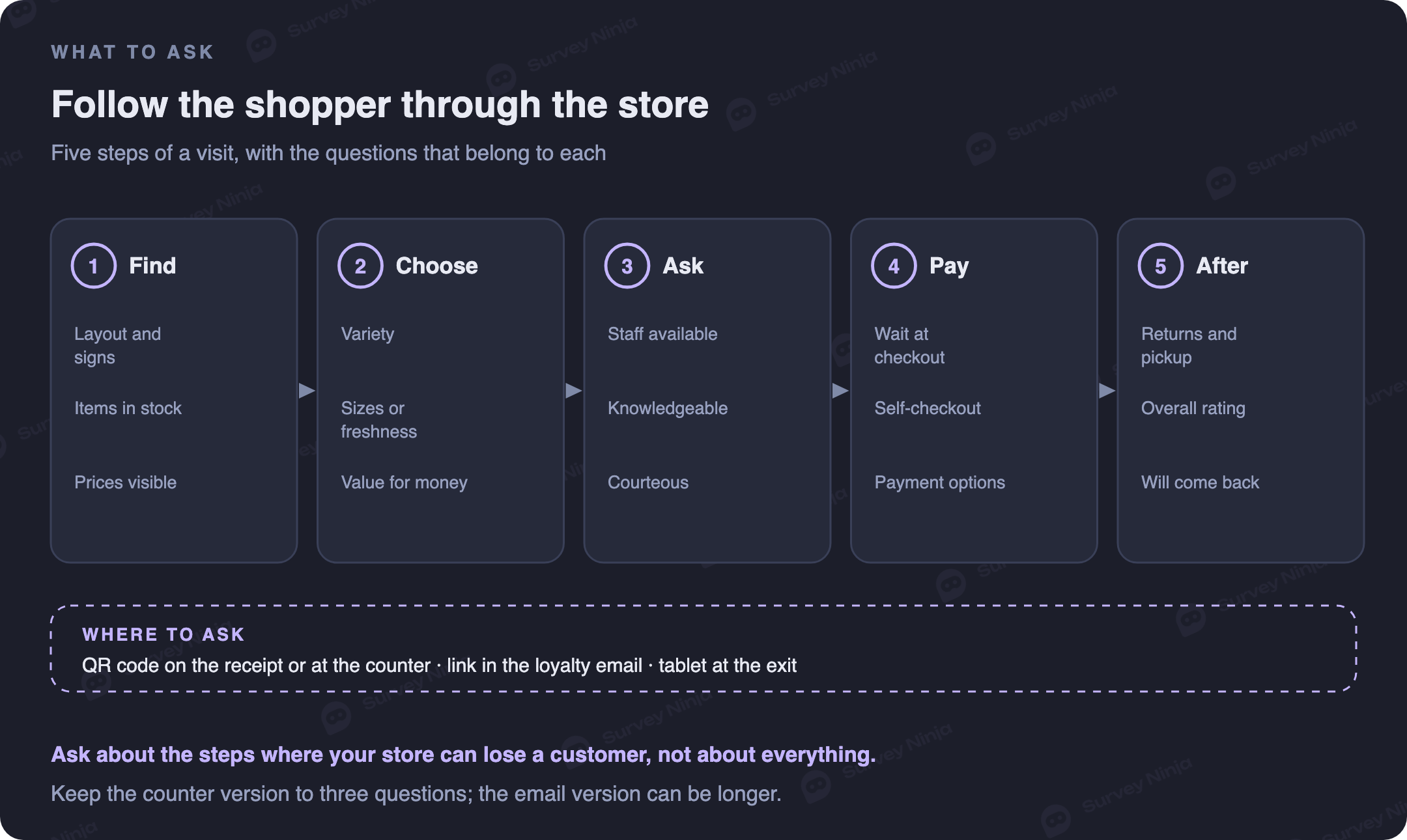
A visit has five steps: finding the product, choosing it, asking for help, paying, and whatever happens afterwards, such as a return or an online order picked up in the store. Each step has its own way to disappoint a customer, and each needs a different fix. Group the questions the same way and the results will point at a step, not just at a mood.
Retail store survey questions
Statements use a five-point agreement scale from strongly disagree to strongly agree, with a word on every point; our page of rating scale examples has the labels. Add a "did not use" option wherever a shopper may have skipped that part of the visit, such as the fitting room or self-checkout.
1. About the visit
- What did you come in for today? A specific item, browsing, a gift, a return or pickup, something else.
- Did you find everything you came for? Yes, partly, no.
- What were you looking for and could not find? Open text, shown only to those who answered partly or no.
2. Finding your way
- The store layout made it easy to find what I needed.
- Prices were clearly marked.
- The products I wanted were in stock.
3. Staff
- A staff member was available when I needed help.
- Staff knew the products well.
- Staff were courteous.
4. Checkout
- How satisfied are you with the time you waited at the checkout? Very dissatisfied to very satisfied.
- If you used self-checkout, how easy was it? Very difficult to very easy, or "did not use".
- I could pay the way I wanted to.
The self-checkout question measures effort rather than satisfaction. Our guide to the customer effort score explains how to read it.
5. The store itself
- The store was clean and tidy.
- The store was a pleasant place to shop.
6. Price and value
- Prices are fair for the quality.
- Promotions and discounts were easy to understand.
7. Overall and coming back
- Overall, how satisfied are you with today's visit? Very dissatisfied to very satisfied.
- How likely are you to recommend this store to a friend? 0 to 10.
- How likely are you to shop here again? Very unlikely to very likely.
8. For clothing stores
- The sizes I needed were available.
- The fitting rooms were clean and easy to get into.
- The return and exchange policy is clear.
9. For grocery stores
- Fruit, vegetables and meat were fresh.
- The items I buy every week were on the shelf.
- The store carries the brands I usually buy.
10. Open questions
- What is one thing that would make your next visit better?
- Is there anything else you want us to know?
Nobody should see all 27. Use the core blocks for every store, add the clothing or the grocery block, and drop the rest.
The three-question version for the counter
A shopper who scans a QR code at the till has a bag in one hand and about twenty seconds. For that moment, use three questions: overall satisfaction with the visit, whether they found everything they came for, and one open question about what would make the next visit better. Our note on micro-surveys explains why short forms get finished, and our guide to QR code surveys covers where to put the code: on the receipt, on the card terminal and at the exit, not in a corner of the window.
Save the long version for an email after a purchase made with a loyalty card or for an online order picked up in the store. People open those at home, and they have the time.
Who gets asked: avoid a skewed sample
The most common error in store surveys is not the wording. It is who gets the invitation. A QR code printed on the receipt reaches only people who bought something. The shopper who walked out because the size was missing never gets a receipt, so a receipt-only survey can look rosier than it should on availability. Put a code or a tablet near the exit as well, and keep the "found everything?" question in every version.
Three more traps are worth guarding against.
- Loyalty members only. Email surveys reach people who joined the program, and they are usually the store's fans. Read them separately from walk-in answers.
- Staff choosing who to ask. If cashiers hand the QR code only to friendly customers, the score measures the cashiers' judgment. Print it on every receipt instead.
- One time of day. A survey that runs only in the morning misses the evening rush, which is when checkout complaints pile up. Keep it running across days and hours.
Decide also whether answers are anonymous. A survey linked to a loyalty account is not anonymous, and shoppers should be told so. Our guide to anonymous surveys explains the difference.
When to run it: always on, plus before and after a change
Keep the three-question counter version running all the time. It costs nothing once the code is printed, and a steady stream of answers shows a bad week while it is still happening. Run the long email version as a wave once or twice a year, with the same questions each time.
The most useful moment of all is a change in the store: a new layout, more self-checkouts, a pickup counter for online orders. Measure for four weeks before the change and four weeks after it, with the same questions and the same channels. The 2026 ACSI study links store redesigns with better scores at several chains. Fred Meyer, which renovated stores in 2025, rose 9% to 82, and Walmart's redesign with new signage, more selection and expanded online pickup came with a 4% rise to 76. A national index cannot prove that the redesign caused the gain. Your own before-and-after survey at least tells you whether your shoppers noticed it.
If you offer online orders picked up in the store, survey those customers separately. Ask how easy the pickup was and whether the order was complete, because their visit has little in common with a walk-in shopper's.
How to read the results
Start with two cuts. First, split overall satisfaction by the answer to "did you find everything you came for?". Second, split checkout complaints by the hour of the visit. Here is an invented store with 400 answers in one month.
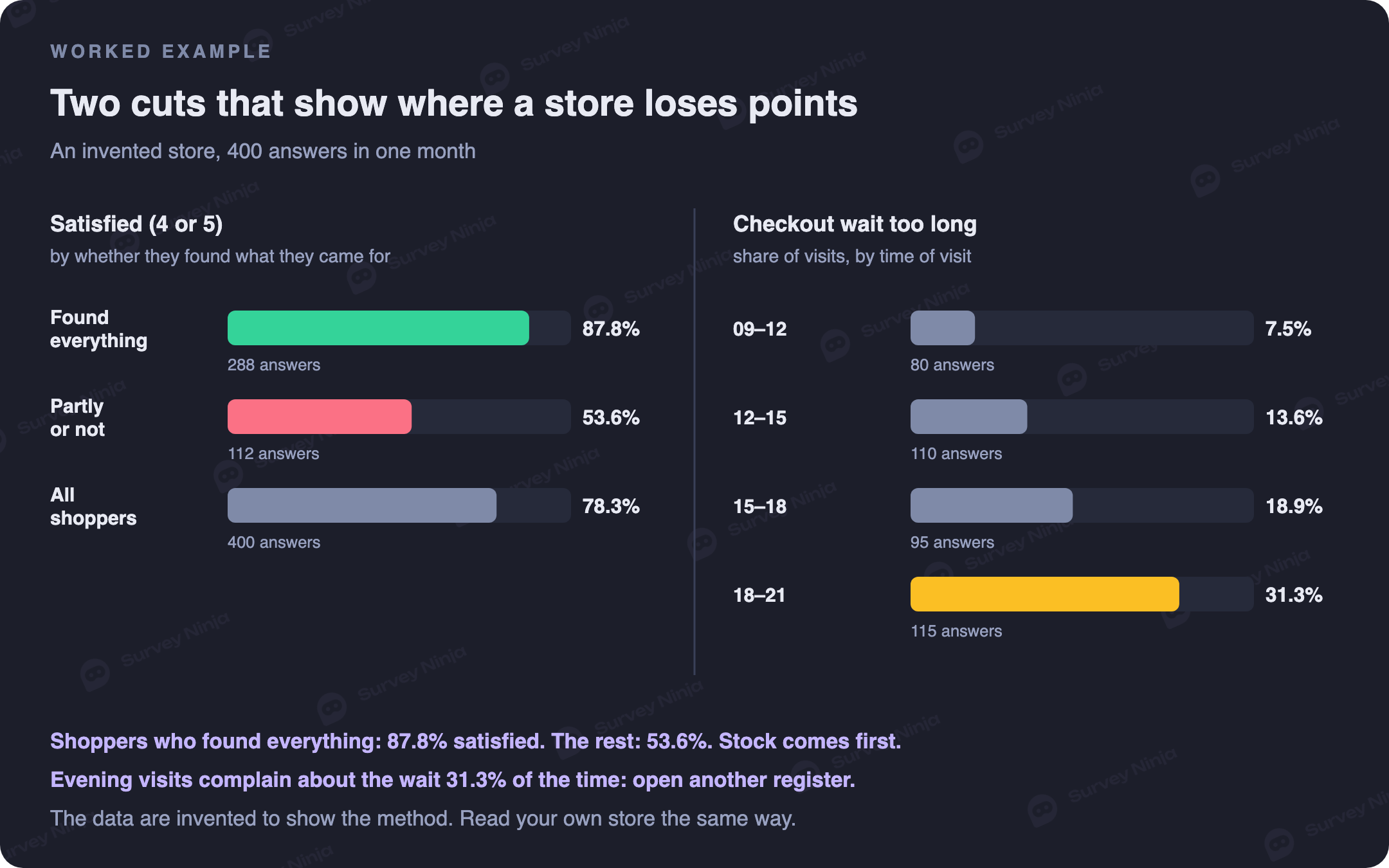
72% of these shoppers found everything they came for, and 87.8% of them were satisfied, which means a score of 4 or 5. Among the other 28%, satisfaction fell to 53.6%. The store's overall 78.3% is mostly a stock problem. Friendlier greetings will not fix it, but a list of the items people could not find, taken from the open answers, can go to the buying team every week.
The checkout cut tells a different story. Before noon, 7.5% of shoppers said the wait was too long. Between 6 and 9 in the evening, 31.3% did. That is a staffing schedule problem, solved by opening another register at the evening peak rather than by training. Our guide to cross-tabulation in surveys shows how to build these splits, and the CSAT calculator and NPS calculator turn raw counts into the headline numbers.
If you run several stores, compare each store with its own past months first, and only then with the other stores. Stores differ in size, location and customers, so the best comparison is often the same store a month earlier.
Acting on the answers
Read every low score within a day. A shopper who rated the visit 1 or 2 and left an email address deserves a reply from the store manager, not a newsletter. Send the "could not find" list to purchasing every week. Line up checkout complaints against the staff rota every month.
When you ask customers for online reviews, ask everyone, not only those who gave you a high score. Google's review policy prohibits selectively soliciting positive reviews from customers, and routing only happy shoppers to Google while unhappy ones go to a private form is exactly that. It also hides the problems your survey is supposed to find.
Common mistakes
- A twenty-question form behind a QR code at the till.
- Surveying only people who bought something, then reading the availability score as good news.
- Letting staff decide who receives the survey.
- Running the survey only on weekday mornings.
- Asking clothing questions in a grocery store and grocery questions in a clothing store.
- Comparing a small corner shop with a flagship store and calling the difference a ranking.
- Collecting answers and never telling the staff what customers said.
How to run a store survey in SurveyNinja
Start from the supermarket satisfaction survey template or build the survey from the questions above. Use logic to show the "what were you looking for" question only to shoppers who did not find everything, and to show the clothing or the grocery block. Generate a QR code from the published link for the receipt, the counter and the exit. If you run several stores, add the store and the register as hidden variables in each link, so report filters can show one store or one checkout at a time. Export the answers when you want to set them against sales or staffing data. You can start building for free.
Frequently asked questions
What is a retail store survey?
It is a short questionnaire for shoppers about their visit to a physical store: finding products, the staff, the checkout, the store itself, price and value, and whether they will come back. Stores use it to find which part of the visit loses customers.
What questions should a customer satisfaction survey for a store include?
Ask whether the shopper found everything they came for, then about layout and stock, staff, checkout, cleanliness, price and value, and overall satisfaction and intent to return. Add a block for your type of store, such as sizes and fitting rooms for clothing or freshness for grocery.
How long should an in-store survey be?
Three questions for a QR code at the counter, because shoppers answer standing up. A longer version of 15 to 20 questions works for an email sent after a purchase, when people answer at home.
How do you get customers to answer a store survey?
Print a QR code on every receipt, place one at the exit and on the card terminal, and email loyalty members after a purchase. Keep the counter version very short and tell shoppers what changed because of earlier answers.
What is a good customer satisfaction score for a store?
In the 2026 American Customer Satisfaction Index, supermarkets scored 78, general merchandise retailers 79 and specialty retailers 80 on a 0 to 100 scale. Your own trend matters more than these national averages, so compare each month with the months before.
Why does checkout matter so much in store surveys?
In the same national study, speed of checkout tied for the lowest score among supermarket experience measures, 79. Waiting is also easy to fix once you know when it happens, which is why a store survey should record the hour of the visit.
Published: Oct 21, 2026