


How to Define Your Target Audience: Methods, Segmentation and Profile
Useful  Mike Taylor Updated: Aug 26, 2026 Reading time ≈ 15 min
Your target audience is the group of people most likely to need your product, and the people your marketing actually talks to. They share a set of traits and similar jobs to get done, which is why a single message can reach them and land.
Almost everything downstream starts here: the channels you buy, the wording of your ads, your packaging, even the product itself. Getting it wrong is expensive, because budget goes to showing ads to people who will never buy, and the message misses everyone else. The one idea worth internalizing early: you don't guess your audience in a meeting, you define it from data, through analytics, interviews and surveys. Below we unpack what an audience profile is made of, how to work it out, how B2B differs from B2C, how to split an audience into segments, and where teams most often trip up.
What an audience profile is made of
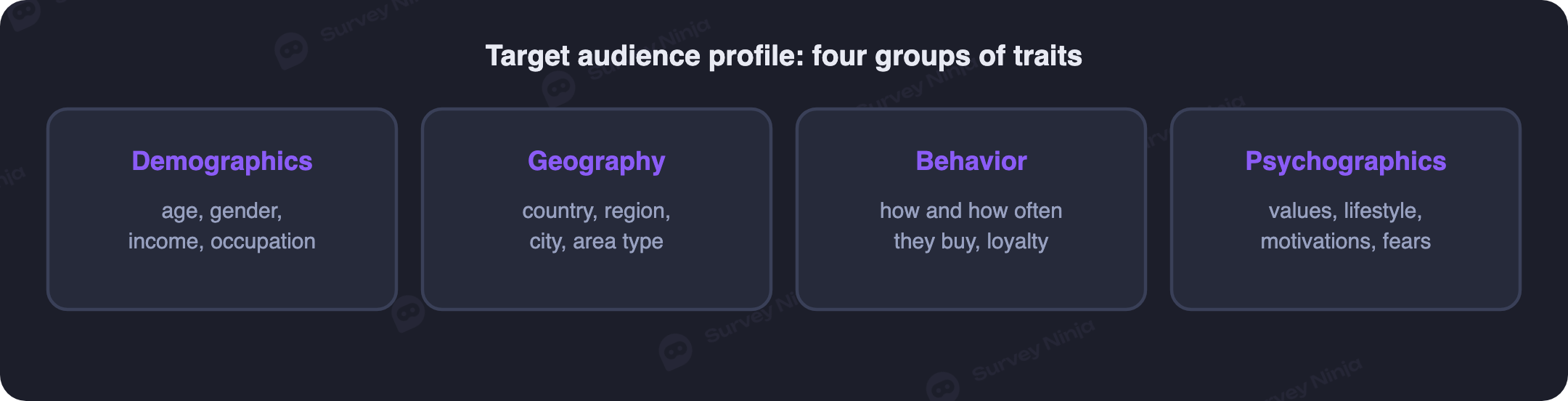
To find an audience and speak to it usefully, you describe it in several layers of traits. The easiest layer to collect is demographics: age, gender, income, education, occupation, marital status. It sits on the surface and is almost always available in your analytics, but on its own it is nearly useless. "Women aged 25 to 45 on an average income" describes both a busy mother of three and a small business owner, and those are completely different customers with different motives.
Geography adds a sense of place: country, region, city, size of the town, sometimes climate. It matters wherever logistics, language, mailing time zones or local promotions depend on it. Behavior is closer to the money: how a person chooses and buys, how often they come back, how much they spend, how loyal they are. It reads clearly in web analytics and your CRM, and this is where approaches like RFM live, splitting customers by recency, frequency and monetary value.
But what really explains a purchase is the fourth layer, psychographics: values, lifestyle, motivations and fears. This layer answers not "who buys" but "why", and it is the one most often skipped in favor of age and income alone. Two people of the same age and income can buy the same gym membership for opposite reasons, one for health and one for how they look, and you have to speak to them differently. Once you group people by shared traits, you get segments, and when all four layers come together into one typical representative, you get a buyer persona that is handy to keep in front of you while you write an ad or shape the product.
The core of your audience: broad and narrow
It helps to separate the broad audience from the narrow one. The broad audience is everyone who could conceivably use your product. The narrow audience, or the core, is the people who buy most often, bring in most of the revenue and are the most loyal. The Pareto rule tends to hold: a smaller share of customers delivers a larger share of income. When budget is tight, start with the core, because it responds to advertising better and costs less to acquire, and only then expand to adjacent groups. The classic mistake is trying to cover the whole broad audience from day one: there is rarely enough money for it, and the message ends up too generic to work.
How a target audience differs from a segment
These two get mixed up constantly, though the difference is simple. A target audience is the entire group of potential customers for a product, while a segment is a part of it with narrower shared traits, worth a separate offer and a separate channel. Take a food delivery service: its target audience is everyone who orders ready meals at home. Inside it you can easily tell apart busy professionals with no time to cook, families ordering on weekends, and students choosing by price. One product, but the message and the promotion for each of these groups will be different, and that is the entire point of dividing them. That is why a single audience is almost always split into several segments.
B2B and B2C: how defining an audience differs
How you define an audience depends a lot on who you sell to. In B2C you describe a person: their demographics, lifestyle, motivations and fears. They usually make the decision themselves, and fairly quickly.
In B2B it is more involved, because the buyer is a company, not a person, and a group of people makes the call. So you describe the audience on two levels. First the company itself: industry, size, revenue, geography, the technologies it uses (this set of traits is called firmographics). Then the people inside it, each with their own stake: the decision maker (thinking about budget and risk), the influencers, for example technical staff (thinking about how the product fits their work), and the end users (thinking about convenience). You have to explain the same product to each of them differently, so in B2B you build a separate profile for each role. To understand the jobs and buying criteria of these roles, customer development interviews help a lot.
How to define your target audience
The most reliable way to define an audience is not from your head but from several sources that check each other:
- Current customers and analytics. If the product already sells, start with the people buying right now: pull your CRM and web analytics, look at demographics and behavior, and single out your most valuable customers. That is the actual picture, not an assumption about it.
- Competitors. Look at whose audience they attract and with which messages, and what people praise or criticize in reviews of their product. How to do this systematically is covered in benchmarking.
- In-depth interviews. Eight to twelve deep conversations surface motivations, barriers and the customer's own language that no report will show you. This is a qualitative method: it explains "why" but does not give you numbers.
- Audience surveys. To find out how widespread the motives from your interviews really are, and to get shares rather than isolated stories, you run a quantitative survey. It shows which segments actually matter.
The logic is always the same: first a hypothesis about who your audience is, then a check against data. Interviews give you depth and the customer's real words, surveys give you scale and numbers, and in practice you chain them: interviews shape the survey questions, and the survey measures how common those motives really are.
The 5W method: five questions to describe a segment
To turn raw data into a clear description, the 5W method by Mark Sherrington is handy. It is five questions whose answers define a segment:
- What is the person buying, which product or which feature of it.
- Who is this person: age, gender, role, the rest of the profile.
- Why are they buying, what job or motive sits behind the purchase.
- When does the need arise, in what situation and at what moment.
- Where do they make the decision, and where can a message reach them.
If different parts of your audience answer these five questions differently, you are looking at different segments, and you should work with each of them separately.
Segmentation: from a broad audience to segments
Defining the audience is only half the job. Next you break it into segments, because talking to everyone the same way means reaching no one: different groups have different motives and objections. You can divide an audience along any of the profile layers, and there are usually a few types of segmentation:
- Demographic and geographic, the simplest: by gender, age, income, city.
- Behavioral, by how a person uses the product: new versus experienced, frequent versus occasional buyers, loyal versus churning.
- Psychographic, by values and motives, the deepest layer and the most useful for ad messaging.
- Benefit-based, by the main value a person is after (price, speed, status, reliability).
Whatever split you choose, size each segment before you commit: will it pay back a separate campaign, or is it a handful of people not worth a dedicated offer? A quick market segmentation survey helps you gauge how big each group is. A sensible number of segments is two to five: more than that and you usually cannot serve them with distinct messages and channels anyway.
Example: the target audience of an online school
Take an online English school. Saying "our audience is everyone who wants to learn the language" says nothing: you cannot write an ad or pick a channel from a phrase like that. But look at the real students and survey them, and behind the general "I want to learn" you find very different stories.
Professionals aged 25 to 35 learn English for their careers: a promotion, a new job, a relocation. They study in short bursts, because they are always short on time, and above all they value a flexible schedule and being able to learn from a phone. Parents of school-age kids do not learn the language for themselves at all: they buy the course for their child, think about the child's future and grades, and decide cautiously, keeping an eye on what other parents say.
Let's write the first segment out as a ready 5W profile. What: an online spoken-English course with a flexible schedule. Who: a professional aged 27 to 34, working in an office or remotely, above-average income. Why: wants to move up or switch to a job where English is required. When: remembers the course right after an interview where their language let them down, or before a trip. Where: follows professional communities and scrolls social feeds in the evening. From a profile like this the message follows directly ("English for work in 20 minutes a day"), and so does the channel (social ads, professional communities) and the argument (a flexible schedule). For the second segment, the parents, the profile comes out completely different, and so does the ad. That is the whole point: instead of one blurry audience, two clear profiles, each with its own offer.
Putting your target audience to work
Defining an audience is not the goal in itself, it is a tool, and it pays off only when it changes decisions. A target audience profile works in several places at once: in advertising it sets both the targeting and the angle for a specific motive; in the product it hints at which features and plans the audience's jobs call for; in content it decides which topics answer customers' pains and questions; and in channel choice it shows where the audience can even be reached. It also helps to lay your segments over the customer journey, so you know at which moment and with which message to reach out.
Common mistakes
People stumble on defining an audience in fairly predictable ways:
- Too broad an audience. "All women aged 25 to 55" is not a choice, it is a refusal to make one: you cannot write a precise message for it.
- Defining it by gut. An audience invented in a meeting room almost always diverges from the people who actually buy.
- Mistaking a segment for the audience. One narrow group gets treated as the whole audience, and the rest of the customers are lost.
- Demographics only. "25 to 45, average income" says nothing about motives, and without behavior and psychographics the profile does not work.
- Copying a competitor blindly. A similar product's audience can differ from yours, so a competitor's audience is something to verify, not to take on faith.
- Define once and forget. An audience shifts along with the market and the product, so it needs re-checking from time to time.
Key takeaways
A target audience is the group of people who need your product, described across four layers: demographics, geography, behavior and psychographics. You define it from data, not guesses, through customer and competitor analysis, interviews and surveys, describe it with the five 5W questions, and then break it into segments, each with its own offer. In B2B you build a profile both for the company and for the roles inside it.
A survey is one of the main tools on this path: it tests your audience hypotheses on a large number of people and shows which segments are real. An audience survey is quick to build in SurveyNinja, with ready-made templates and a free plan with no response limit to get started, so you can create an audience survey without paying. And to word your questions so the data stays clean, see the difference between open and closed questions and how to run a quantitative survey.
Frequently asked questions
What is a target audience?
A target audience is the group of people most likely to need your product and the people your marketing is aimed at. They are held together by shared traits: demographic, geographic, behavioral and psychographic.
What is a target audience profile made of?
Of four groups of traits: demographic (age, gender, income, occupation), geographic (region, city, type of settlement), behavioral (how and how often they buy, loyalty) and psychographic (values, lifestyle, motivations and fears).
How do you define a target audience?
Use several sources: analysis of current customers and web analytics, competitor analysis, in-depth interviews and audience surveys. The core principle is to define your audience from data, not guesswork.
What is the 5W method for defining a target audience?
It is Mark Sherrington's method: five questions, What, Who, Why, When and Where, that help describe a segment of the audience and tell one segment apart from another.
How does a target audience differ from a segment?
A target audience is the entire group of potential customers for a product. A segment is a part of that audience with narrower shared traits, one you can build a separate offer and channel for. A single audience usually breaks into several segments.
How do you define a target audience in B2B?
In B2B you describe the audience on two levels: the company (industry, size, revenue) and the people inside it, the decision maker, the influencers and the end users. A group makes the decision, each with their own stake, so you build a profile for each role.
How do you define a target audience for a new product?
When you have no customers yet, you lean on competitors' audiences, market estimates and hypotheses, then test them with interviews and surveys of potential users. First a hypothesis about the audience, then a check against data.
How many segments should you have?
As many as you can genuinely serve with distinct offers and channels, usually two to five. Splitting an audience into dozens of micro-segments with no separate actions behind them makes no sense.
Updated: Aug 26, 2026 Published: Jul 8, 2026