Research Questions Examples: From Research Problem to Objectives and Survey Items
Research methods  Mike Taylor Nov 29, 2026 Reading time ≈ 20 min
Contents
- The chain: problem, question, objective, hypothesis, survey item
- How to write a research problem statement
- Types of research questions, and the analysis each one needs
- What makes a good research question
- 20 research questions examples by field
- How to write research objectives with SMART verbs
- From objectives to survey questions: a worked example
- Common mistakes with research problems, questions and objectives
- How to plan and run the study in SurveyNinja
- Frequently asked questions

Research questions examples make sense once you see the chain behind them. A research question is the specific question your study is designed to answer: it grows out of a research problem (a gap between what is known and what someone needs to know), and it turns into objectives, often a hypothesis, and finally the questions in your survey. Below you get that chain on one running example, a problem statement template, 20 research questions by field and a worked example with survey data.
The guide is written for students preparing a thesis or capstone and for anyone who runs a survey to answer a real question at work. If you are at the proposal stage, our guide on running a survey for a thesis or dissertation covers the rest of the process.
Key points
- A research problem names a gap and why it matters; the research question is the one answerable question that closes that gap.
- Research questions come in five types: descriptive, comparative, relational, causal and exploratory. The type decides your method and your analysis.
- Objectives restate the question as actions with measurable verbs, and each specific objective should map to at least one survey item.
- A cross-sectional survey can show that two things go together. To show that one causes the other, you need an experiment.
The chain: problem, question, objective, hypothesis, survey item
Every element of a study answers the one before it. The problem says what is wrong or unknown. The research question asks the one thing you need to know about it. The objectives say what you will do to answer it. A hypothesis, where you have one, is your expected answer stated so the data can reject it. The survey items are the measurements that feed each objective.
Methods literature uses the same order. In their paper on research questions, hypotheses and objectives (Canadian Journal of Surgery, 2010), Farrugia and colleagues derive the hypothesis from the question and describe objectives as the way the study addresses it, including the outcome measures. They call the development of the research question "the most important aspect of a research project".
Here is the running example we will use through the whole article. A public university offers free tutoring for first-year courses, and few students book it.
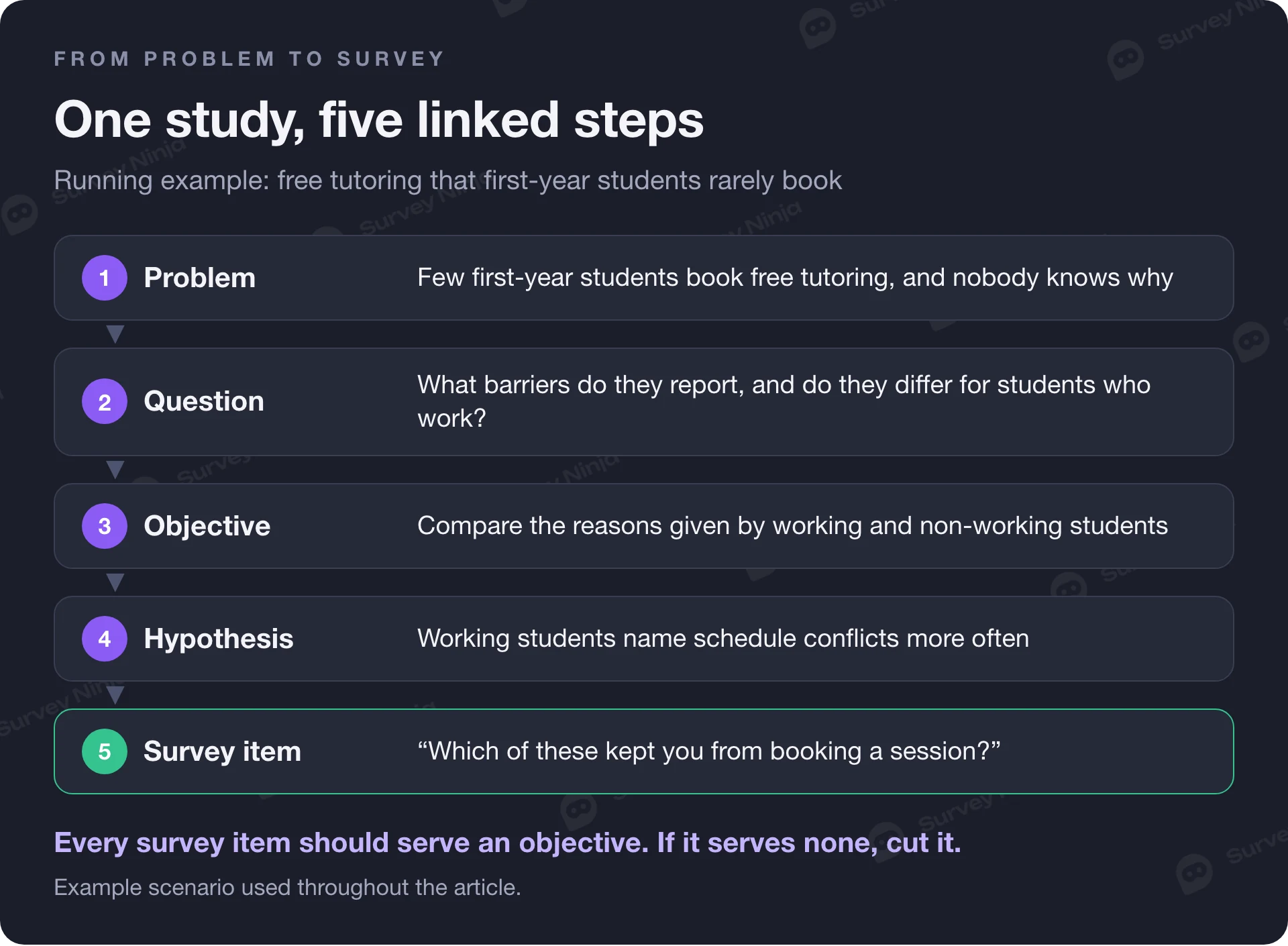
The research design is the plan that connects these pieces to a method and a sample.
How to write a research problem statement
A research problem statement is a short paragraph, usually four or five sentences, that describes a situation, shows with evidence that something is wrong or unknown, and says what the study will do about it. Write it before the research question: if you cannot state the problem, the question will drift.
This four-sentence template works for most theses and applied studies:
| Sentence | What it does | Running example |
|---|---|---|
| 1. Context | Describes the situation as it should work | The university offers free tutoring for first-year math and writing courses to reduce failure rates. |
| 2. Evidence of the problem | Shows the gap with a fact or a number | Booking records show that about 22% of first-year students used it last term, and the share is lower among students with jobs. |
| 3. What is unknown | Names the missing knowledge | The university does not know what keeps students from booking, so it cannot tell whether to change the hours, the format or the promotion. |
| 4. Purpose | Says what this study will do | This study surveys first-year students to identify the barriers and compare them between working and non-working students. |
The numbers in the example are illustrative. In your own statement, sentence two cites records, earlier studies or official statistics, with the year. If your program asks for a justification, add a fifth sentence on consequences ("the tutoring budget may go to changes that miss the real barrier").
Types of research questions, and the analysis each one needs
There are five common types of research questions: descriptive, comparative, relational, causal and exploratory. The first four are quantitative and fit a survey or an experiment; exploratory questions usually call for interviews or open answers. Pick the type on purpose, because it fixes the method, the sample and the statistics you will report. Our overview of types of research places these in the wider classification.
| Type and what it asks | Example from the running case |
|---|---|
| Descriptive. How much, how many, how often, what share | How many first-year students have used free tutoring this term? |
| Comparative. Whether two or more groups differ | Do working and non-working students differ in the barriers they report? |
| Relational. Whether two variables move together | Is the number of weekly work hours related to tutoring use? |
| Causal. Whether changing X changes Y | Do evening sessions increase bookings among working students? |
| Exploratory. How or why people experience something | How do working students decide whether to ask for academic help? |
The second table shows how you analyze survey data for each type.
| Type | How you analyze survey data |
|---|---|
| Descriptive | Percentages, mean or median, margin of error |
| Comparative | Chi-square for categories; t-test or Mann-Whitney for scores |
| Relational | Correlation (Spearman for ordinal answers), regression |
| Causal | An experiment: random assignment, then compare groups |
| Exploratory | Interviews or open answers, coded into themes |
Comparative and relational questions always involve at least two variables, one you suspect drives the other and one you expect to change. Naming them early helps you write both the hypothesis and the items; see our guide to independent and dependent variables for how to turn each into a survey question.
What makes a good research question
A good research question names one population, the variables you will measure and a place and time, and it can be answered with data you are able to collect before your deadline. Farrugia and colleagues summarize the test with the FINER criteria: feasible, interesting, novel, ethical and relevant. A common feasibility trap in student projects: a question about "all university students" with a sample of 80 classmates is not feasible as written.
Compare these weak and strong versions:
| Weak | Problem | Stronger |
|---|---|---|
| What do students think about tutoring? | No population, no variable, no decision | What barriers do first-year students at the university report for not using free tutoring in the spring term? |
| Does social media affect students? | "Affect" implies cause; outcome undefined | Is daily time on social media related to self-reported loneliness among first-year students? |
| Is our app good? | Yes/no answer, no measure | How do new users rate the ease of each step of the sign-up flow on a 1-5 scale? |
| How can the company improve retention? | A request for advice, not a question data can answer | Do employees who joined in the last 12 months differ from longer-tenured staff in their intention to stay? |
20 research questions examples by field
These research questions examples are grouped by field and labeled by type, so you can borrow the structure even if your topic is different. Replace the bracketed parts with your population and place.
| Research question | Type |
|---|---|
| Education. How many hours a week do first-year students at [university] spend on paid work during the semester? | Descriptive |
| Education. Do students in online and in-person sections of the same introductory statistics course differ in final exam scores? | Comparative |
| Education. Is the number of hours students sleep before an exam related to their exam score? | Relational |
| Education. How do first-generation students describe their first month at university? | Exploratory |
| Health and psychology. What share of adults aged 18-29 in [city] report sleeping less than seven hours on work nights? | Descriptive |
| Health and psychology. Do nurses on rotating shifts report higher burnout scores than nurses on fixed day shifts? | Comparative |
| Health and psychology. Is weekly physical activity related to self-reported stress among office workers? | Relational |
| Health and psychology. Does a text-message reminder increase the share of patients who attend follow-up appointments? | Causal |
| Business and marketing. Which factors do online shoppers in [country] rate as most important when choosing a delivery option? | Descriptive |
| Business and marketing. Do customers who contacted support in the last 90 days give lower satisfaction ratings than those who did not? | Comparative |
| Business and marketing. Is perceived price fairness related to the intention to renew a subscription among small-business customers? | Relational |
| Business and marketing. Does showing the annual price first change the share of visitors who choose the annual plan? | Causal |
| Workplace and HR. Why do employees in hybrid teams choose to come into the office on some days and not others? | Exploratory |
| Workplace and HR. Do managers and non-managers differ in how fair they find the promotion process? | Comparative |
| Workplace and HR. Is the frequency of one-to-one meetings with a manager related to engagement scores? | Relational |
| Social sciences and policy. What proportion of residents in [district] use public transport at least three times a week? | Descriptive |
| Social sciences and policy. Do rural and urban households in [region] differ in access to home broadband? | Comparative |
| Social sciences and policy. Is trust in local government related to willingness to take part in public consultations? | Relational |
| Technology and UX. At which step of the sign-up flow do new users of [app] report the most difficulty? | Descriptive |
| Technology and UX. Does a shorter onboarding checklist increase the share of new users who finish setup in their first week? | Causal |
How to write research objectives with SMART verbs
Research objectives restate the research question as actions: one general objective that mirrors the main question and two to five specific objectives, each starting with a verb that names a measurable action. The general objective says what the study achieves; the specific objectives are the steps that get there.
Match the verb to the question type. For descriptive questions use estimate, describe or identify. For comparative ones use compare or determine whether … differ. For relational ones use examine the relationship between. For causal questions use evaluate the effect of, and for exploratory ones explore or describe how. Avoid "understand", "know" and "learn about": no reader can verify that. "Improve tutoring" is also not a research objective, because it describes the decision your results will feed.
The SMART test, which George Doran proposed for management goals in a 1981 article, adapts well to research objectives. Specific: one variable and one population. Measurable: you can point to the survey item or metric. Achievable: you can reach enough respondents. Relevant: it answers part of the main question. Time-bound: it names the data collection period.
For the running example:
| Level | Objective |
|---|---|
| General | Identify the barriers that keep first-year students at the university from using free tutoring in the spring term, and compare them between working and non-working students. |
| Specific 1 | Estimate the share of first-year students who know about free tutoring and the share who have used it this term. |
| Specific 2 | Identify the most frequent reasons for not booking a session. |
| Specific 3 | Compare the reasons given by working and non-working students. |
| Specific 4 | Examine the relationship between weekly work hours and tutoring use. |
Specific objective 3 is comparative, so it carries a testable hypothesis: working students name schedule conflicts more often than non-working students (the null hypothesis says there is no difference). Our article on the research hypothesis shows how to write the null and alternative versions and which test to plan.
From objectives to survey questions: a worked example
Each specific objective becomes one or more survey items, and each item comes with the analysis you will run on it. Writing that mapping before you build the questionnaire is the fastest way to catch missing or useless questions.
| Survey item (ready to copy) | Answers | Analysis |
|---|---|---|
| Objective 1: Before today, did you know that the university offers free tutoring for first-year courses? | Yes / No | Percentage with margin of error |
| Objective 1: How many tutoring sessions have you attended this term? | 0 / 1 / 2-3 / 4 or more | Percentage with at least one session |
| Objective 2: Which of these kept you from booking a session? Select all that apply. (shown only to students with 0 sessions) | Sessions are at times I can't attend / I didn't know how to book / I don't think I need it / I'd feel uncomfortable asking for help / The location is hard to reach / Other (please specify) | Share choosing each reason |
| Objective 3: Do you have a paid job during this term? | Yes / No / Prefer not to say | Grouping variable for the comparison; chi-square test |
| Objective 4: On average, how many hours a week do you work for pay? | 0 / 1-10 / 11-20 / 21-30 / More than 30 | Tutoring use by band; Spearman correlation |
Two rules from Pew Research Center's guidance on writing survey questions apply directly here: ask one thing per question, and pretest the questionnaire with a few people before launch. A short pilot study with five to ten first-year students would show whether "tutoring" means the same thing to them as to the university. Because you ask about jobs and schedules, leave out names and student IDs unless you need them, and ask if your program requires ethics review before you collect data.
Now suppose the survey closes with 400 first-year respondents. One hundred (25%) attended at least one session, a little above the 22% in the booking records, which hints that students who used tutoring were more willing to answer. Of the 300 who never booked, 120 work and 180 do not. Here is what they said:
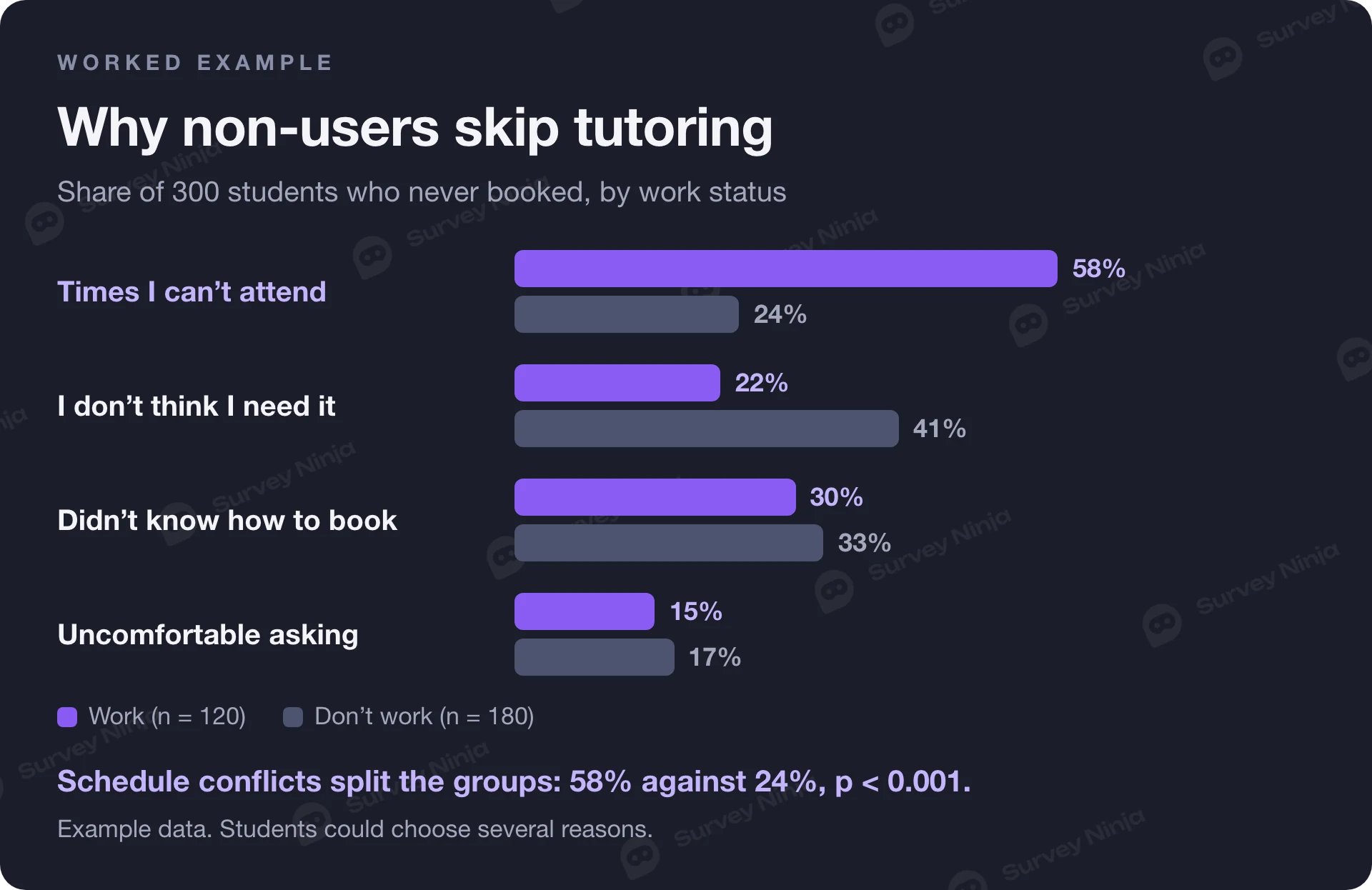
Schedule conflicts were named by 58% of working students (70 of 120) and 24% of non-working students (43 of 180). A chi-square test on those counts gives χ² ≈ 36 with one degree of freedom, p < 0.001, so the data reject the null hypothesis. Non-working students more often said they did not think they needed tutoring (41% against 22%), while not knowing how to book was similar in both groups (around 30%).
That answers the main research question in one sentence a dean can act on: the barrier differs by group, so evening or online sessions target working students, and a message about who benefits from tutoring targets the rest. The numbers here are example data; with your own results, our guide to the statistical treatment of data shows how to describe the tests in chapter 3, and the guide to respondents of the study covers how to report the sample. To plan how many responses you need for each group, use the sample size calculator.
Common mistakes with research problems, questions and objectives
Most problems in a methods chapter trace back to a break in the chain: a question that does not follow from the problem, or objectives that the survey never measures. Check your draft against this list:
- The problem statement describes a topic and never shows evidence that something is wrong or unknown.
- The main question asks about cause ("the impact of …"), while the method is a one-time survey.
- The population in the question ("university students") is far wider than the sample you can reach ("my classmates").
- Objectives start with "understand" or "know", so nobody can tell when they are met.
- An objective has no survey item, or the survey has items that serve no objective.
- Two questions are packed into one item ("Is tutoring useful and easy to book?").
- The question and objectives are rewritten after the data come in to fit the results.
How to plan and run the study in SurveyNinja
SurveyNinja covers the chain from the research question to the data, and the planning tools work in the browser without an account:
- Describe what you need to find out and the decision it feeds in the research plan generator. It returns a plan with an objective, method, audience, sample size estimate, questions, channels, timeline, metrics and risks, which you can edit as a template.
- Paste your problem or assumption into the hypothesis generator. For each hypothesis it suggests a null hypothesis, a way to test it, a survey question, a metric and a rough sample size.
- Build the questionnaire in the survey maker, for free. Ninja AI (Beta) can draft the survey from a description or from your proposal uploaded as a PDF or DOCX, and every change waits for you to apply it. Skip logic, which shows the reasons question only to students with zero sessions, works on every plan.
- Share the link or a QR code, then export the answers to CSV, XLSX or SPSS for the tests in your analysis plan.
Frequently asked questions
What is a research question?
A research question is the specific question a study is designed to answer. It comes from a research problem, names the population and the variables, and can be answered with data the researcher can collect. It guides the objectives, any hypothesis, the method and the analysis, so it should be fixed before data collection starts.
What are some examples of good research questions?
Good examples name a population, a variable and a context: "Do nurses on rotating shifts report higher burnout scores than nurses on fixed day shifts?" or "Is daily social media time related to self-reported loneliness among university students?" Each one is answerable with a survey and points to a clear analysis, a group comparison in the first case and a correlation in the second.
What is the difference between a research problem and a research question?
The research problem describes a gap: a situation, evidence that something is wrong or unknown, and why it matters. The research question is the single answerable question that addresses that gap. The problem is written as a short paragraph of statements, the question as one sentence ending with a question mark.
How do you write a research problem statement?
Use four sentences. Describe the context as it should work, show the gap with a fact or number and its source, name what is not known, and state what the study will do. Add a fifth sentence on consequences if your program asks for justification. Keep it specific to a population, a place and a time.
How many research questions should a study have?
Most theses and applied studies use one main research question and two to four sub-questions, each tied to a specific objective. More sub-questions usually mean a longer survey and a sample too small to answer them all. If you have many, check whether some belong in a follow-up study.
What is the difference between research questions and research objectives?
A research question asks what you want to know; a research objective states what you will do to find out, starting with a measurable verb such as estimate, compare or examine. Usually the general objective mirrors the main question and each specific objective matches one sub-question and at least one survey item.
Published: Nov 29, 2026