 25 Questions for a Travel Agency Customer Satisfaction Survey
360-Degree Feedback: From Questionnaire to Report
Useful  Mike Taylor Sep 11, 2026 Reading time ≈ 21 min
A 360 review rarely fails on theory. It fails on the questionnaire, on the rater list, and on what happens the day the report lands. All three are settled before anything is sent, and they are what separates a useful diagnostic from a file nobody opens twice.
What 360-degree feedback is and who takes part is settled in our glossary entry on 360-degree feedback. This guide starts where that definition stops. Here is the instrument: how the questionnaire gets written, how raters are chosen, what you can honestly promise about anonymity, and how to read a report when a person and their team disagree.
Plenty of people go looking for a 360 feedback test, and the word test is misleading, because there are no right answers here and no pass mark to clear. There is a portrait shot from several cameras, and the value sits exactly where the shots disagree.
What a 360 should decide, and what it should never decide
The first decision is not what to ask. It is what the result will be used for, and that choice leaks into everything else: the questionnaire, the rater list, the tone of the invitation. A 360 is for individual development and for surfacing the blind spots that nobody has ever said to the person's face, which is a narrower job than most rollouts assume.
It is not for handing out bonuses. Worth being blunt here, because this is the mistake that kills the instrument most often: the moment staff work out that their ratings move money, the assessment stops measuring behavior and starts measuring politics. Allies give each other top marks. Anyone carrying a grudge uses the anonymity to settle it. The cautious majority, which is most people, ticks the middle box on everything, and what you get back is an expensive report full of fours out of five.
It is not a replacement for the performance review either. Performance measures results against targets and the manager owns that, while a 360 measures observable behavior and the people who sit alongside the person every day own that. The two can coexist. They should not share a form or a meeting.
There is a third confusion, with climate. An employee engagement survey tells you how the company is doing. A 360 tells you how one person is doing. If what you actually want to know is why people keep leaving the same team, that answer lives in neither instrument, and you will find it in exit interviews instead.
Who rates whom: the four circles
The name comes from geometry, and the geometry is literal. Around the person rated there are four circles, and each sees something the others cannot.
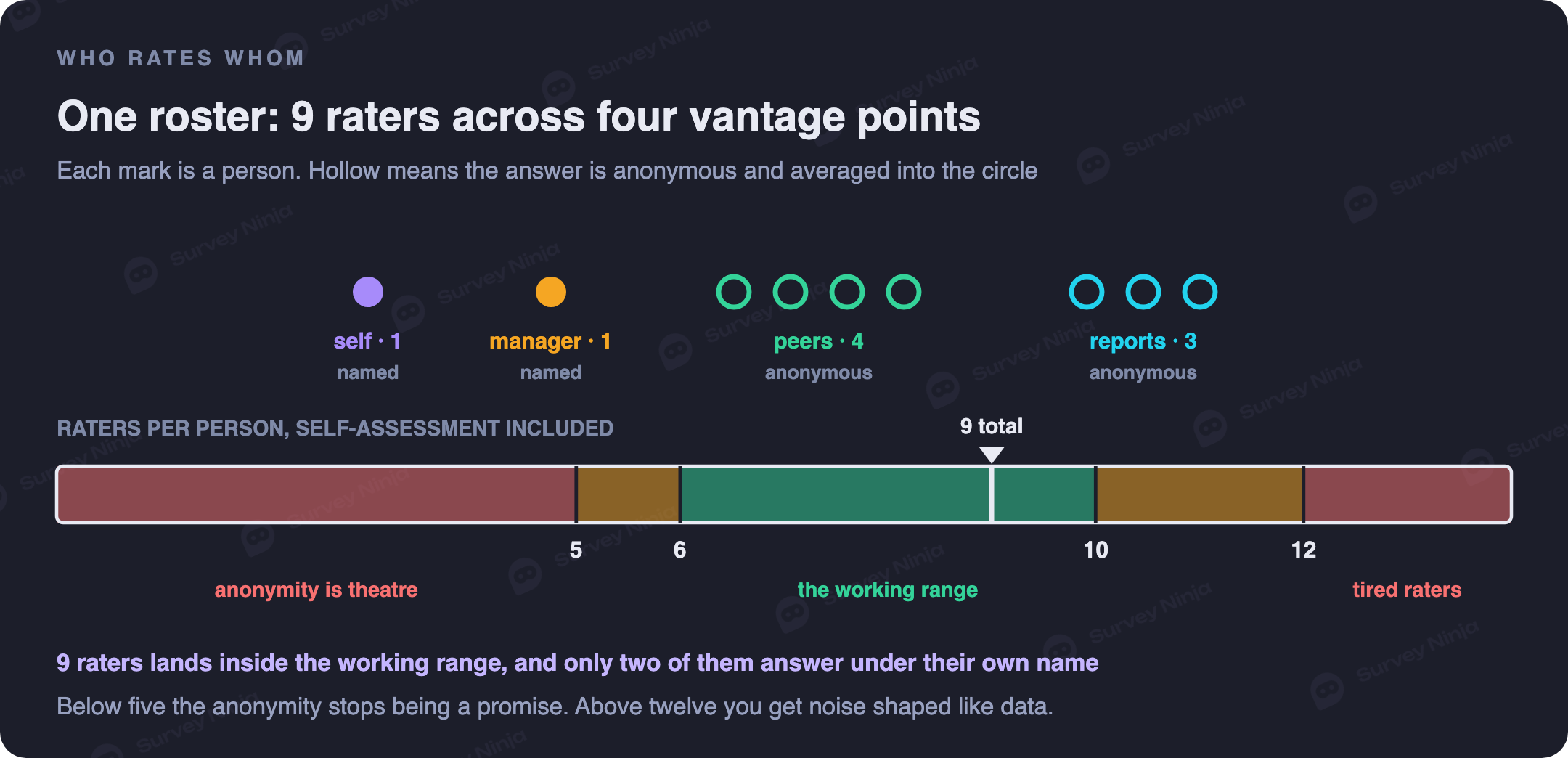
The direct manager sees output and judgment: what gets decided when nobody is watching, how work is prioritized, what ships and when. This is the one circle that is usually not anonymous, and that is fine. The manager's view is already part of a conversation the two of them have every quarter, so hiding the source would change nothing except the credibility of the report.
Peers see the sideways day to day. How help gets asked for. How criticism lands. Whether information travels or parks itself on one desk. This circle carries the most diagnostic value and needs the most careful handling, because everyone goes back to working together on Monday.
Direct reports are the circle that produces the surprises, and it only applies to people who manage. Whether they delegate or hoard. Whether they listen. Whether they cover for the team upward. Whether recognition ever arrives. None of that is visible from above.
The self-assessment is the fourth circle and the one most teams treat as filler. Mistake. Without it there is nothing to compare anything against, and the comparison between how a person sees themselves and how the room sees them is the actual product of a 360.
One detail that saves grief later: the four circles should not answer the same questionnaire. A peer cannot judge delegation with any authority, and a direct report never sees how their boss negotiates with other departments. The sensible shape is a common trunk plus a role-specific block. If you cannot draw who works with whom, a personnel sociometric research survey settles that map first.
How many raters per person
Short answer: six to ten, self-assessment included. The long answer explains why both extremes hurt.
Below five, two things break at once. One is statistical. With three raters, a single person having a bad week drags the average of an entire competency. The other is anonymity. With three peer responses anyone can recognize the voice in an open comment, and everyone knows who the three were, so the anonymity stops being a promise and becomes set dressing.
Above twelve the problem changes shape. Reliability is fine. The load is not. If twenty people rate twenty people, every employee ends up filling in twenty questionnaires inside the same week, on top of whatever they were actually hired to do. Nobody does that carefully. By the fourth form people are ticking the middle column and typing "great to work with" into every open field. A tired rater does not produce data. They produce noise shaped like data.
The entry criterion is neither fondness nor seniority: what counts is having worked with the person regularly over the last six to twelve months, on real projects rather than in passing. Someone who says hello in the corridor cannot rate their conflict handling. And one rule that almost never gets written down: the list is proposed by the person being rated and by HR together. Anyone who picks their own raters unfiltered picks friends, and the report comes back beautiful and useless.
Designing the questionnaire: from competency to observable behavior
This is where the real work is. A 360 questionnaire does not ask about qualities. It asks about behavior somebody could actually have witnessed.
Start by choosing competencies, and choose few: four to six. Communication, teamwork, leadership, customer focus, problem solving and developing others will cover almost every role you are likely to assess, and most published frameworks are these six under longer names. Three gives you a flat portrait. Ten and the last few collect box-ticking. Choose by role: for a technical specialist with nobody reporting to them, "developing others" generates filler.
Then turn each competency into three or four concrete statements. That translation decides the quality of the entire report.
| Competency | Vague wording that fails | Observable statement |
|---|---|---|
| Communication | Has strong communication skills | Explains an idea so I can repeat it without asking again |
| Leadership | Is a natural leader | Admits to the team when a decision of theirs went wrong |
| Teamwork | Is a collaborative person | Offers help when someone is stuck, without being asked |
| Conflict handling | Has emotional intelligence | Keeps their tone when someone challenges their work |
| Customer focus | Is customer focused | Meets deadlines promised to other teams, or flags slips in time |
| Developing others | Develops their team | Gives feedback on specific work, not only general praise |
Look at what changes between the columns. The left asks for a verdict on a person. The right asks for a memory of a situation. One gets answered from prejudice, the other from recall. The right-hand column also converts straight into a development action that somebody can practice on a Tuesday morning, whereas "improve your emotional intelligence" is not a plan. It is a wish.
On length, fifteen to twenty-five closed statements plus two or three open questions is a good range: eight to ten minutes. If the blank page is the obstacle, the HR survey generator drafts a block per competency that you cut back by hand, and the team effectiveness questionnaire works as a skeleton.
The rating scale and the option not to rate
The scale looks like a formatting detail. It is not. It decides how much information survives contact with the raters.
Five points is the sensible standard. With three options everyone hides in the middle, and you lose the one distinction that development actually depends on, the difference between meeting expectations and standing out. With ten, nobody discriminates between a seven and an eight, and every rater uses a different stretch of the range. The general rules live in our Likert scale guide. Here is what changes in a 360.
Label every point with words, not just the two ends. "Almost never, sometimes, often, almost always" measures better than a bare 1 and 5 with nothing in between, because the real question is about observed frequency and not about a grade. It also takes the edge off scoring high out of politeness.
And always add one option outside the scale: "I have not had the chance to observe this". Without it something happens that quietly wrecks whole reports. A rater who does not know does not leave the question blank. They tick the midpoint instead, and that midpoint then enters the average as though it were a real observation made by somebody who was genuinely there. With the off-scale option it drops out of the calculation, and it says something on its own. If sixty percent of peers cannot rate conflict handling, that competency never belonged in the peer questionnaire.
One extra control if you repeat this yearly: the Cronbach's alpha calculator checks whether the statements inside one competency behave consistently. A low alpha usually means two ideas are sharing one label.
Open questions that actually add something
Closed questions give you the map. Open ones give you the coordinates. Without two or three text fields the report stays a cloud of averages, and nobody sitting in the feedback conversation knows how to turn an average into a change in behavior.
The usual mistake is one giant box labelled "comments". Nobody writes in it, or they write "all good". Three narrow questions work better:
- What should this person keep doing exactly as they do it now? Names the strength as a behavior instead of a trait.
- What one change in how they work would make your own work easier? The wording is the point: it asks about the impact on the respondent, not about the person's flaws. It gets answered with far less discomfort.
- Describe one situation from the last few months that illustrates your answer. The example keeps the feedback session from becoming an argument about whether the average was fair.
What each format is good for is covered in our comparison of open and closed questions. In a 360 the split is clean: closed questions run the report, open ones run the conversation.
Anonymity: what you can honestly promise
This is where the process earns its credibility, and where impossible promises tend to get made.
What you can promise: peer and direct-report responses are shown aggregated by circle, without names, and the person rated never sees who said what. What you cannot promise is that nobody could work it out. If a manager receives ratings from their only three reports and one comment mentions a project only one person touched, anonymity broke without anyone breaking a rule. Honesty pays better here. Explain how the aggregation works, what the minimum per group is, and what happens to a circle that falls short of that minimum, and people will believe the rest of what you tell them.
Three operating rules cover almost everything. First: a minimum of three responses per circle before any average is displayed. A circle with two either merges with another or is not shown at all. Second: comments are delivered unedited, shuffled, and without saying which circle they came from, apart from the manager's. Third: nobody in the reporting line sees individual responses.
Worth separating anonymity from confidentiality. A form that sends a personalized link to each rater technically knows who answered, even if it shows that to nobody. Saying so in the invitation buys more trust than a promise the first curious person can dismantle. Which levels exist, and where identity leaks, is in our guide to anonymous surveys.
How to read the results of a 360 assessment
The report arrives, and this is where most projects are lost. The temptation is to look at the overall average and sort people by it. That number means nothing. A 360 does not produce a score. It produces gaps, and the information is in the gaps. Five comparisons are worth making.
| Gap | What it compares | What it usually means | First step |
|---|---|---|---|
| Self against everyone else | Own view against the other circles' average | A blind spot or a confidence gap, by sign | Pull matching examples from the open answers |
| Manager against peers | Vertical view against horizontal | Behavior that shifts with the audience | Ask where each version shows up |
| Peers against direct reports | Sideways treatment against downward | A leadership style peers never see | High priority if the person manages |
| Spread inside one circle | Agreement inside one group | Inconsistent behavior, or raters with too little contact | Recheck the rater list first |
| One competency against the rest | The person's internal profile | Where the strength and the hole are | Pick one competency for the plan |
The fourth row gets misread almost every time. A wide spread among peers, two very high ratings and two very low, does not mean the truth sits in the middle. It usually means the person behaves differently with different groups, and that is a finding worth chasing, not dirty data to be averaged until it disappears.
On comparing people with each other: don't. Ranking twelve rated employees by their average turns development into a leaderboard, and next year everyone will answer accordingly. The only legitimate comparison is against the same person a year ago.
When the self-assessment and everyone else disagree
This is the most valuable part of the report, and the reason to include a self-assessment at all. Cross what the person gave themselves with what everyone else gave them and four situations appear, each with a different conversation attached.
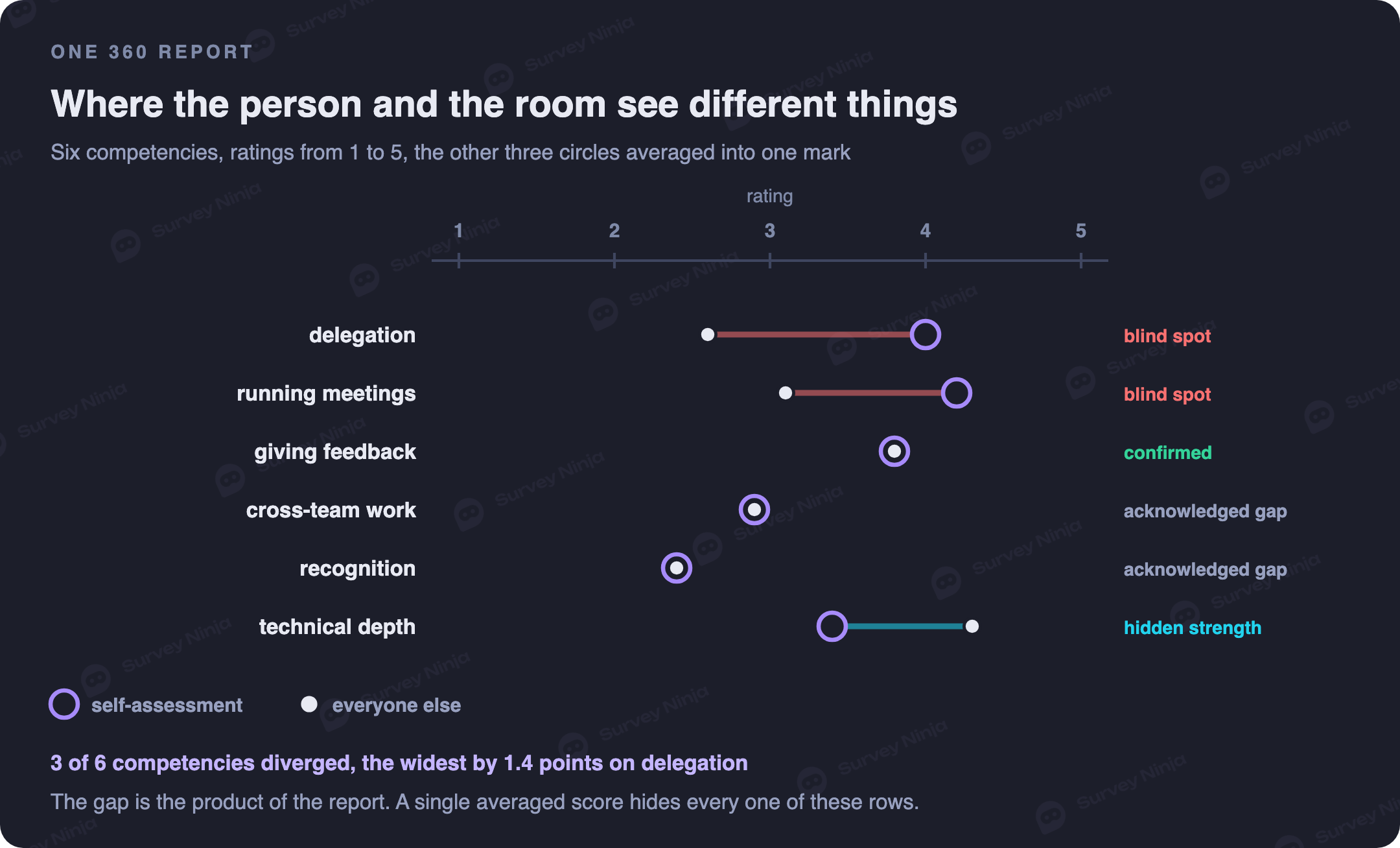
Blind spot: high from the person, low from everyone else. The uncomfortable case, and the most useful one, because nobody has ever told them. Here the conversation holds together on examples, not on averages. Lead with the number and you will be told the raters misread the question. Lead with three concrete situations pulled out of the open answers, and the conversation changes on its own, usually inside the first ten minutes of the meeting.
Hidden strength: low from the person, high from everyone else. It happens more than people expect, especially with technical profiles and anyone new to a role. It is the easiest gap to close. Sometimes showing them the report is the whole intervention.
Confirmed strength: high on both sides. Not filler. This is what to protect if the person changes role, and what makes them a reference point for the team.
Acknowledged gap: low on both sides. The most comfortable one, because there is nothing to argue about. The agreement already exists, so you go straight to the plan.
One warning. A high self-assessment is not arrogance and a low one is not humility. Often they are different readings of what a four on the scale means. That is why frequency labels beat bare numbers, and why the pattern matters more than any single row. Someone who rates themselves above the pack on all six competencies equally is showing you a response style, not six blind spots.
The feedback conversation and the development plan
The report is not the product. The conversation is. And one rule decides whether any of the earlier work mattered: results go to the person being rated first, always.
The format that works is an hour with HR or an external facilitator, never with the manager in the room on the first pass. You walk through the report competency by competency, you open with the confirmed strengths rather than the gaps, and you close the hour by choosing what to work on. Choosing is the critical part. A plan with six development areas will not be executed, and a year later none of the six will have moved.
One competency. Two at the outside. With actions somebody can verify: a course with a date on it, a mentor with meetings in the calendar, a behavioral commitment that can be practiced weekly. Two or three months of horizon, and a checkpoint before the next round.
Connect the plan to what the person wants, not only to what the report points at. Someone with a leadership gap who never intends to manage anyone will not spend energy closing it, however clear the chart looks. An employee career expectations survey asked first keeps you from planning a route to a destination nobody wants. Inside a wider listening program, the 360 sits alongside your employee engagement work.
Seven ways to ruin a 360 assessment
None of these are hypothetical. They are the seven ways these projects fall over, roughly in order of frequency.
- Tying it to pay, bonuses or layoffs. It goes first because it destroys the instrument permanently. Once people learn that answers move money, there is no way back for years.
- Letting the rated person pick their own raters. They will pick the people who like them. The list gets agreed with HR, with regular contact as the criterion.
- Asking for fifteen or twenty ratings per person. Quality collapses after the fourth questionnaire of the week, and what arrives after that is polite filler.
- Competencies named out of a textbook. Resilience, agility, emotional intelligence. Every rater understands something different, and the average adds up perceptions that were never comparable.
- Promising anonymity and breaking it with the data cut. A dashboard that filters down to two responses breaks the promise even when nobody means harm. The threshold is set before anything is sent.
- Collecting and never coming back. In trust terms this is the most expensive failure. People spent their time writing, and with no visible effect the next round returns half the responses.
- Running it once and never again. Without a second measurement you cannot tell whether the plan worked, and a one-off 360 ends up as a snapshot in a shared folder.
On cadence, the flip side of that last point: six months to a year suits key roles and anyone with an active plan. Under six months there is not enough time for a change in behavior to become visible to anyone else, so the second round mostly measures how people felt about the first one. You also do not have to run the whole company at once. Starting with fifteen people costs far less than finding the flaw with two hundred questionnaires already sent. Build the first round in a free survey builder, with separate questionnaires per role and an individual link per rater.
Frequently asked questions
How many raters does a 360-degree feedback assessment need?
Six to ten per person, self-assessment included. Below five, one outlying response moves the average and anonymity stops holding. Above twelve, quality drops through workload alone. The criterion is regular working contact over the past year.
How many questions should a 360 feedback questionnaire have?
Fifteen to twenty-five closed statements across four to six competencies, plus two or three open questions: eight to ten minutes to complete. Each competency needs three or four statements about observable behavior, not personality traits.
Is 360-degree feedback anonymous?
Peer and direct-report ratings are, aggregated by circle with a minimum of three responses per group. The manager's rating is usually identified, because it already belongs to the official conversation. What cannot be promised is that a comment's source is impossible to deduce in a small group.
Can 360-degree feedback be used to decide raises or layoffs?
No, and it is the mistake that kills the instrument most often. Once staff understand that answers move money, ratings stop measuring behavior and start measuring politics: inflated scores between allies, and a lot of people ticking the midpoint. Compensation belongs to the performance review.
What does it mean when the self-assessment is higher than everyone else's?
That is the gap known as a blind spot: the person believes they do something well and the people around them do not see it that way. The conversation holds together on examples from the open answers, not on the average. If the pattern repeats in every competency, it is usually a response style.
How often should a 360-degree feedback assessment be repeated?
Every six to twelve months for key roles, or for anyone with an active development plan. Under six months a change has no room to become visible from outside, so the second measurement collects noise. Starting with fifteen people and expanding later costs less.
How is 360-degree feedback different from an engagement survey?
The unit of analysis. An engagement survey describes how the organization is doing and is read in aggregate. A 360 describes one person's behavior and is read individually. The first feeds management decisions, the second a development plan.
Published: Sep 11, 2026