


How to Run an Employee Engagement Survey That Leads to Decisions
Useful  Mike Taylor Sep 2, 2026 Reading time ≈ 30 min

An engagement survey usually produces one number: a 7.2 out of 10 on a slide. Leadership asks whether that's good, what changed, and what to do next, and nobody has an answer. Here is how to build the version that answers all three.
The number itself is rarely the problem. A well-built engagement survey produces a 7.2 just as easily as a badly built one does. What breaks is everything around the number: something to compare it against, a breakdown that survives a manager asking for their team's results, and a plan for what happens next. Skip those and the exercise is theater. Employees notice, and the next survey collects fewer honest answers because of it.
What engagement actually measures
Ask five people in a leadership meeting to define employee engagement and you'll get five overlapping but different answers: morale, happiness, retention risk, culture. The imprecision is not harmless. It decides which questions go into the survey, and a survey built on a fuzzy definition measures a fuzzy mix of everything.
Engagement is discretionary effort. It's the gap between what a job requires and what a person is willing to give beyond that, day after day, without being asked. An engaged employee stays fifteen minutes to finish something that actually matters. A disengaged one delivers exactly what the role requires and not one thing more, competently and politely, and never becomes an official problem.
Satisfaction measures something else. How comfortable the conditions are: pay, benefits, hours, the chair. A satisfied employee can be entirely disengaged, doing solid work with none of the extra effort that separates a good year from an average one, simply because the conditions are fine and nothing more has been asked of them emotionally. Conflating engagement with satisfaction is the most common design error in this space, because the two feel adjacent when you're writing questions on a deadline.
Happiness is more volatile still. It swings with a good week, a rough one-on-one, or free lunch on a Tuesday. None of that says much about whether someone is actually invested in the work six months from now.
eNPS, the employee version of Net Promoter Score, asks one forward-looking question: how likely are you to recommend this company as a place to work? It's a reputation metric, cheap to collect and genuinely useful, but it is not engagement on its own. eNPS can rise while day-to-day effort stays flat, because someone will happily recommend a company for the salary and the name on their resume without feeling much pull to go above and beyond once they're actually inside it. The broader distinction between metrics like this and relationship-health scores is covered in NPS, CSAT, CES and CSI compared; the short version for engagement work is that eNPS earns one question in the survey, not the whole survey.
This distinction decides what you ask, not just what you call the exercise. A questionnaire built around comfort and reputation will read as reassuringly high even while your best performers are quietly coasting toward their notice period. Every block in this article is built around effort and investment, on purpose, because that's the thing an engagement survey exists to catch before it shows up as a resignation letter.
Five things that kill an engagement survey
Most engagement programs fail for one of five reasons, and if you're reading this before your first launch, you're probably already committing at least two of them without knowing it.
- A single score with nothing to compare it against. A 7.2 means nothing on its own. It only becomes informative next to your own 6.9 from six months ago, or a 7.6 in engineering sitting beside a 5.8 in support. Run one wave, show the number, and you've produced a fact nobody can act on.
- A questionnaire long enough that people straightline it. Past roughly twenty five questions, attention degrades and answers start clustering on the middle option regardless of what's actually true. The export still looks complete. It just stops being honest somewhere around question thirty, and nothing in the data tells you where that happened.
- Promising anonymity you haven't actually built. Telling people their answers are anonymous while collecting email addresses, logging IP addresses, or reporting a team of four as its own line item is worse than promising nothing. The next survey inherits the distrust. This gets its own section further down, since it's where most programs quietly break their word.
- Slicing the data until a manager can identify one person. A department of six, filtered by tenure and location at once, can collapse into a group of one without anyone intending it. The floor on group size needs to be a rule set before launch, not a judgment call made when a manager asks nicely.
- Running the survey with no capacity to act on it. This does the most damage of the five, because asking the question is itself a promise. Employees who spend twenty minutes describing what's wrong and then hear nothing for a year learn that honesty costs effort and changes nothing. The second survey gets a lower turnout than the first, and it will have earned that.
Two or three of these usually show up in the same program together, because they share one root cause: treating the survey as a deliverable rather than the start of a process.
The five question blocks that work
A working engagement survey covers five areas and no more, if you want something short enough to finish in ten minutes and precise enough to act on. Fifteen to twenty two questions across the five blocks below hits both targets: three to five per block, plus one or two open questions at the end. Score each item on a consistent scale, five or seven points, labeled clearly at both ends; the mechanics of picking and labeling that scale are in the Likert scale guide.
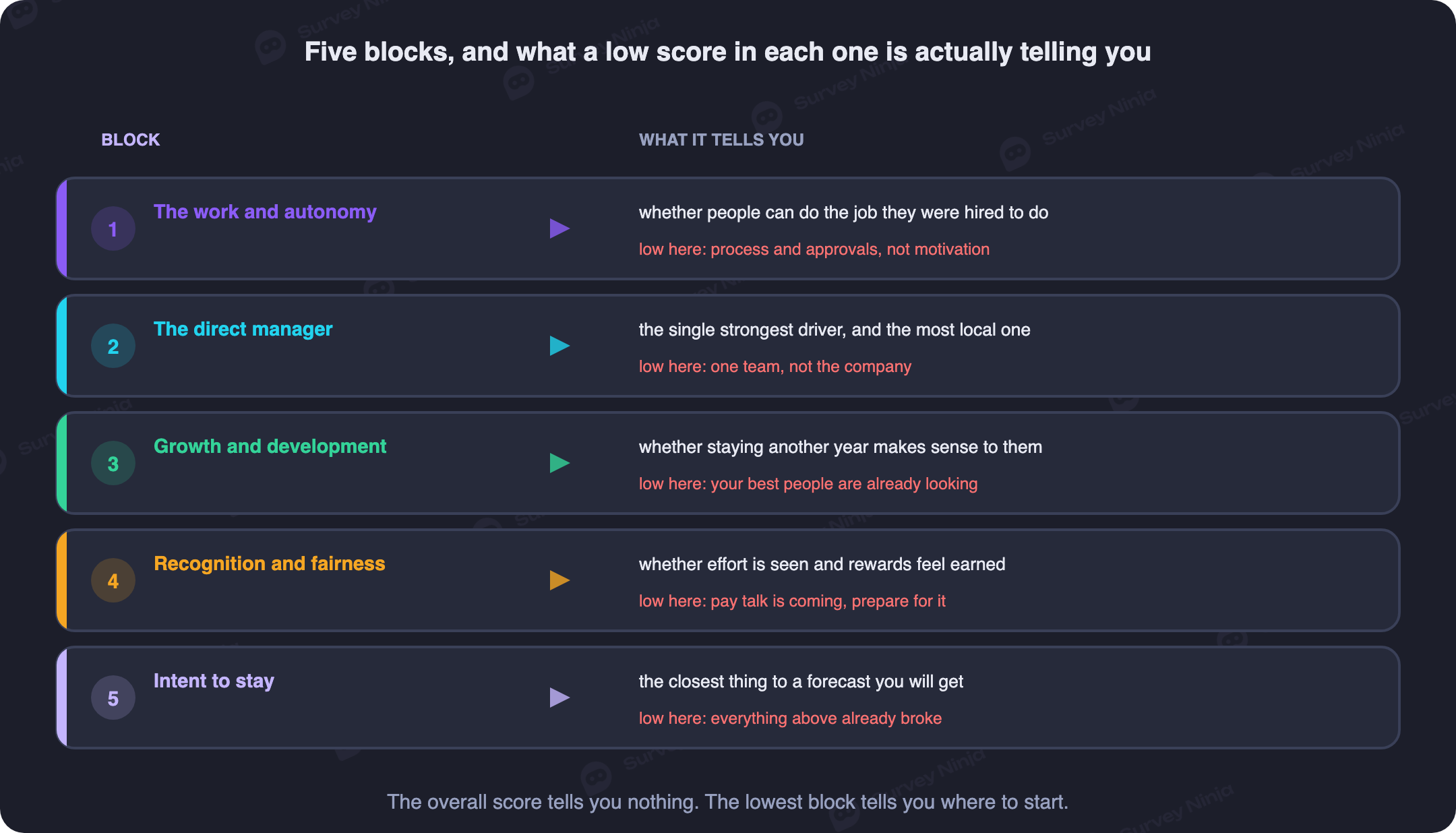
The work itself and how much say you have over it. This is the base layer: whether the job makes sense and whether the person doing it has room to decide how. Skip it and every other block floats without a foundation.
- I understand what a good outcome looks like in my role.
- I have enough control over how I do my work to do it well.
- The work I do here matters, and I can explain why.
- I have the tools and resources I need to do my job properly.
The direct manager. Manager quality predicts turnover better than almost anything else you can put in a survey, which is why this block sits second rather than near the bottom of the form.
- My manager gives me feedback I can actually use.
- I can raise a problem with my manager without it costing me anything.
- My manager makes time for me when I need it.
- Decisions that affect my work get explained to me, not just announced.
Growth and development. The most common reason a strong performer leaves a company they otherwise like is some version of "there was nowhere left to go here," and this block catches that early instead of in an exit interview.
- I can see a path for my career at this company.
- I've had a real conversation about my development in the last six months.
- I'm learning skills here I'll still be using in five years, not just this quarter.
Recognition and fairness. These sit together because they answer the same underlying question: does effort here get noticed and rewarded in proportion to what it costs.
- My work is recognized when it goes well.
- People here are rewarded based on what they actually do, not who they know.
- I'm paid fairly for my role relative to others doing similar work.
- Strong work and mediocre work get treated differently around here.
Intent to stay, and whether the future here still fits. This is the forward-looking block, the closest thing to a leading indicator the survey offers, and the natural home for eNPS.
- I can see myself working here in two years.
- How likely are you to recommend this company as a place to work, from zero to ten?
- What this company is trying to become still matches what I want from my work.
- I would think hard before leaving, even for a modest pay increase elsewhere.
Close with one or two open questions: what would you change first, and what should we absolutely keep doing. The trade-offs between an open question like that and the closed scales above are covered in open versus closed questions. General wording pitfalls, leading phrasing especially, are covered in feedback form questions, and they cost more here than usual: a bad item sitting inside a fixed comparison block distorts the trend for every future wave, not just this one.
A validated instrument or your own questionnaire
The blocks above can be built from scratch, or licensed as a validated instrument such as Gallup's Q12 or one of several similar commercial batteries. Both routes work. They fail for different reasons, so the choice deserves an actual decision rather than whichever one a consultant pitches first.
A validated instrument buys you two things a homemade questionnaire cannot. Wording that's been tested across large samples for ambiguity and bias, and an external benchmark, a number that says whether your 7.2 is genuinely strong for your industry and size band. That second part matters most in year one, when you have no wave of your own yet to compare against.
The cost is real, and it's not only the license fee. The wording is fixed. You can't add a question about the office move or the new commission plan without breaking comparability to the benchmark, which is the entire reason you paid for it in the first place. The benchmark itself ages too. A normed score from a study run five years ago describes a workforce that no longer exists.
Your own questionnaire costs nothing but the time to write it well, and it can ask about whatever is actually happening this quarter: the reorg, the new tool rollout, the return-to-office policy. What it can't do on day one is tell you whether a 7.2 is good. There's no external answer until you've built a second wave of your own to compare it to, and that gap is the real price of going custom.
Pick a validated instrument when you genuinely need to benchmark against your industry, or when leadership won't trust a number built in-house. It also earns its keep when you're running the same battery across many disconnected units and need results comparable across all of them. Pick your own instead when you already know what you're worried about, or when your main comparison will always be your own history rather than a peer group. License budget matters too; most companies under a few hundred people are better off writing their own, since the benchmark rarely resolves anything a good manager conversation wouldn't have resolved anyway. A ready-made engagement template is a reasonable middle position: no license, no benchmark claim, but a starting set of tested wording so you aren't writing item one from a blank page. You can start from a ready-made engagement survey template already built around the five blocks, or generate a version fitted to your sector with the engagement survey generator. Either way your first wave becomes the baseline every later one is measured against.
Cadence: annual, quarterly or pulse
Three cadences cover almost every real program, and the choice trades depth against frequency rather than searching for the objectively correct answer.
| Cadence | Length | What it buys | What it costs | Typical failure |
|---|---|---|---|---|
| Annual | 20-30 questions, all five blocks | Real wave-over-wave comparison, room for slow-moving topics like growth | Speed. A March problem surfaces the following January | Treated as a once-a-year event with no follow-up in between |
| Quarterly | 10-12 questions, one or two blocks rotated | A problem caught within a quarter instead of a year | Needs a person whose job includes acting on it every quarter | Run without action between waves, training people to stop answering honestly |
| Pulse | 3-5 questions, every 2-4 weeks | A read on sentiment within days during a specific window | Almost all diagnostic depth | Left running as a permanent default with nothing urgent to track |
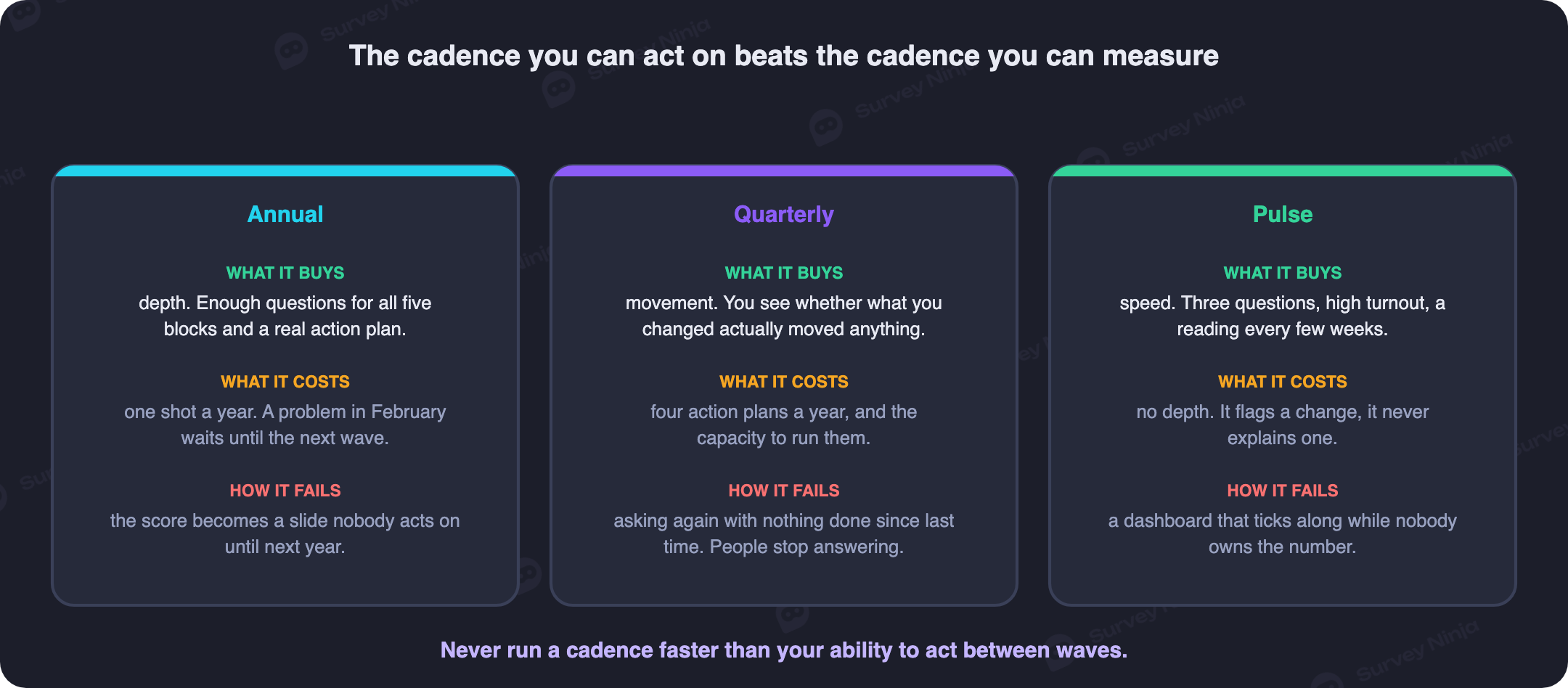
A full annual survey is the right default for a first engagement program and stays the backbone even once you add something faster. It's the only cadence long enough to support a proper wave-over-wave comparison, and the length gives you room to ask about long-arc things like career growth that don't move month to month. The cost is speed: if something breaks in March, the annual survey tells you about it the following January.
A shorter quarterly version rotates through one or two blocks per quarter instead of asking everything every time. It fits organizations with a hundred or more people and someone whose job includes acting on the results, because the entire point of the added frequency is catching a problem inside a quarter rather than a year. Cadence without the staffing to respond becomes the fifth killer from earlier, just repeated four times a year instead of once.
A pulse survey, three to five questions sent every two to four weeks, trades nearly all depth for speed. It suits a defined window, a reorg, a leadership change, a major process rollout, where you need to know within days whether sentiment is moving. It's a poor permanent default, structurally close to a microsurvey in size, because the questions are too few to diagnose anything on their own, only to flag that something needs diagnosing.
The specific failure that shows up with quarterly and pulse cadences, and almost never with annual ones, is running the rhythm without doing anything between waves. A once-a-year survey has twelve months of natural cover for slow action. A quarterly one advertises, by its own frequency, that the company is watching closely, and when three quarters pass with the same unaddressed complaint sitting there, respondents draw the obvious conclusion: answering here changes nothing. The fourth wave gets skipped, or filled in on autopilot. If you can't commit to visible action between two consecutive quarterly waves, run the survey annually instead, and put the difference in effort into making that one action plan real.
Turnout, and how much you can trust it
Read the response rate before you read a single score. A number built on 35 percent of the company is not the same fact as the identical number built on 85 percent, even though the export looks the same either way.
Turnout under roughly half the company is itself a finding, not a footnote to skip past. People who feel unheard skip optional surveys at a far higher rate than people who feel fine, so a low-turnout survey systematically over-represents two groups: the genuinely engaged, who show up for almost anything, and the furious, who show up specifically to vent. The quiet middle, most of the company on an ordinary week, stays home, and its absence pulls the visible score in whichever direction the louder of the two remaining groups happens to lean that quarter.
As a working rule: above roughly 70 to 80 percent, read the results with normal confidence. Between 50 and 70, read them, but treat every conclusion as directional rather than final, especially at the team level where the sample thins out fast. Below half the company, the response rate is the headline. The honest move is reporting the turnout number to leadership before presenting a single score, since a 7.2 built on 40 percent of the roster isn't describing the company. It's describing the 40 percent willing to talk to you.
The fix for low turnout is not a reminder email. It's making last survey's action visible before you send the next one, keeping the questionnaire under ten minutes so completing it on a phone in a five-minute gap is realistic, and having the invitation come from a leader people actually respect rather than an anonymous HR list. The mechanics of where people abandon a form and why are covered in how to reduce survey dropout; most of what that piece says about mid-survey abandonment applies to engagement surveys one step earlier, since a workforce expecting nothing to change abandons the invitation itself, before ever opening the form.
None of this replaces basic sample size math either. A team small enough that even full participation returns eight responses isn't a sample you can read with confidence, turnout aside, and that ceiling matters for engagement surveys just as much as the turnout floor does.
Anonymity and breakdowns, in one paragraph
What anonymous, confidential and pseudonymous actually mean, how re-identification happens in practice, and the mechanics of a minimum reporting group are covered in full in our anonymous surveys guide. None of that changes for engagement work, so read it once and apply it here rather than re-deriving it every cycle. What's specific to engagement surveys is the discipline around breakdowns: managers will ask for their team's numbers, and the moment a report gets cut by department, tenure and location at once, a group of forty can collapse into a group of one without anyone intending it. Set a floor, five to seven responses is a common working number, before you collect a single answer. Apply it to every cross-tab and every filtered view a manager might request, and when a specific request conflicts with the rule, the rule wins. Turn on group-size filtering on reports before launch, not after the first uncomfortable request lands in your inbox.
How to read the results
This is where most engagement write-ups stop, right after the headline number, and it's also where nearly all of the real value sits. Four habits separate a report that leads to decisions from one that leads to a slide.
Read the spread before the average. A block that averages 5.5 because everyone answered five or six is a different situation from a block averaging 5.5 because half the team answered seven and half answered three. The second case means two genuinely different experiences are being averaged into a number that describes neither of them, and no action plan built on the average alone will help the group actually struggling.
Read the lowest-scoring question, not the overall score. The overall number is an average of averages, smoothed until it says almost nothing specific. The single lowest item in the whole survey, recognition, say, or clarity of expectations, tells you exactly where to start, and it usually tells a sharper story than the topline number ever will.
Compare against your own last wave, not an external benchmark. The instrument section above already covers why a borrowed number rarely resolves anything, and it's worth repeating here because the temptation to search for an average score resurfaces the moment leadership sees the topline. Your last wave, same questions, same scale, same people, is the only comparison that actually means something.
Look for where two blocks disagree. A team that scores the work itself highly and the manager block low is telling you something precise: people like the job and don't like how it's managed, which points at a manager conversation rather than a broad culture initiative. A team high on manager trust and low on growth is a different problem entirely, one about ceiling rather than relationship. The disagreement between blocks is usually where the real, addressable problem hides, and a report that only shows five separate averages never surfaces it.
None of these four take more than an extra hour with the export you already have. That hour is usually the entire difference between a survey that produces a decision and one that produces a slide.
What to say before, during and after
Announce the survey from a leader people report to, not from an HR distribution list, and say four things in under a hundred words: why you're asking, what will and won't be visible to whom, how long it takes, and roughly when people will hear something back. An email invitation sent from the CEO or a senior lead outperforms the identical invitation sent from HR, for the plain reason that people read intent into who is asking.
During collection, one or two reminders to people who haven't responded is enough. More than that reads as pressure, and pressure applied to a survey you're calling anonymous sends a mixed signal people notice.
The after message is the one that decides next year's turnout, and it's the one most programs skip or delay past the point where it still matters. A summary within two to three weeks, while the survey is still fresh, needs to say three things: what came in, in rough terms; what you're doing about the two or three biggest items; and what you heard but aren't acting on this cycle, stated plainly rather than buried. That last part matters more than it looks. Silence on something people raised reads as either it wasn't heard or it was dismissed, and both readings cost the same thing: a lower response rate next time, because the people who answered honestly just learned that honesty didn't change anything visible.
The action plan, the step everyone skips
Everything up to here produces a diagnosis. This step turns it into a decision, and it's the one most survey write-ups quietly drop right after the slide with the score.
Pick two things. Not the fifteen items sitting below your reporting threshold, two. The lowest-scoring question and whichever single item moved the most since the last wave make a defensible starting pair, and picking exactly two forces the kind of prioritization a long list lets everyone avoid.
Name an owner and a date for each. "HR will look into recognition" is not a plan. It's a sentence that dissolves the moment the meeting ends. "Maria will roll out a monthly recognition ritual to all managers by the fifteenth" is a plan, because someone specific can be asked about it in six weeks and either has done the thing or hasn't.
Say publicly what you will not do this cycle, and why. Nearly every company skips this part, and it does more for trust than almost anything else on this list. "We heard the feedback about compensation review timing. We can't move that this year because of the budget cycle, and we'll revisit it in the next planning round" costs you nothing and buys more credibility than silence would, because it proves someone actually read the comment instead of routing it to a folder.
Report back before the next wave opens, not during it. A three-line update, here's what we said we'd do, here's what actually happened, closes the loop the after-message above started. It's also the single biggest lever on the turnout problem: a company that visibly acted on last year's answers gets a materially higher response rate this year, the same way a store with a working returns policy earns more first-time customers.
A realistic timeline for one cycle
A full annual cycle, from deciding to run it to reporting back on the action plan, takes about ten to twelve weeks when nothing slips. Something almost always slips by a week or two, so plan for that instead of being surprised by it.
- Weeks 1-2: build and pilot. Draft the questionnaire from the five blocks, run it past five or six people outside HR for wording problems, and fix anything that reads as leading or ambiguous before it reaches everyone else.
- Week 3: announce and open. Send the leader-authored announcement, open the survey, and keep it open for one to two weeks depending on company size.
- Weeks 4-5: collect, with one reminder. Track turnout daily. If it stalls under half by the midpoint, that's a signal to check the invitation channel, not to extend the deadline indefinitely.
- Week 6: analyze. Read the spread, the lowest item, the wave-over-wave comparison and the cross-block disagreements before anyone drafts a slide.
- Week 7: pick two priorities and assign owners. A short meeting, not a workshop, because narrowing to two already happened in the reading step.
- Week 8: publish the summary and the plan. Company-wide, including the one item you're explicitly not acting on this cycle.
- Weeks 9-12: check in on the owners. A short status update partway through the quarter, ahead of the next survey rather than instead of it.
Common mistakes
- Publishing one score with nothing to compare it to. A 7.2 in a vacuum is a fact nobody can act on.
- Writing fifty questions because a template has fifty. Past roughly twenty five, people straightline the back half and the data quietly stops being honest.
- Calling it anonymous while collecting email addresses. The first time someone notices, every future survey inherits the distrust.
- Reporting a breakdown below your floor because a manager asked. The rule has to beat the request every time, or it was never really a rule.
- Comparing your score to an industry average found online. Different scale, different wording, different workforce; the comparison tells you nothing real.
- Running a quarterly pulse with no one assigned to act between waves. The frequency itself becomes the promise, and a broken quarterly promise costs more trust than an annual one.
- Presenting the score before the response rate. A number built on 35 percent of the company needs that context stated first, not buried in a footnote.
- Going silent after collection. No visible action is the single biggest reason turnout drops on the next survey.
Frequently asked questions
What is employee engagement, and how is it different from job satisfaction?
Engagement is discretionary effort, whether someone gives more than the job strictly requires and keeps doing it without being asked. Satisfaction is about conditions: pay, hours, comfort. A well-paid, comfortable employee can be entirely satisfied and still disengaged, doing exactly what's required and nothing more.
How many questions should an employee engagement survey have?
Fifteen to twenty two works for most annual surveys: three to five questions across five blocks, the work itself, the manager, growth, recognition and fairness, and intent to stay, plus one or two open questions. Past roughly twenty five, answers start straightlining and the data quietly loses accuracy in the back half of the form.
Should we use a validated instrument like Gallup Q12 or write our own questions?
Use a validated instrument when you need an external benchmark and can live with fixed wording; it costs money and can't be edited to fit this quarter's specific situation. Write your own when you already know what you're worried about and your main comparison will always be your own history rather than an industry number. Most companies under a few hundred people are better served by their own questionnaire.
How often should we run an engagement survey?
A full annual survey is the right default and the only cadence deep enough to support a real wave-over-wave comparison. Add a shorter quarterly version only if someone is specifically responsible for acting on it, and a short pulse only around a defined window like a reorg. Running any cadence more often than you can act on trains people to stop answering honestly.
What response rate do we need before we can trust the results?
Above roughly 70 to 80 percent, read the results with normal confidence. Between 50 and 70, treat conclusions as directional, especially by team. Below half the company, the turnout number is itself the finding, since people who feel unheard skip the survey at a higher rate than everyone else, which skews the visible score.
Can we keep an engagement survey anonymous and still break results down by team?
Yes, up to a floor. Set a minimum reporting group, five to seven responses is a common working number, before you collect a single answer, and apply it to every cross-tab and filtered view, not just the top-level report. A group that would fall below the floor gets folded into a broader category instead of reported on its own.
Should we look at the overall score first when the results come in?
No. Read the response rate first, then the spread inside each block rather than just the average, then the single lowest-scoring question, then where two blocks disagree with each other. The overall score is the least informative number in the whole report, and reading it first tends to anchor every conclusion that follows.
What is the most important thing to do after an employee engagement survey?
Pick two priorities, not fifteen, assign a named owner and a real date to each, say publicly what you are not addressing this cycle and why, and report back on progress before the next wave opens. Skipping this step, running the survey with no intention of acting on it, does more damage to trust than not running the survey at all.
Published: Sep 2, 2026