 25 Questions for a Travel Agency Customer Satisfaction Survey
Exit Interview Questions People Actually Answer Honestly
Useful  Mike Taylor Updated: Sep 29, 2026 Reading time ≈ 28 min

Every exit interview produces an answer. Most produce the same one: no real complaints, just chasing growth. That sentence is rarely a lie. It is a person managing risk on the way out the door, and treating it as the plain truth is where most exit interview programs quietly fail.
What an exit interview is actually for
On paper, an exit interview is simple: a short conversation with someone who is leaving, meant to learn something useful before they go. In practice, picture the standard version. Thirty minutes on a shared calendar during someone's last week, a page of tidy notes, a folder nobody reopens. The person on the call already has a start date somewhere else. They are polite, brief, and give an answer that closes the conversation rather than opening one. That version is common, and it is close to worthless.
An exit interview is not closure for the person leaving. They rarely need it, and if they do, that is what a personal goodbye from a colleague is for, not a structured conversation with HR. It is not a courtesy either, a box checked so offboarding looks complete on paper. And it is not primarily a file kept for the record, in case a claim surfaces later, though it can serve that purpose as a side effect.
What it actually is: one input into reducing regretted attrition, meaning the departures of people you would rather have kept. Not every exit is regretted. Someone who was struggling with the role, or whose fit with the team never quite worked, leaving is a relief dressed up as a loss. The exit interview earns its keep on the other group, people doing good work who chose to leave anyway, because their reasons are usually fixable and usually repeat across other people too.
Here is the test that separates a real program from a ritual. If nothing in the business has changed because of what exit interviews turned up over the last year, not a policy, not a manager conversation, not a pay adjustment, stop running them. A process that produces only a filed transcript is not gentler than no process at all. It is worse, because it creates the appearance of listening without the substance, and people notice the gap eventually, including the ones who are still employed.
The conversation is not neutral, and here is why
Before any question wording, deal with the actual obstacle. The person answering has reasons, plural, to shade the truth toward pleasant, and almost none of them are about protecting the company.
The first is the reference. Most people leaving a job will, at some point, need someone at that company to say something decent about them to a future employer. Burning that bridge over an exit interview, a conversation nobody outside HR will ever read verbatim, is a bad trade for almost anyone. So specific grievances get rounded into vague, safe language. "Not the right fit for where the team was heading" stands in for "my manager took credit for my work twice."
The second is how small most industries actually are. Two or three moves in, most professionals operate inside a network where the same fifteen or twenty companies recruit from each other, sit on the same panels, and know each other's leadership by name. Word travels through that network far more easily than an org chart suggests, and a departing employee usually knows it. Total honesty in an exit interview can cost real relationships years later, for a benefit that mostly accrues to the company, not to the person answering.
The third is the boomerang possibility. Rehiring people who left on good terms has become common enough that most experienced professionals now factor it in, consciously or not. Burning the door on the way out forecloses an option that costs nothing to keep open. So even someone with real, specific complaints will often pick the version of events that leaves the door swinging rather than the one that slams it shut.
The fourth is the most direct: sometimes the interviewer is part of the reason. If the departing employee's manager runs the conversation, the bias is obvious and nobody pretends otherwise. It is less obvious, and just as real, when HR runs it. HR usually reports through the same leadership chain the person is leaving because of, and the departing employee generally knows that too. Telling HR that a specific director is the reason you quit is telling the org chart's own reporting structure, which is a strange thing to expect candor from.
None of this means exit interviews are pointless. It means the honest reason someone left is systematically underrepresented in the data you collect by default. Every decision from here, who asks, when, in what format, is either fighting that bias or quietly reinforcing it.
Who should run the conversation
There is no interviewer who gets full candor for free. Every option trades some access to the truth for some practicality, and the honest move is picking the trade deliberately instead of by default org chart logic.
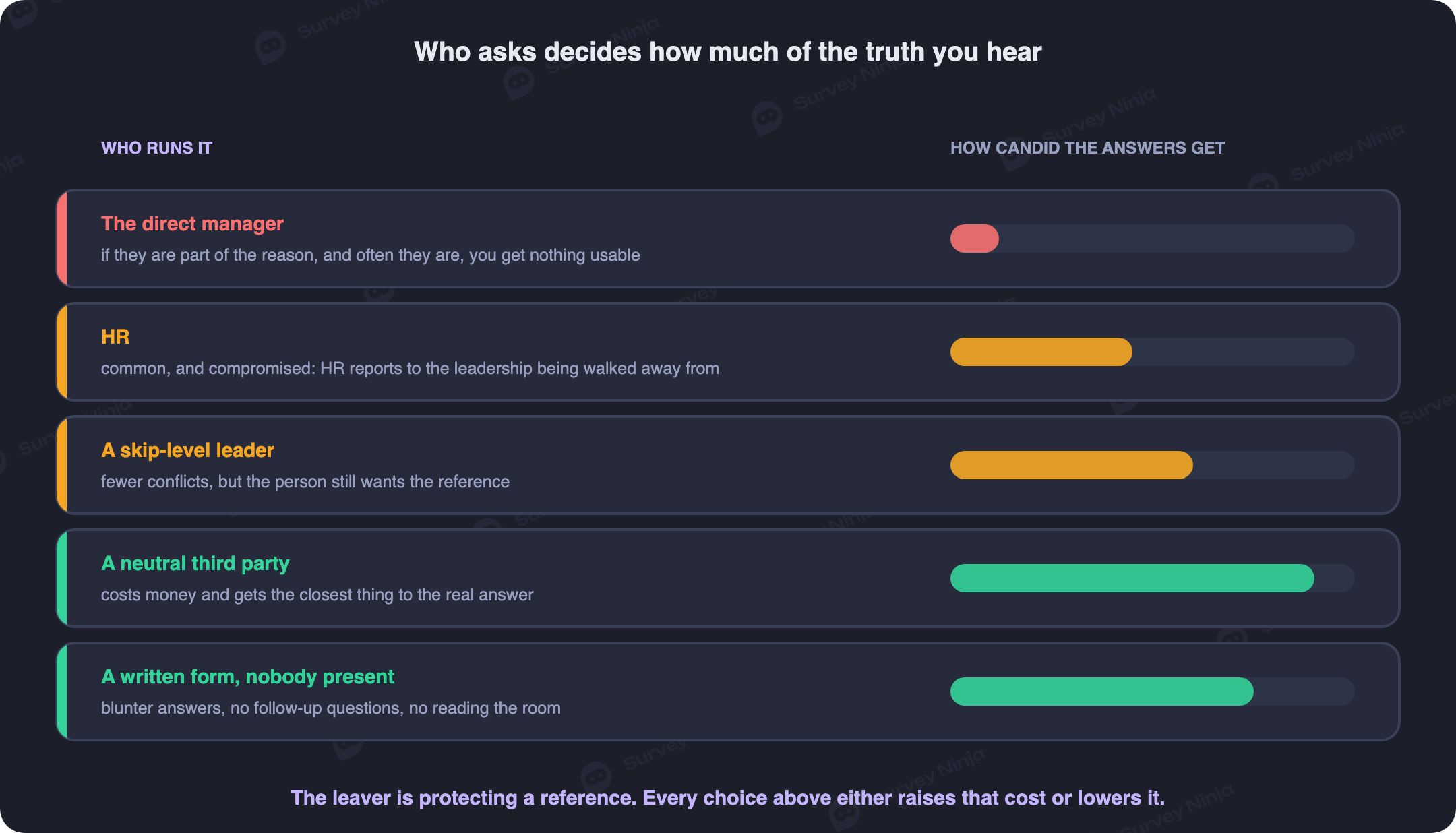
The direct manager should almost never conduct it. Even when the relationship was fine, the structural conflict is unavoidable. This is the one person the departing employee has the strongest incentive not to criticize to their face, reference or no reference. If the manager is part of why someone left, which happens often enough to plan for, putting them in the room guarantees a useless conversation.
HR is the common default, and it is a real improvement over the manager, but it is not neutral. HR usually reports up through the same leadership the departing employee may be quietly criticizing, and most employees are aware of that reporting line even if nobody states it out loud. What HR buys is consistency. The same person or team running every exit means comparable notes and comparable follow-up questions across many departures, which matters once you start looking for patterns.
A skip-level leader, someone senior but outside the chain directly under discussion, often gets more candor about a specific manager than HR does, because talking to the boss's boss carries a certain protection that talking to HR doesn't quite have. The cost is time from someone senior, and inconsistent execution, since not every departure gets a skip-level's calendar.
A neutral third party, an HR business partner with no stake in the team's outcomes, or an outside consultancy brought in specifically for exits, buys the most candor of the live options, because there is no reporting line left to protect. It costs money or process overhead that many smaller companies will decide isn't worth it for routine departures, and is better reserved for senior roles or exits with obvious tension.
A written form with nobody in the room is the bluntest of all on sensitive line items: pay, a named manager, a specific complaint. There is no face to manage and no body language to read. What it cannot do is follow up. A vague answer stays vague forever if nobody was there to ask what it meant.
| Who asks | What it buys | What it costs |
|---|---|---|
| Direct manager | Immediate reaction to specific recent events | Almost no candor if the manager is part of the reason |
| HR | Consistent process, comparable notes across exits | Same leadership chain as the person may be criticizing |
| Skip-level leader | More candor about the immediate manager specifically | Senior time, inconsistent across departures |
| Neutral third party | Highest candor, no reporting line to protect | Cost or overhead, hard to justify for routine exits |
| Written form, nobody present | Blunt answers on sensitive line items | No probing, vague answers stay vague |
Most companies land on a workable compromise. HR runs the live conversation, a skip-level or third party is reserved for exits where the stakes are obviously high, and a written form runs in parallel to catch what the live version misses. None of the options gets everything. Combining a couple of them gets you closer than picking one and hoping.
Ask twice, not once
Most companies interview once, during the notice period, and consider the topic closed. That single conversation happens at the worst possible moment for honesty and the best possible moment for logistics, which is exactly backward from how most programs are designed to use it.
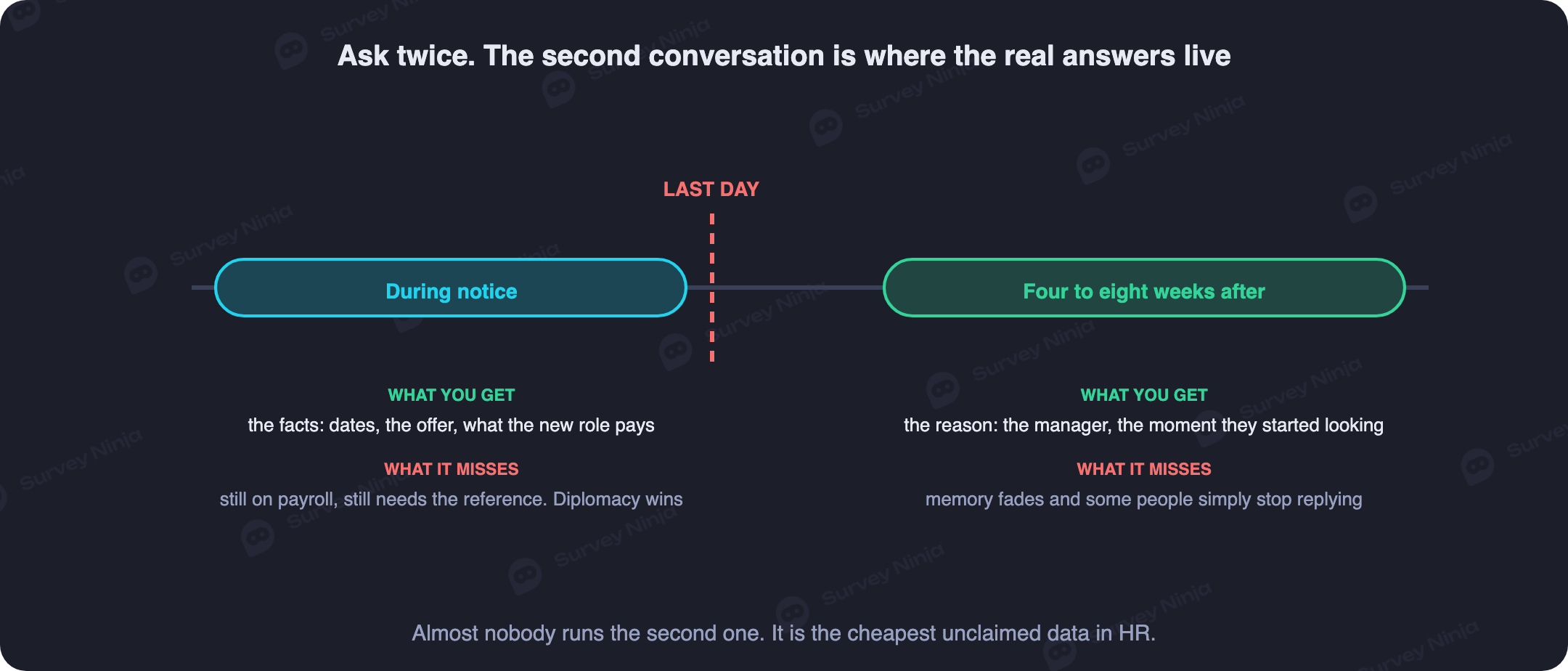
During notice, the person is still your employee. They may need a reference from this manager within the year. Their final paycheck, their last performance review, their handoff, their goodwill toward former colleagues, all of it is still live and still theirs to manage. Whatever they say lands inside that context, whether they intend it to or not. What you reliably get here is logistics, a clean handoff, and reasons phrased carefully enough to be true without being complete.
Weeks after departure, once they have started somewhere new and have nothing left riding on this employer's opinion of them, the calculation changes. The reference is either secured or irrelevant by then. A manager conflict that felt too risky to name with a badge still active often gets named plainly once it costs nothing to say. This is where the real reason usually surfaces, if it was ever going to surface at all, and it is the round almost nobody runs.
The mechanics are simple. Send a short follow-up, four to six weeks out as a rule of thumb, to a personal email address rather than the one that no longer exists, framed explicitly as separate from anything discussed during notice. Keep it brief. This is not the moment to ask fifteen questions of someone who has already moved on. It is the moment to ask the two or three that during-notice diplomacy was least likely to answer honestly.
Conversation or a written form
Each format is good at exactly what the other is bad at, which is the whole argument for using both rather than picking a favorite.
A live conversation gets nuance. A skilled interviewer can follow up on "it just wasn't working anymore" and discover it was a specific reorg six months earlier that nobody explained well at the time. It catches things nobody thought to ask about in advance, because a good follow-up question doesn't exist on any form. The cost is the presence of another person, which invites the same diplomacy problem covered above, and notes taken live are lossier than a typed answer, however careful the interviewer is.
A written form gets blunter answers, especially on the sensitive line items: pay, a manager's name, a specific complaint about a colleague. There is no face across the table to manage, and typing a hard sentence is easier for most people than saying it out loud to someone taking notes. What it cannot do is dig. "Communication issues" on a form stays exactly that vague forever, because nobody was there to ask what it meant.
For most companies the sensible setup pairs both, and the order follows the timing question directly. Run the live conversation during notice, while scheduling a call is easy and the person is still reachable through normal channels. Run the written form as the delayed round weeks later, when arranging a live call is awkward for both sides anyway and the blunter written format suits someone who has already mentally left. The two formats end up matched to the two windows almost by accident, and the match works in both directions: live conversation where nuance is available, written form where bluntness is.
Whether you can record a live conversation, and what you are required to keep or allowed to discard afterward, differs by country and often by company policy on top of that. Check with whoever handles employment matters for you before this becomes a problem rather than a plan.
The questions, organized by what you are trying to learn
A flat list of exit interview questions is easy to find and mostly useless, because the value sits in matching a question to what you actually want out of it. Organize by goal instead, and wording gets easier to adapt once the goal is clear.
Why they started looking. The trigger matters more than the accumulated list of complaints, because a trigger is a specific, often fixable event, while a complaint list is mostly atmosphere.
- What was happening in your work life when you first started paying attention to other openings?
- Was there a specific moment you would point to as the one where you decided you were done, even if you didn't act on it right away?
What the new role offers that this one didn't. This is the closest thing to a direct comparison you will get, and it is concrete in a way general dissatisfaction never is.
- What does the new role give you that this one didn't?
- If we had been able to offer that here, would it have changed your decision?
The manager relationship. Approach it carefully, and never as a rating with a name attached. Ask about the relationship itself.
- How would you describe your working relationship with your manager over the past year?
- Was there ever a conversation you needed to have with your manager but never had?
Growth. Stagnation rarely announces itself. It accumulates quietly until it becomes the whole reason.
- Did you have a clear sense of what came next for you here?
- When did you last feel like you were learning something new in this role?
Workload and burnout. Ask about a period, not a mood. Moods are unreliable, and periods are checkable against what actually happened.
- How would you describe your workload over the last six months?
- Was there a point where the job stopped feeling sustainable, and if so, when?
Pay and fairness. This category gets skipped more than any other, usually out of discomfort, which is exactly why it needs a direct question rather than a hint.
- Was compensation a factor in your decision to leave?
- Did you feel your pay kept pace with how your role changed over time?
What would have kept them. The single most valuable question in the whole set, because it tells you directly whether this exit was preventable and, if so, exactly what would have prevented it.
- Realistically, is there anything that could have changed your mind in the last month before you decided to leave?
What to fix for whoever comes next. Reframing the question around a successor rather than the company gets people to answer plainly, since it reads as practical advice to a stranger rather than a complaint on the record.
- What is one thing you would change for the person who takes over your role?
- What do you wish someone had told you when you started here?
Two of the questions above carry more weight than the rest. "Is there anything that could have changed your mind" tells you whether the exit was preventable at all, which most of the others don't. And "what was happening when you first started looking" pinpoints the trigger rather than the accumulated grievance, which is where the actionable detail usually lives. If a program only has time for two follow-up questions past a scripted opening, those are the two.
Questions to cut
A few questions show up in almost every generic template and earn their place in none of them.
"Would you recommend us as an employer?" asked to someone actively leaving is close to nonsensical. The answer is contaminated by the question itself. A person walking out the door either softens the answer to stay diplomatic, or inflates a complaint because there is no cost left to doing so. Ask this one of current employees on an engagement survey, not someone on their way out.
Anything asking the departing employee to rate a named individual by number, one to five on their manager, one to five on a colleague, reads less like research and more like HR building a file. People sense that and respond one of two ways: a guarded, safe score that tells you nothing, or a refusal to answer at all. It is also unfair to the person being rated, who never sees the score and never gets to respond to it.
Anything that reads as defending the company rather than learning from the departure belongs low in the list, or out entirely. "What did you like best about working here" as an opening question primes a pleasant answer before the harder ones get asked. It works fine as a closing softener. It is the wrong first question.
Confidentiality, and the promise you cannot make
General anonymity mechanics, what the word actually requires and where it breaks down in practice, are covered in anonymous surveys. Exit interviews carry one problem specific to them, worth stating plainly here.
In a small team, a single exit interview is identifiable by definition. If four people report to one manager and one of them leaves, "an anonymous exit interview flagged concerns about management style" has exactly one possible author, whether or not a name is attached anywhere. Promising anonymity to that one person is a promise you cannot structurally keep, no matter how carefully the form is built.
The honest alternative is confidentiality with a named boundary, stated before the conversation starts rather than discovered afterward. Say precisely who reads the raw answer, typically an HR partner and one named senior leader, never the manager under discussion. Say what moves upward from there: coded themes and trends, not verbatim quotes attributable to one person, especially not into a room where the departing employee's old manager might be present. Then hold that boundary without exception, because the value of the whole program rests on people believing the boundary is real the next time someone considers being candid.
From one exit to a pattern
One exit interview is an anecdote. If the stated reason is "the commute got worse," that is true, and it tells you almost nothing about the organization, because it is specific to one person's circumstances.
The value shows up once answers get coded into a fixed set of themes, manager conflict, workload, pay, lack of growth, and so on, across many exits, and you watch which theme grows relative to the others over time. A single loud, detailed complaint can look like a crisis in isolation, and turn out to be one person's bad month once it sits next to twenty quieter, more consistent responses. The method for turning open text into countable themes is covered properly in thematic analysis. The exit-specific point is simpler: the themes need to be fixed in advance and applied consistently, or you cannot compare one quarter to the next.
As a rule of thumb, treat anything under roughly eight to ten coded exits in a rolling quarter as too thin to act on structurally, one dramatic exception aside. Below that range, a single vivid complaint can read as a trend that a slightly bigger sample would show isn't one. Above it, a theme recurring across unrelated people and unrelated departure dates is worth treating as real, even without a larger, more formal study behind it.
Where exit interviews and engagement surveys disagree
The two instruments answer different questions, and conflating them causes most of the confusion companies run into. An engagement survey tells you who might leave. An exit interview tells you why someone actually did. They are not two measurements of the same thing, and treating a gap between them as a contradiction misses the more useful reading.
When someone scores high on engagement a month before resigning, then names a specific manager conflict or a burnout period on the way out, the mismatch is not a data quality problem with the exit interview. It is usually the engagement survey that was being flattered. People answer engagement surveys about a job they still depend on, often on a cadence where a manager can see who participated even without seeing individual answers, and that context shapes responses even when nobody intends to lie. The exit interview, especially the delayed round weeks after departure, comes after that dependency is gone.
The practical instruction is straightforward. When a high-engagement employee leaves for reasons that contradict their last survey, treat the exit interview as the more trustworthy account for that specific person. Treat the size of the gap itself as a data point about your engagement survey generally, since a program where this keeps happening is one where employees do not feel safe answering honestly while still employed, which is a bigger problem than any single exit.
Turning answers into action
Access should narrow as detail increases. Raw individual transcripts stay with a small, named group, typically the HR partner running the program and one senior leader, never the departing employee's manager. A coded summary, rolled up by theme with counts and no names attached, is what moves to department heads and leadership, usually on a quarterly cadence.
A quarterly readout worth reading contains a few specific things: how many exits were coded that quarter, the top three or four themes and whether each grew or shrank against the previous quarter, one or two de-identified quotes per theme so the report reads as real conversations rather than an abstract percentage, and any theme that repeats across multiple, unrelated people.
That last point deserves its own sentence, because it is the one companies most often soften into something safer. If three separate exits in a single quarter name the same manager as a contributing reason, that is not a data point to fold into "manager relationship, 23 percent" and move past. That is the finding. A readout that buries it inside an aggregate theme has technically reported the data and completely failed the purpose of collecting it.
Common mistakes
- Running it once, during notice, and never again. The delayed round after departure is where the honest answers usually live, and skipping it throws away the most useful data for the cost of one follow-up email.
- Letting the departing employee's manager conduct or sit in on the conversation. The structural conflict makes candor close to impossible, regardless of how the relationship actually was.
- Promising anonymity a small team cannot structurally deliver. Promise confidentiality with a stated boundary instead, and hold it.
- Treating one dramatic exit as a mandate. A single vivid story is an anecdote until it recurs across unrelated people; act on the pattern, not the anecdote.
- Asking "would you recommend us as an employer," or rating a named manager by number. Both questions produce guarded or contaminated answers and belong nowhere near an exit interview.
- Collecting themes and never producing a readout anyone reads. Data with no route to a decision is a cost with no return, and employees eventually notice that nothing changes.
- Ignoring a repeated name because it is politically inconvenient. The manager named in three exits is exactly the finding the program exists to surface, not the one to soften.
- Assuming the engagement survey number is the honest one when the two disagree. Usually it is the reverse.
- Concluding that everyone says the same polite thing, so the process is pointless. That is true of a badly designed process. The fix is redesigning who asks, when, and in what format, not abandoning the question.
Building the process without extra headcount
None of this requires a research team. It takes a written form built once and reused consistently, a short conversation guide for the live round, and a fixed set of themes that does not change every quarter, because comparability over time is most of the value.
Starting from a ready-made exit survey template avoids the wording mistakes covered above before you even have to think about them, and an exit interview question generator can adapt the wording to your own common reasons for turnover instead of a generic set. Where exits are frequent enough to warrant it, a dedicated exit survey workflow keeps the delayed round from depending on someone remembering to send it manually.
SurveyNinja covers the mechanics: branching logic that routes a low workload score toward a follow-up question without lengthening the form for everyone else, hidden fields for tenure and department so a theme can be sliced by team without asking twice, and filtered reports for building the quarterly readout instead of recoding open text by hand every time. The free plan has no cap on responses, which matters for a use case that is naturally infrequent per person but needs to run indefinitely; see the pricing page for what is included at each tier. Build the form, pair it with a short live conversation during notice, and put the delayed follow-up on a recurring reminder so it survives past the person who first set it up.
Frequently asked questions
What is an exit interview actually for?
Not closure for the person leaving and not a courtesy for the record. It is one input into reducing regretted attrition, meaning the departures of people the company would rather have kept. If nothing in the business changes because of what exit interviews turn up, the process is not working, and running it again unchanged will not fix that.
Should the departing employee's manager conduct the exit interview?
Almost never. The structural conflict is unavoidable: the manager is the one person the departing employee has the strongest incentive not to criticize directly, and if the manager is part of the reason for leaving, having them run the conversation guarantees a useless one.
Why are exit interview answers usually so diplomatic?
Several overlapping incentives push toward polite answers: the need for a future reference, how small most industries actually are, the chance of being rehired later, and the fact that the interviewer, HR included, often reports through the same leadership the person may be criticizing. None of it means people are lying so much as managing risk on the way out.
When should you run an exit interview?
Twice, ideally. Once during the notice period, which is convenient but happens while diplomacy still has a purpose. And again four to six weeks after departure, once the person has nothing riding on this employer's opinion anymore, which is where the more honest answers usually surface.
Should exit interviews be anonymous?
Usually not literally, because in a small team a single exit interview is identifiable by definition regardless of what the form promises. Promise confidentiality with a named boundary instead: state who sees the raw answer, what moves upward as a theme rather than a quote, and hold that boundary consistently.
How many exit interviews before a pattern is worth acting on?
As a rule of thumb, treat anything under roughly eight to ten coded exits in a rolling quarter as too thin to act on structurally, one dramatic exception aside. Above that range, a theme recurring across unrelated people and dates is worth treating as real.
What is the difference between an exit interview and an employee engagement survey?
An engagement survey tells you who might leave. An exit interview tells you why someone actually did. When the two disagree, for instance a high-engagement score followed by a resignation citing a specific manager conflict, the engagement number is usually the one that was being flattered, not the exit interview.
What questions should be avoided in an exit interview?
"Would you recommend us as an employer" asked to someone who is leaving, anything asking to rate a named manager or colleague by number, and any question that reads as defending the company rather than learning something. All three produce guarded or contaminated answers instead of usable information.
Updated: Sep 29, 2026 Published: Sep 6, 2026