


How to Run a Brand Awareness Survey
Useful  Mike Taylor Updated: Oct 11, 2026 Reading time ≈ 16 min
A brand awareness survey measures whether people can recall or recognize a brand within a category. This guide explains how to choose the audience, protect unprompted answers, write a short questionnaire, and report three awareness measures with clear denominators.
What a brand awareness survey measures
Awareness has several meanings. Unaided recall asks people to name brands without seeing suggestions. Aided recognition asks whether they recognize brands in a supplied list. First mention, often called top of mind, records the first brand a person names. Because a list supplies a cue, someone who cannot name Morrow in the open questions may still recognize it beside relevant competitors; that difference is exactly what the two blocks are designed to capture.
These responses answer different questions. Recognition concerns familiarity with a supplied name; recall concerns bringing a name to mind. First mention identifies which name surfaces first under the survey's wording, while purchase intent, sales, and market share require separate evidence about what people want or actually buy. Qualtrics' brand research guidance uses a category prompt and a first-brand question for unaided awareness.
Keep the research focused on a decision, such as whether a local bottle brand needs broader visibility among recent category buyers. An awareness survey can reveal a recognition gap worth investigating. A complete brand health study would also examine associations, preference, experience, and other outcomes. Adding every possible measure to one form makes the central question harder to answer.
Define the audience before choosing questions
Define the category, market, age range, and relevant time window; for the questionnaire below, the population is adults in a specified market who bought a reusable water bottle during the past six months. That definition gives the team an audience it can seek and a category participants have recently encountered.
Recent buyers are a particular population. They exclude people who may buy later, use a bottle received as a gift, or last purchased a bottle years ago. If the decision concerns all potential buyers, design eligibility around that broader population instead. The target audience guide helps turn a loose idea of the market into explicit inclusion rules.
Your customers and social followers can be useful research participants, but they already have a relationship with your brand. Their awareness results describe that group. A mailing list of Morrow customers cannot automatically estimate awareness among everyone buying bottles in the market. Recruitment must reach the people described in the study definition, including customers of other brands.
Plan subgroup bases first. A total of 200 does not provide 200 answers in every city or age group. The sample size calculator can support planning under its stated assumptions; it cannot correct selective recruitment. A large convenience sample may still miss parts of the market, and its size alone does not justify a conventional margin of sampling error.
Protect recall from early brand cues
Review everything participants encounter before the open questions: invitation, sender name, survey title, introduction, logos, and eligibility screens. A message headed "Help Morrow understand bottle buyers" has already supplied an answer. A brand logo can do the same. Asking whether people own Morrow products during screening also contaminates a later unprompted question.
A neutral invitation might say: "Take a short study about reusable water bottles. We are interested in the brands people know. Participation is optional." Add truthful details about the research organization, privacy, purpose, and actual time required. Follow the email survey guide for delivery, then audit the invitation specifically for brand cues.
Required truthful disclosure takes priority. If a sponsor must be identified before participation, identify it. Do not invent an independent sender or conceal identity deceptively to obtain cleaner recall. Record that the sponsor name could have prompted respondents, and qualify the resulting recall measure. A neutral category title does not undo a branded invitation.
Place brand lists and experience questions after both open recall questions. Pew Research Center explains that earlier closed questions can supply concepts people later mention in open answers. During testing, also check whether respondents can revisit recall after seeing the list. Record that risk if the survey setup permits it.
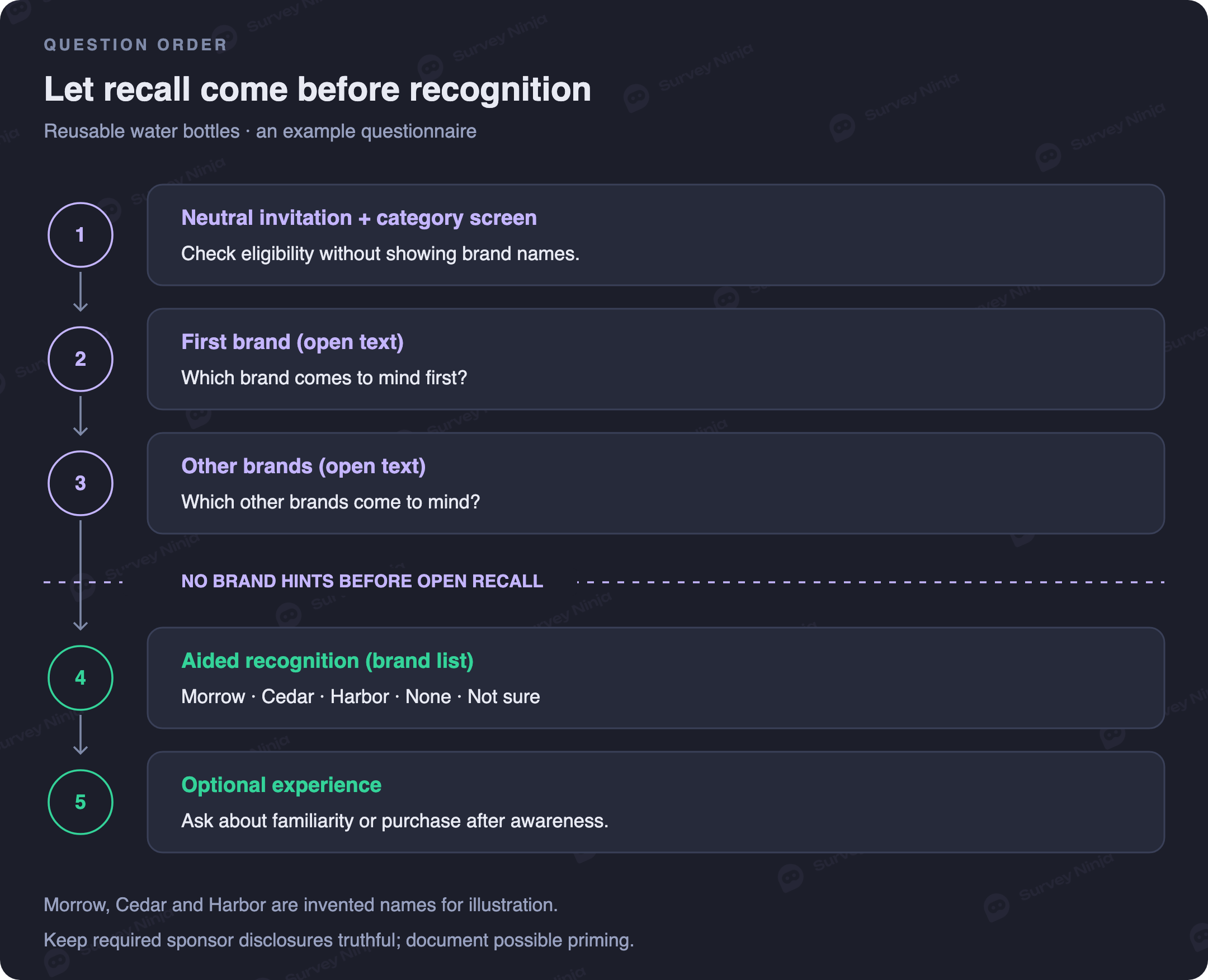
Use this short questionnaire in this order
Confirm market and adult eligibility without naming a bottle brand. Then use the following original questions. Replace the category and time window consistently if the study has a different population. The guide to open and closed questions explains why the two formats require different analysis.
- In the past six months, have you bought a reusable water bottle for yourself or someone else? Single choice: Yes; No; Not sure. Only Yes qualifies for this recent-buyer study. End other paths politely, without treating them as awareness answers.
- Thinking about reusable water bottles, what is the first brand that comes to mind? One open text answer. Ask for one name only and allow an explicit "No brand comes to mind" or "Don't know." Keep skipping distinct from these answers.
- What other reusable water bottle brands, if any, come to mind? A separate open text answer. Participants may name several brands or explicitly answer "No other brands" or "Don't know." Do not show examples or suggest a target number.
- Before taking this survey, which of these reusable water bottle brands had you heard of? Multiple choice: relevant real brands in the market, plus "None of these" and "Not sure." Allow several brand selections. None and Not sure must each be exclusive of brands and of each other.
- How familiar are you with [focal brand]? Optional single choice after the awareness questions: Know the name only; Know something about its bottles; Know its bottles well; Had not heard of it before this survey; Not sure. This adds context without changing the earlier awareness answers.
- Have you bought a [focal brand] reusable water bottle in the past six months? Optional single choice: Yes; No; Not sure. This describes reported recent purchase among respondents, rather than establishing the brand's market share.
The aided list needs relevant competitors and consistent name presentation. Morrow, Cedar, and Harbor are invented names for this article's demonstration, not decoys to insert into a real study. Use genuine brands when collecting actual awareness data. Avoid giving your own brand a logo while presenting competitors as plain text.
List order can influence selections. If the research requires rotated versions, plan and document those versions and their allocation separately. Check what your actual survey setup supports; do not assume automatic list randomization. For a fixed list, keep the order stable across waves and report that choice.
Pilot the questionnaire and recruit suitable participants
Ask a small group resembling the intended audience to complete the questionnaire and explain how they understood each question. Did "reusable water bottle" include sports bottles? Did "bought" include gifts? Can they distinguish a name they recognize from one they first saw in the survey? Revise confusing wording before fieldwork. AAPOR recommends pretesting questions and piloting survey procedures.
Test every route. On a desktop and a phone, try an eligible person who recalls several brands, one who knows none, an uncertain respondent, an ineligible respondent, and someone who skips an awareness item. Check that None cannot be submitted with brand selections. Test returning to earlier screens and inspect how those answers are recorded.
A successful test response proves the form can collect an answer. It does not prove the audience is representative or that awareness is high. Keep pilot answers separate from the main study, especially if wording changes afterward.
Recruitment is a separate task. Consider a suitable research provider, category communities, or other routes that can reach the defined population. Evaluate who each route excludes and how incentives might affect participation. The respondent recruitment guide describes possible sources; creating a survey does not supply a built-in panel.
Record recruitment source, field dates, eligibility, invitations where countable, and completed awareness items. Check duplicate submissions using a declared rule appropriate to the recruitment method. Avoid excluding people merely because they recognize fewer brands than expected.
Calculate three measures with the same clear base
Suppose a fictional Morrow study has 200 eligible respondents. Every respondent answers the awareness items, including explicit none or don't know answers. Forty name Morrow first, 70 name it anywhere across the two open questions, and 120 select it in the aided list. These invented results illustrate calculation, not an industry benchmark.
| Measure | Count | Base and result |
|---|---|---|
| First mention | 40 | 40 ÷ 200 = 20% |
| Any unaided recall | 70 | 70 ÷ 200 = 35% |
| Aided recognition | 120 | 120 ÷ 200 = 60% |
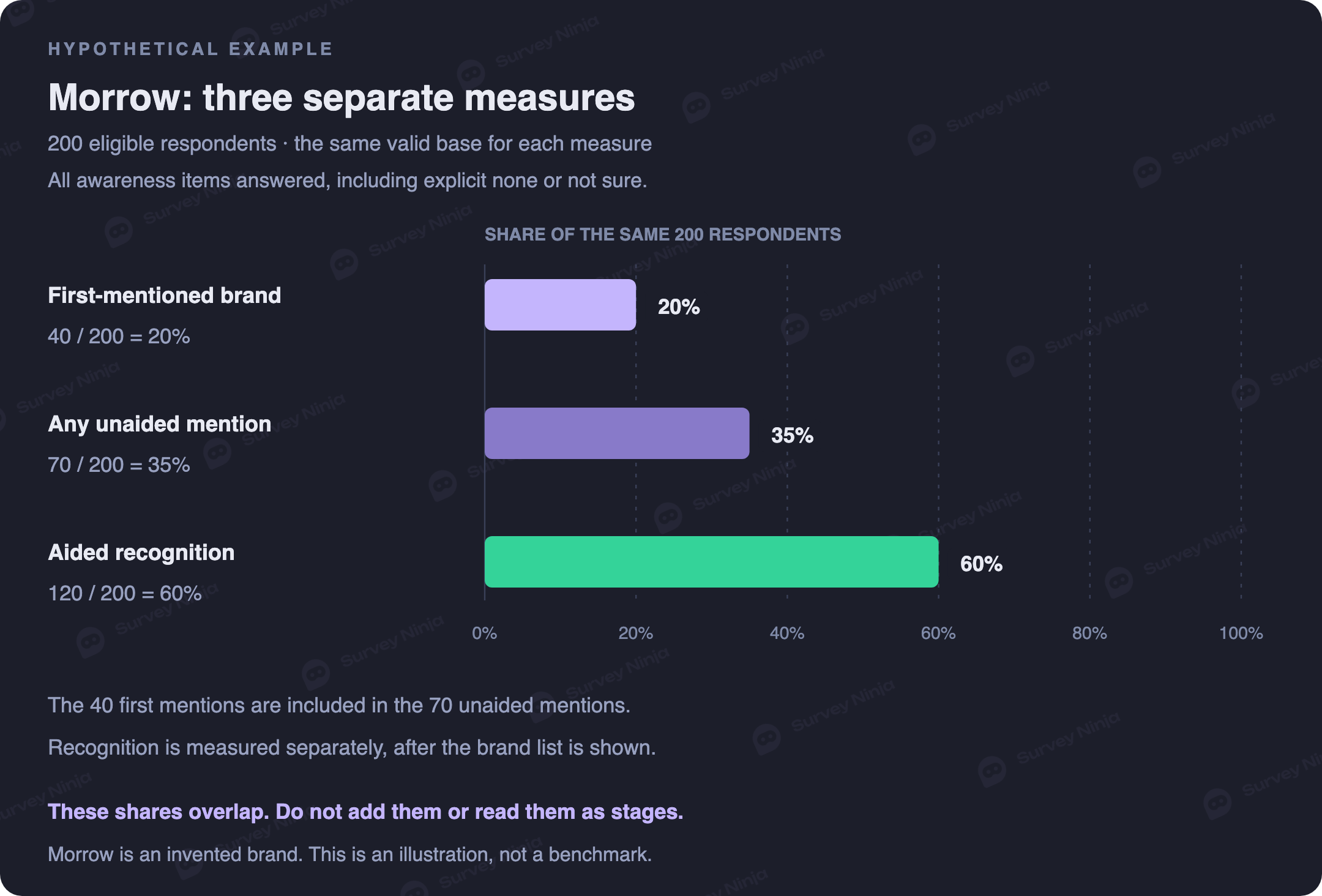
Here, the 40 first mentions are included in the 70 unaided mentions. By construction of this example, all 70 also recognize Morrow in the aided question. That second relationship is not a universal rule. In real responses, recall and recognition can disagree. Preserve the separate answers and investigate discrepancies rather than forcing them into a funnel.
In this constructed dataset, 50 respondents recognize Morrow without recalling it in the open questions, so the gap between 35% and 60% describes different responses from the same 200 people, rather than identifying 50 customers who would buy after seeing an advertisement.
For this report, top of mind means 40 ÷ 200 = 20%. Dividing 40 by 70 gives 57.1%, the share of Morrow's unaided recallers who named it first. That is a different conditional measure. Label its narrower base explicitly if it is useful; do not present it as the all-base top-of-mind result.
Code names and handle missing answers honestly
Preserve raw text, then use a documented alias map to group legitimate spelling variants. Decide in advance how to handle abbreviations, misspellings, retailers, product lines, and ambiguous names. Leave doubtful names unresolved. Keep a record of changes so another reviewer can follow the decision.
Count each brand once per respondent for any unaided recall, even if it appears in both open fields. For first mention, use the first-brand field. Do not infer it from the order of several names in a general text response. If someone enters several names in the first field, use your predeclared ambiguity rule rather than silently choosing one.
A blank is not an explicit negative answer. Keep skipped, missing, and unusable answers distinct from "No brand comes to mind," "None of these," and "Don't know." State which explicit responses belong to each valid base. Here, none and don't know count in the base without adding a Morrow mention; an unanswered item does not.
Real question bases may differ. If 190 eligible respondents give usable aided answers and 114 select Morrow, report 114 ÷ 190 = 60%, alongside 10 missing aided answers. Do not silently reuse the study's total of 200. For combined unaided recall, use a complete-case base: both open items must be usable, including explicit none or don't know answers. Preserve mentions from partial responses separately and report them separately; do not add them to the complete-case numerator. A blank second field does not establish that no other brand was recalled.
Use descriptive analysis for counts and clearly labeled percentages. The thematic analysis guide can help organize later comments, while brand-name coding should retain explicit respondent-level rules. Multiple brand selections mean recognition percentages across brands can exceed 100% in total.
Use the findings to choose the next investigation
Morrow's 60% recognition and 35% unaided recall suggest that more respondents can recognize its name than retrieve it without a cue. The gap can motivate research into category associations or situations where the brand comes to mind. It does not establish why the gap exists or which advertising channel will close it. If recognition is strong among customers but weak among other recent bottle buyers, the team can investigate where those other buyers encounter category information, using the result to choose follow-up interviews or a visibility test rather than declaring that the survey identified an effective channel.
Check subgroup bases. A few responses from one city can suggest interview questions, but an exact-looking percentage may exaggerate the evidence. Check counts and recruitment coverage first.
For repeated waves, hold category wording, eligibility, awareness questions, recruitment approach, and brand presentation as steady as possible. Record field dates and changes. Report population, recruitment, wording, and bases in the methods note, following AAPOR's disclosure standards.
A rise after a campaign is an observed change, not automatic proof of brand lift caused by that campaign. Different respondents, competitor activity, seasonality, and other exposure may contribute. Causal brand lift requires a suitable comparison design. Keep business outcomes separate.
Build the questionnaire in SurveyNinja
The dependable starting point is to create a survey manually using the reviewed questions above. Add category screening, two separate open text questions, and an aided multiple-choice question in that order. Place optional familiarity and purchase questions afterward. Check the features overview for general product capabilities, then verify the controls available in your own setup.
The brand awareness survey template and brand awareness question generator are alternative draft starting points. The template's opening brand-familiarity question needs to be replaced with neutral screening and open recall before it can serve this design. Review every question, response option, screen, and introduction before use. A generated draft still needs the same audience definition, neutral recall sequence, and denominator rules.
Preview the form. Confirm eligibility paths and inspect how open answers and skipped items appear in collected data. If the setup cannot enforce exclusive None and Not sure selections, replace the aided list with the same question for each real brand: "Before taking this survey, had you heard of [brand]?" Use Yes, No, and Not sure. Choose the format before fieldwork and retain it across repeated waves; a checklist and separate brand questions may produce different results. Submit a test answer and check its recorded values before inviting the intended audience. Maintain a survey version and coding note so the questionnaire and report remain connected.
Frequently asked questions
What is the difference between unaided and aided brand awareness?
Unaided awareness asks people to name brands without suggestions. Aided awareness asks whether they recognize names from a supplied list. Keep the two responses separate because recognition and recall measure different tasks.
Which awareness question should come first?
Ask for the first brand in open text, then other brands in a separate open question. Show the aided list afterward. Audit the invitation, sender, and introduction for earlier brand cues, while preserving required truthful disclosure.
How do you calculate top-of-mind awareness?
Divide first mentions of a brand by the declared valid base for the first-brand question. In this example, 40 of 200 is 20%. Dividing 40 by 70 instead describes first mention among that brand's unaided recallers.
Can customers represent the whole target market?
Not automatically. Customers already have a relationship with the brand, so their results describe customers. A market study needs recruitment that reaches the defined population, including suitable people who buy from other brands.
Is 200 respondents enough for a brand awareness survey?
There is no universal sufficient number. Consider the sampling method, desired precision, and bases for important subgroups. A larger sample does not remove selective recruitment, and a small pilot does not establish market awareness.
Can respondents select several brands in the aided question?
Yes. People may recognize several brands, so allow multiple brand selections. None of these and Not sure should each be exclusive. Percentages for individual brands may sum to more than 100%.
Should a skipped answer count as no awareness?
No. Keep missing and skipped answers separate from explicit none or don't know responses. Report the valid base for each measure and the missing count. Never silently convert an unanswered question into a negative answer.
Does an awareness increase prove campaign brand lift?
No. A before-and-after difference may reflect recruitment changes, other exposure, or external events. Establishing campaign-caused brand lift requires an appropriate comparison design. Awareness alone also does not establish purchase or sales.
Updated: Oct 11, 2026 Published: Oct 9, 2026