 WooCommerce Post-Purchase Survey: 7 Questions, When to Ask and What to Do Next
Holiday Party Survey: Questions to Ask Before and After the Party
Events and communities  Mike Taylor Nov 5, 2026 Reading time ≈ 16 min
Contents
- Holiday party planning survey: questions to ask before the party
- Post-party feedback survey questions
- Optional: a short year-end pulse survey
- When to send each survey
- How to get more people to answer
- Anonymity: which parts to keep anonymous
- How to run the holiday party survey in SurveyNinja
- Frequently asked questions
A holiday party survey is really two short surveys: a planning survey sent four to six weeks before the party to settle date, format, food and access, and a feedback survey sent within 24 to 48 hours after it to learn what to keep. Below are ready question sets for both, an optional year-end pulse, a timeline and tips on response rates and anonymity.
Most office parties are planned by one or two people guessing what a hundred others want. A five-minute survey replaces the guess with answers: which evening works, who needs a vegetarian or alcohol-free option, who needs step-free access, and who would rather have lunch on a Thursday than drinks on a Friday. The same answers also show what keeps people away, which matters as much as the head count.
Key points
- Run two short surveys, a planning one four to six weeks before the party and a feedback one within 24 to 48 hours after it.
- The planning survey asks about dates, format, dietary needs, alcohol-free drinks, accessibility and plus-ones, and the feedback survey asks what to keep and change.
- Send the feedback survey to everyone invited, including people who did not come, with an optional anonymous question about what kept them away.
- Aim for about 10 to 14 planning questions and six to nine feedback questions, and keep the feedback survey anonymous.
Holiday party planning survey: questions to ask before the party
The planning survey decides four things: when, what kind of event, what people eat and drink, and what everyone needs to be able to attend. The same questions work for a Christmas party, a year-end party or a New Year lunch. Keep it to 10 to 14 questions. Each table below gives the question, the answer format and the decision it feeds.
Date and time
| Question | Answer format | What it decides |
|---|---|---|
| Which of these dates work for you? | Multiple choice: three or four dates, plus "None of these" | The date with the most availability |
| Which time of day suits you best? | Single choice: lunch during work hours / right after work / evening / weekend daytime | Whether to plan a daytime or evening event |
| How long would you like it to last? | Single choice: 1 to 2 hours / 2 to 4 hours / the whole evening | Venue booking and program length |
Offer several dates as a multiple choice instead of asking for the "best" one. You want the date most people can attend, and a single favorite hides the second-best option that would have worked for everyone.
Format and venue
| Question | Answer format | What it decides |
|---|---|---|
| Which kind of event would you enjoy most? | Single choice: sit-down dinner / an activity such as bowling, a cooking class or an escape room / a relaxed daytime event at the office / an online event / Other | The format |
| Where would you prefer it? | Single choice: at the office / a restaurant / an activity venue / No preference | The venue shortlist |
| Rank what matters most to you at a team event | Ranking: food, the activity, music, time to talk, the location, the timing | Where the budget goes |
| If you work remotely, how would you like to take part? | Single choice: travel in and join in person / join an online part / skip this year | Whether to add an online part or travel support |
The ranking question replaces "How much should we spend?", which employees cannot answer and should not have to. It tells you where to put a fixed budget: if most people rank time to talk above the activity, a good restaurant beats an expensive outing.
Remote events are a small share of company parties. In Challenger, Gray & Christmas's 2024 holiday party survey of 173 U.S. HR and business leaders, 64% of companies planned holiday celebrations and 4.5% held virtual events. For a distributed team, though, an online part may be the only way some people can join, so ask before you decide.
Food, drinks and access
| Question | Answer format | What it decides |
|---|---|---|
| Do you have dietary needs we should plan for? | Multiple choice, optional: None, vegetarian, vegan, halal, kosher, gluten-free, lactose-free, food allergy (please specify), Other, Prefer not to say | Menu and catering brief |
| Which drinks would you like available? | Multiple choice: alcohol-free cocktails, soft drinks, beer or wine, coffee and tea | The bar order and alcohol-free options |
| Do you need anything to attend comfortably? | Multiple choice, optional: step-free access, seating, a quiet area, captions for the online part, Other, Prefer not to say | Venue requirements |
Ask about drinks as a list of preferences. People who do not drink, for health, faith or personal reasons, can ask for good alcohol-free options without explaining themselves, and you learn how much of each to order. Dietary and access answers can reveal health or religion, so keep those questions optional, say under each one that the answer only goes into the catering and venue brief, and pass on counts rather than names wherever the caterer does not need them.
Guests and inclusion
| Question | Answer format | What it decides |
|---|---|---|
| If partners or guests are invited, would you bring one? | Single choice: Yes / No / Depends on the date | Head count and budget per person |
| What kind of theme would you enjoy? | Single choice: a year-end celebration with no particular theme / a winter theme / holiday decorations are fine / No preference | Name, decorations and music |
| Would you like a gift exchange as part of the party? | Single choice: Yes, I would join / I would skip it / No preference | Whether to organize an opt-in Secret Santa |
| Is there anything that would make it hard for you to attend? | Open text, optional | Constraints you did not think of: caregiving, commute, religious observance |
Not everyone celebrates Christmas, and some people celebrate nothing at this time of year. Calling it a "year-end party" and asking about the theme lets the team choose instead of the organizer assuming. If people want a gift exchange, our Secret Santa questionnaire has the question bank for it.
Post-party feedback survey questions
The feedback survey tells you what to repeat next year. Send it within 24 to 48 hours, while people remember the food and the music, and keep it to six to nine questions. Send it to everyone who was invited, including the people who stayed away, because their reasons are often the most useful answers. Skipping the party is a normal choice: keep this survey anonymous, make the reason optional, and use the answers to change the event, never to follow up with the people who stayed home.
| Question | Answer format | What it tells you |
|---|---|---|
| Did you attend the party? | Single choice: Yes / No | Splits the survey into two paths |
| What kept you from coming? | Multiple choice, optional: the date, the time, the location, the format, not my kind of event, Other, Prefer not to say (shown only to those who did not attend) | What to change to reach more people |
| Overall, how would you rate the party? | Rating, 1 to 5 stars | The headline score to compare year to year |
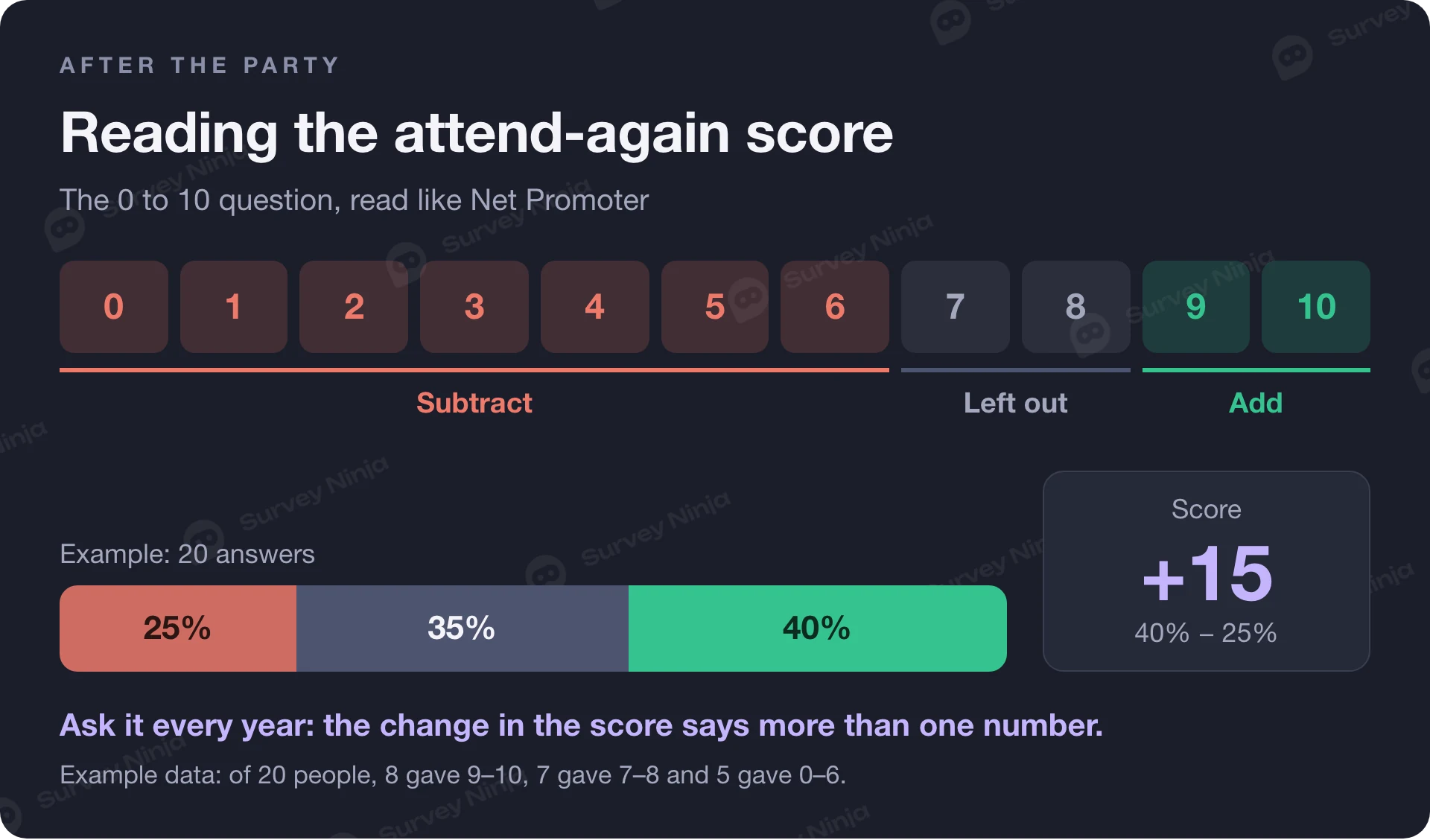
| How likely are you to attend next year's party? | Scale from 0 to 10 | An NPS-style intent score |
| How did the date and time work for you? | Single choice: Very well / Fine / Not well | Whether to move the date or the time |
| Did the food and drinks suit you, including your dietary needs? | Single choice: Yes / Partly / No | Catering choices for next year |
| Did the venue work for you, including getting there and moving around? | Single choice: Yes / Partly / No, with an optional comment | Venue and access |
| What should we keep next year? | Open text | What worked, in people's words |
| What one thing should we change? | Open text | The top fix |
Read the 0 to 10 question the way you would read a Net Promoter question: the share of 9s and 10s minus the share of 0s to 6s. It is a rough signal, and it becomes useful when you ask the same question every year. The two open questions carry the detail, and "one thing to change" forces people to choose, so the answers rank themselves.
For more feedback question ideas, the AI event feedback question generator drafts a set for any event type, and our guide to event surveys before, during and after covers the general method.
Optional: a short year-end pulse survey
The end of the year is a natural moment to ask how people feel about work, and it is tempting to add those questions to the party feedback. Keep them in a separate survey. Party feedback is light and low-stakes; engagement questions need anonymity to get honest answers, and mixing the two lowers the quality of both.
| Question | Answer format |
|---|---|
| How likely are you to recommend [company] as a place to work? | Scale from 0 to 10 (eNPS) |
| I felt recognized for my work this year | Agreement scale, 1 to 5 |
| I have what I need to do my job well | Agreement scale, 1 to 5 |
| How do you feel about the year ahead at work? | Single choice: Optimistic / Neutral / Concerned |
| What one thing should we start or stop doing next year? | Open text |
Turn on anonymous mode, say so in the first sentence of the survey, and report results only for groups large enough that no one can be identified. The eNPS calculator turns the first question into a score. If the pulse shows a problem worth digging into, run a full survey in the new year; our guide to the employee engagement survey shows how to design one that leads to decisions.
When to send each survey
Send the planning survey four to six weeks before the party and the feedback survey within 24 to 48 hours after it. The planning window gives you answers before you book anything; the feedback window catches people while they still remember the evening.
Week by week: send the planning survey six weeks before with a one-week deadline. At five weeks, send one reminder, close the survey and pick the date and format. At four weeks, book the venue and announce the plan, with a line on what the team chose. At two weeks, collect RSVPs, final dietary needs and plus-ones. Within 48 hours after the party, send the feedback survey to everyone invited, and in early January share the results and what you will change next year.
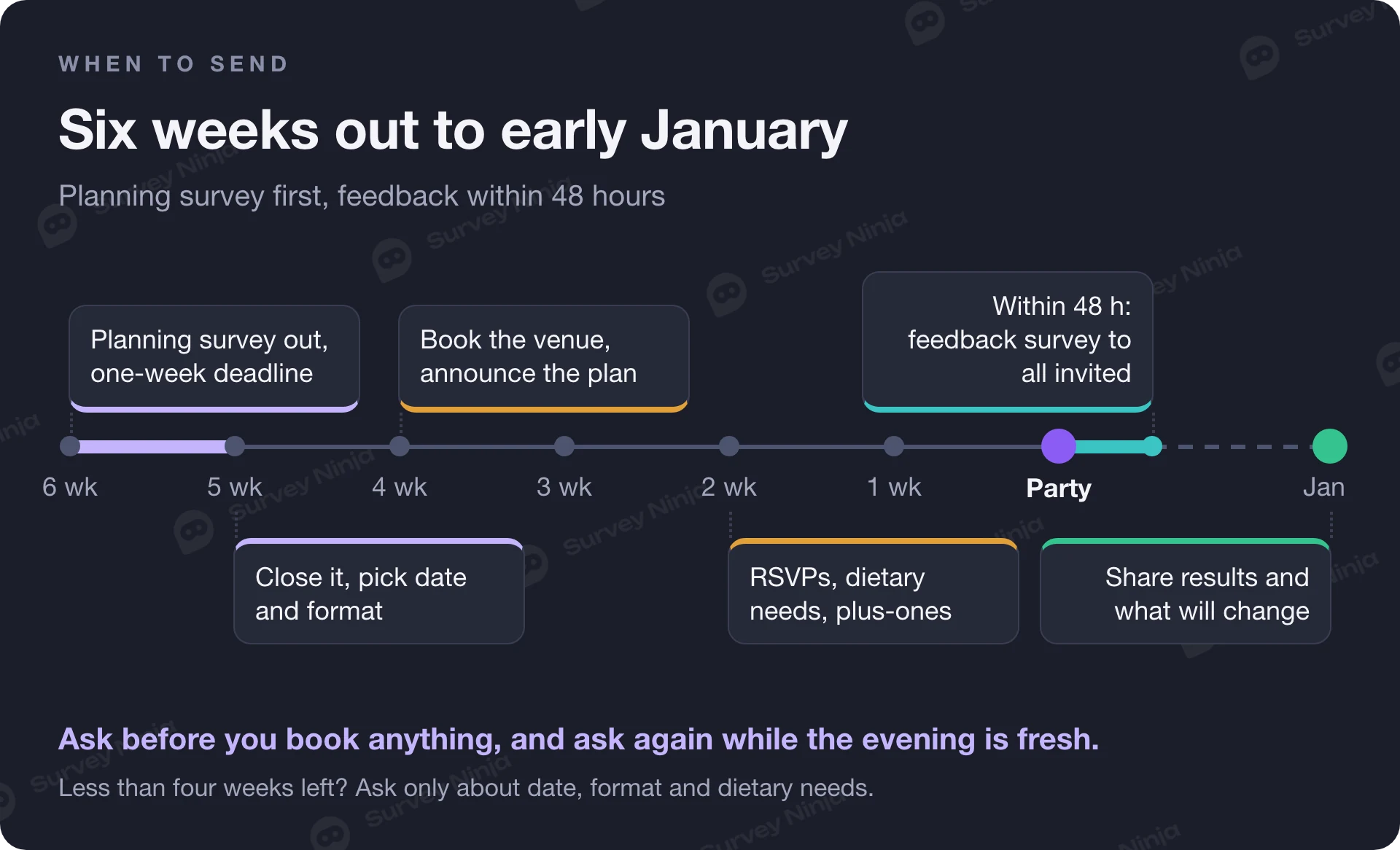
In December, venues and calendars fill up early, so the six-week mark matters more than it looks. If you are already closer than four weeks, cut the planning survey to the date, format and dietary questions and send it today.
How to get more people to answer
A party survey competes with year-end deadlines. These habits keep the response rate up:
- Keep it short. Ten questions for planning and six to nine for feedback. Say the expected time in the invitation: "three minutes".
- Make it work on a phone. Many people will open it from a chat message, between other things.
- Give a deadline and send one reminder. A week is enough. More reminders annoy the people who already answered.
- Ask team leads to share it. A note from team leads in their own channels reaches people that a company-wide email misses. Ask them to share the link once and not to check who has answered.
- Show the answers shaped the plan. "You picked Thursday lunch, so it is Thursday lunch" is the strongest argument for answering next time.
To check that you heard from enough people, divide answers by invitations; the response rate calculator does the math and also tells you how many invitations you need to reach a target number of answers.
Anonymity: which parts to keep anonymous
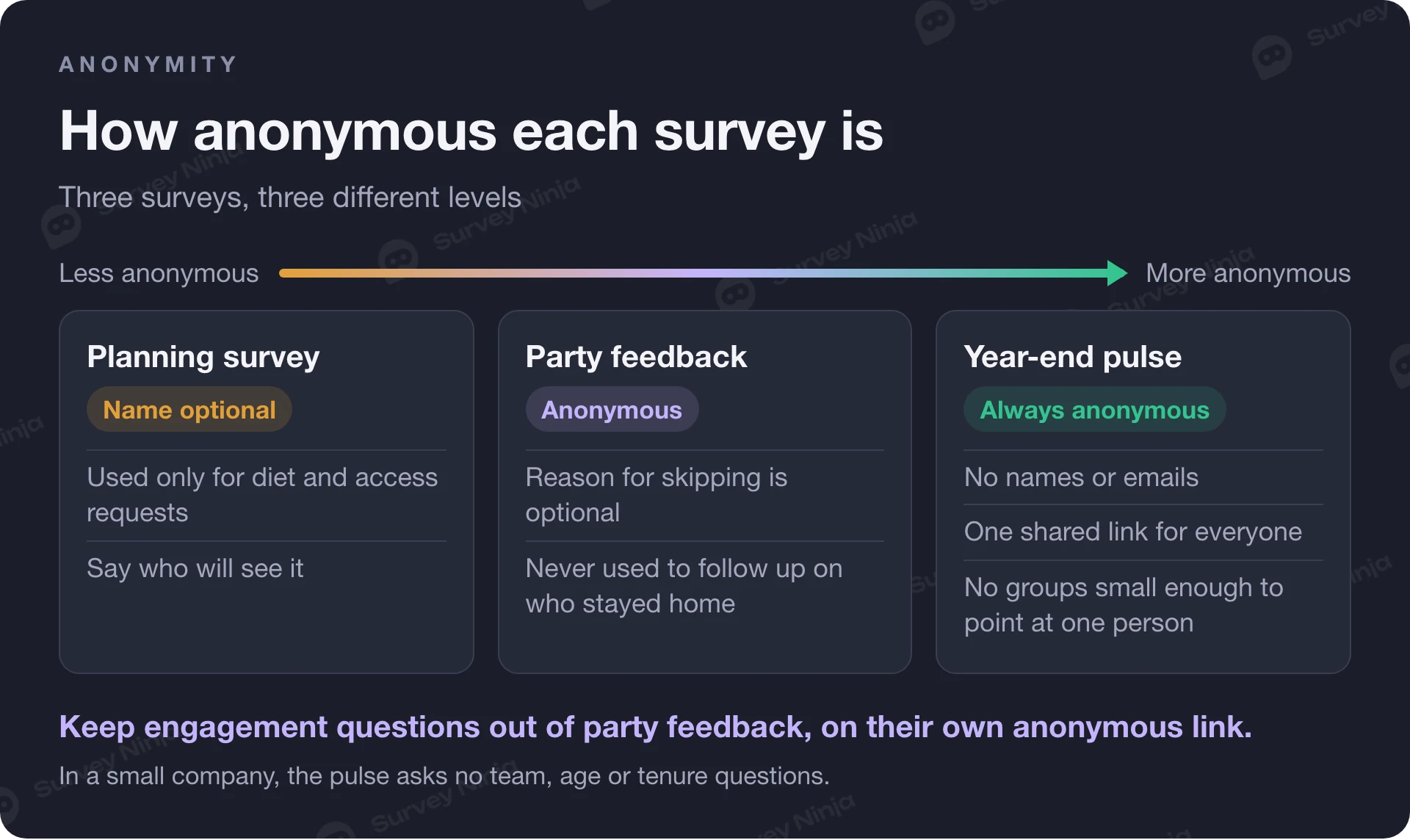
The three surveys need different levels of anonymity. The planning survey can ask for names, because dietary needs and accessibility requests have to reach the caterer and the venue. Make the name optional, use it only for those requests and tell people who will see it.
The feedback survey works better anonymous. People are more candid about a boring program or a bad venue when their manager cannot trace the answer. The year-end pulse must be anonymous, for the reasons covered in our guide to anonymous surveys: say so up front, collect no names or emails, send one shared link rather than personal links, and do not break results into groups small enough to point at one person. In a small company, that means no team, age or tenure questions at all.
How to run the holiday party survey in SurveyNinja
Start from the ready Christmas party survey, a planning survey with 12 anonymous questions from the tables above: dates, time of day, format, activities, dietary and access needs, drinks and a voluntary gift exchange. Coming is optional in it, and nobody is asked for a name. Copy it to a free account and put in your dates. If the party includes a team activity, the team building survey template asks how people see their team, which is a useful baseline. After the party, start from the event feedback survey template, which asks for a 1 to 10 satisfaction rating, a favorite moment and one thing to change. Add the attendance question and a logic rule that shows "What kept you from coming?" only to people who answered No.
Share each survey by link in your team chat or email, or show a QR code on the office screen. Turn on anonymous mode for the feedback and pulse surveys. To read the open answers quickly, remove any names they mention and paste them into the free AI Survey Summary, which groups them into themes with positive and negative signals. Then share the results with the team, through the public report link or a short summary, so everyone sees what was decided; check first that no open answer points to a person.
Frequently asked questions
What questions should I ask in a holiday party survey?
Before the party, ask which dates and times work, which format people prefer, dietary needs, drink preferences including alcohol-free options, accessibility needs, plus-ones and theme. After it, ask whether people attended, an overall rating, whether they would attend again, what to keep and what to change.
When should you send a holiday party planning survey?
Send it four to six weeks before the party with a one-week deadline. That leaves time to pick a date, book a venue and order catering based on the answers. If the party is less than four weeks away, ask only about date, format and dietary needs.
When should you send a post-event feedback survey?
Within 24 to 48 hours after the party, while people still remember the food, the venue and the program. Send it to everyone who was invited, including people who did not come, and let them say what kept them away in an optional, anonymous question. Their reasons, such as the date, the location or the format, show what to change to reach more people next year.
Should a holiday party survey be anonymous?
The planning survey can ask for names, because dietary and accessibility requests need to reach the caterer and the venue; keep the name optional. Feedback works better anonymous, and any engagement questions should go into a separate anonymous survey with no names or emails.
How do you make a company holiday party inclusive?
Call it a year-end party, ask the team about theme and format, offer daytime and evening options, plan good alcohol-free drinks, ask about dietary and accessibility needs, and give remote colleagues a way to take part. Make it clear that attending and any gift exchange are optional.
How many questions should a holiday party survey have?
About 10 to 14 for planning and six to nine for feedback. Short surveys get more answers in December, when people are busy with year-end work. Keep a separate year-end pulse to three to five questions, and send it on its own link so it can stay anonymous.
Published: Nov 5, 2026