


Customer Churn Surveys: What to Ask and How to Use the Answers
Useful  Mike Taylor Oct 8, 2026 Reading time ≈ 16 min
A customer churn survey explains why paying customers leave. Ask at the right moment, keep cancellation easy, and connect the answers to confirmed account changes. This guide gives you two practical templates and a worked example for turning reasons into product decisions.
A cancellation report shows that an account ended. It rarely explains whether the customer outgrew the product, never found its value, or left after an unresolved problem. A short survey supplies that missing context. The useful outcome is a better decision about onboarding, product quality, pricing, or customer fit.
What a customer churn survey measures
A customer churn survey asks people who end a paid customer relationship about their decision. For a SaaS business, that might mean an account owner canceling the last active subscription. For a recurring service, it might mean a client declining renewal. Define the event before you write the questions.
Choose your unit carefully. If an account starts with five paid seats, removes three at renewal, and keeps the remaining two active on the same paid plan, the company has reduced its contract rather than ended its customer relationship. That is contraction. Canceling one of several active subscriptions also need not end the whole account. Survey the person who understands the decision, then record whether the event concerns a seat, subscription, or whole account.
Separate voluntary churn, where the customer decides to leave, from involuntary churn after a payment problem. A failed card does not establish dissatisfaction. Stripe's revenue recovery documentation describes retries and payment notifications as ways to address payment failures. Keep those cases in a billing workflow and analyze confirmed voluntary cancellations separately.
The survey does not calculate your churn rate. Billing or customer records establish who actually left and when. Survey answers describe the reasons reported by the people who respond. Nor does an inactivity survey establish churn: someone who stopped logging in may still pay, return later, or use the service through colleagues.
Choose the moment and the right customer
Start with two moments tied to a customer's decision. A brief question after cancellation confirmation captures the immediate reason; a follow-up after access ends can explore the wider experience. Treat inactivity as a separate diagnostic: ask what got in the way, without labeling an active paying account as a churned customer. Later research can test whether an improvement matters to former customers who agreed to further contact.
Keep a cancellation request distinct from an ended subscription. A customer may cancel renewal today but retain access through the paid period, and may reverse that decision. Stripe's cancellation documentation distinguishes scheduled cancellation from the subscription ending. Your survey records should preserve the request date and effective end date, rather than counting both as separate departures.
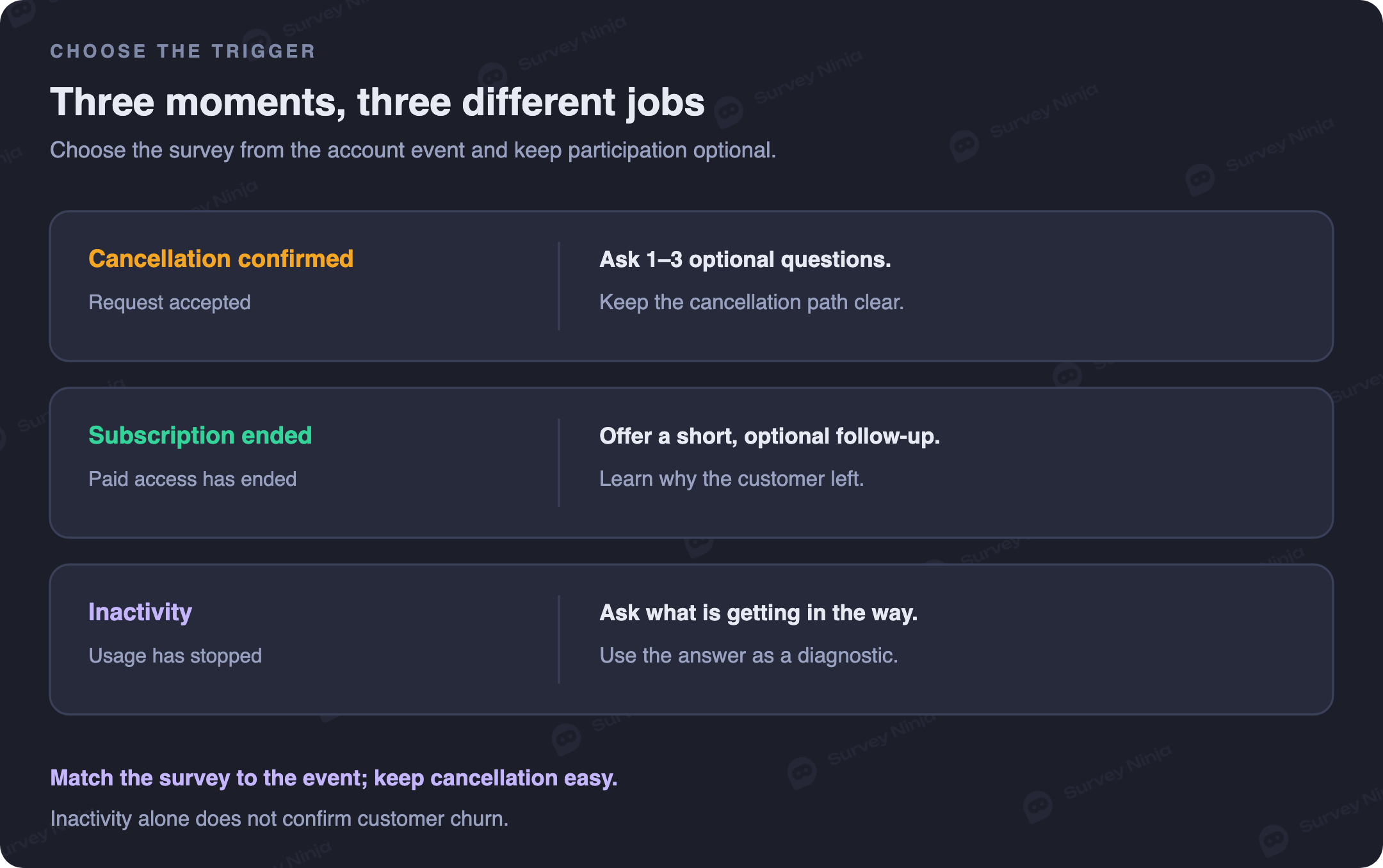
For the first survey, present the form after confirmation or make skipping it as straightforward as answering. Cancellation must never depend on completing the survey. Avoid hiding the final action behind questions or repeatedly asking the customer to reconsider. The cancellation confirmation should remain clear even when the customer closes the survey.
For a follow-up, choose a short, consistent interval after the effective end date while the experience is still recent. There is no universal best number of days. Start with a timing rule suited to your renewal cycle, document it, and adjust if customers consistently say they cannot yet explain their decision.
In B2B, send the survey to the account owner or decision maker. A daily user can describe product friction but may not know why procurement canceled. If you need both perspectives, label them separately. Use a stable account identifier to avoid counting three colleagues from one company as three lost accounts.
A three-question cancellation survey
This template is designed for the cancellation moment. Show a short explanation: "Your cancellation is confirmed. These optional questions help us understand what to improve." Offer a visible skip option. Keep all three questions optional, including contact permission.
1. What is the main reason you decided to cancel [product]?
Use single choice for the primary reason. Start with a manageable set of options:
- I did not get enough value or use it enough.
- A feature I needed was missing.
- The price no longer worked for us.
- Reliability or support did not meet our needs.
- The project ended or our needs changed.
- Another reason.
- Prefer not to answer.
Keep the choices short enough to scan on a phone.
Adapt the labels to your service and separate reliability from support if each has a distinct owner and enough answers to analyze. Keep an "another reason" option because your categories will miss some experiences. Do not make "too expensive" the only plausible negative answer. Stripe's customer portal guide offers another example of collecting a cancellation reason alongside subscription management.
2. What would you like us to understand about that reason?
Make this an optional text question and adapt it with conditional logic. For missing functionality, ask "What were you trying to do that [product] could not support?" For value, ask "What result did you expect that you did not get?" For price, ask "What made the cost hard to justify?" For reliability or support, ask "What happened, and how did it affect your work?"
One relevant follow-up usually explains more than several generic ratings. Let customers describe the problem without requiring an essay. A price answer may reveal low usage, a budget cut, or a comparison with an alternative. These call for different decisions. Our guide to feedback form questions covers writing neutral prompts.
3. May our research team contact you about this feedback?
Use a clear yes or no choice and explain what contact means. For example, "An optional conversation about your experience. Choosing no will not affect your cancellation." Ask for a contact address only when needed and avoid preselecting yes. Research permission is not blanket permission for promotional messages or a winback campaign.
A longer survey after the subscription ends
Use this version when you need context beyond the cancellation form. Invite customers after a confirmed voluntary end, explain why you are asking, and give a realistic completion time. If you already have their primary reason, show or carry it into the analysis rather than asking it twice without a purpose.
- What was the main reason you stopped using [product]? Use the same single-choice categories as the short survey.
- What were you mainly trying to achieve with [product]? Offer your main use cases plus another option. This helps distinguish a failed outcome from a completed project.
- How well did [product] help you achieve that result? Use a fully labeled scale from "not at all" to "completely", plus "not sure" or "not applicable".
- What will you use or do instead? Include another paid tool, an internal process, a free tool, stopping the activity, and not decided. Make an alternative's name optional.
- What, if anything, would need to change for you to consider using [product] again? Optional text. Treat the answer as a condition to investigate, not a promise to return.
- May we contact you for an optional research conversation? Explicit permission, with contact details only if needed.
Keep the survey at six questions or fewer by choosing what your team can act on. If you add a branch about a missing feature, replace another question rather than letting the path grow indefinitely. Review the longest path, not just the first screen.
Later research should have its own purpose. You might invite consenting former customers to discuss a changed workflow. A winback offer is a separate activity with appropriate contact permission and a relevant proposition. Neither an answer nor a predicted willingness to return automatically triggers a call or offer.
Read the results with the right denominator
Suppose your billing records show 200 confirmed voluntary account cancellations in one month. Each account receives one invitation, and 100 customers answer the primary single-choice question. This is a hypothetical example, not a published benchmark. Its primary-question response rate is 100 ÷ 200 = 50%.
| Primary reason | Answers | Share of respondents |
|---|---|---|
| Low value or little use | 30 | 30% |
| Missing feature | 25 | 25% |
| Price | 20 | 20% |
| Reliability or support | 15 | 15% |
| Project ended | 10 | 10% |
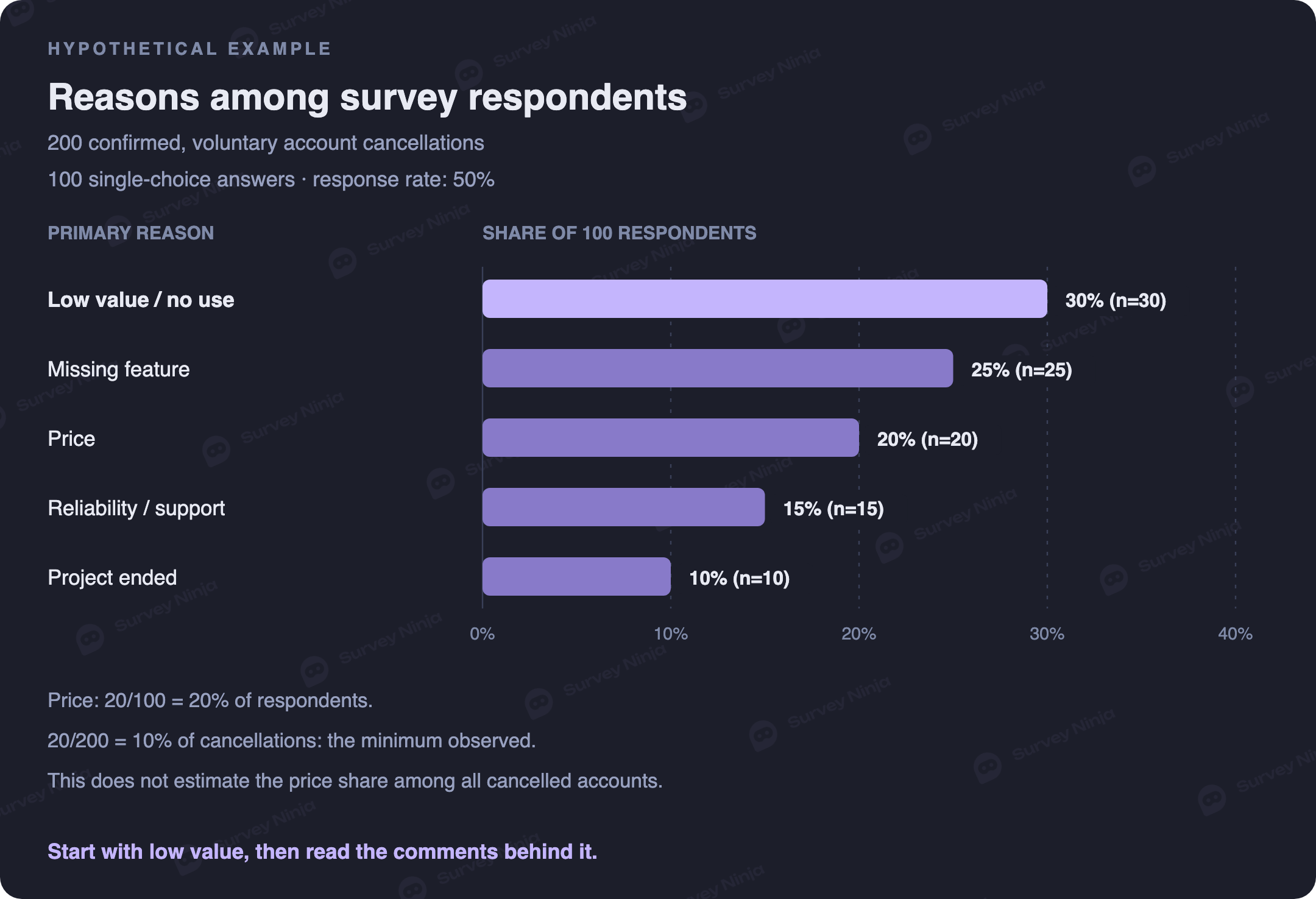
It is accurate to say that 20% of respondents selected price. It is inaccurate to say that 20% of all canceled accounts left because of price. Twenty known price answers across 200 cancellations establish a confirmed minimum of 10%; the reasons of the other 100 customers remain unknown.
Nonrespondents may differ from respondents. AAPOR's Standard Definitions discusses nonresponse as a source of survey error. Compare response coverage by plan, tenure, and account size before generalizing. Track invitations, primary-question answers, and full completions separately.
For example, if the people who answered mostly bought the entry plan recently, while the customers who stayed silent had longer contracts, larger teams, and different workflows, the same percentage could describe the vocal group accurately and still misrepresent the accounts you most need to understand. Compare their coverage first. Billing records can show the missing segments; they cannot supply the missing reasons.
A multiselect question changes the calculation. If one customer selects price and a missing feature, both categories count that customer, so category percentages may exceed 100% in total. Label them "share selecting each reason" and use the number who answered that question as the denominator. Keep that analysis distinct from a single primary reason.
Turn reasons into decisions
Read the comments before choosing a remedy. Low value among new accounts can suggest an onboarding problem; low value among established accounts may reflect a changed use case. Examine whether customers reached the outcome they bought, then compare with research on active customers, such as a product-market fit survey.
Missing-feature answers need specific tasks. "More integrations" is not a build specification. Learn which system, what information must move, and what workaround failed. Group comments by the job customers could not complete and check whether that job belongs to your intended market before committing to a roadmap change.
Price answers deserve the same care. If customers were barely using the product, a discount may delay the next cancellation without restoring value. If the product worked but a customer's project ended, recurring need may be the issue. Separate affordability, packaging, and perceived return before choosing an experiment.
Reliability and support comments should lead to incident or case review. A customer effort score survey can investigate a specific workflow that made work difficult. Broader NPS, CSAT, CES, and CSI measures answer different questions; adding all of them to a cancellation form rarely improves the explanation.
Assign one owner, one hypothesis, and one observable outcome to each priority. For example, the onboarding team can test whether a guided first export helps new accounts reach their first useful result, then compare activation and later confirmed cancellations across customers with similar plans, use cases, and renewal opportunities. Allow time for renewal. A drop in a survey category alone does not prove that churn improved.
Count lost accounts and lost revenue separately. Twenty small accounts and two large accounts can imply very different revenue exposure. The example above contains no prices or contract values, so it cannot establish revenue at risk. Join appropriate account-level billing data, prevent duplicate responses, and state which revenue measure you use before reporting financial impact.
Build the survey in SurveyNinja
Start with the churn survey question generator or create a survey from the templates above. Review generated wording against your service and keep the primary reason as single choice. The churn survey use case gives the product context, while the features overview covers the available survey tools.
Use conditional logic for the follow-up that matches the selected reason. Pass useful context through hidden variables, such as an opaque account identifier, plan, tenure group, event type, and survey version. Keep billing secrets and unnecessary personal information out of survey URLs. Join the response to protected account records where your team performs the analysis.
The invitation can be manual or driven by your own system or an external integration. Confirm the relevant billing event before sending it and record whether the subscription is scheduled to end or has ended. This requires a workflow you configure; collecting answers in SurveyNinja does not by itself synchronize cancellations with Stripe.
For delivery, use the triggered survey guide to define the event and the email survey guide to write the invitation. Test every reason branch, the skip path, permission choices, and repeated invitations. A customer who ignores the form must still have a completed cancellation.
Keep the measurement consistent
Review results on a regular schedule with the same eligibility rules, timing, and account definition. Keep original comments alongside coded themes, and document changes to reason labels. Otherwise an apparent improvement may simply reflect a new question or a different group of respondents.
Begin each review with confirmed cancellations, invitations, and answers. Then show the reported reasons, important segments, and evidence behind the proposed action. If a subgroup contains only a few accounts, report counts and read the comments instead of presenting a precise-looking ranking.
A useful churn survey creates a repeatable loop: observe a confirmed departure, ask a focused question, investigate the answer, make a relevant change, and check customer behavior. It is successful when the team makes better decisions and verifies their effects.
Frequently asked questions
What is a customer churn survey?
It is a survey of customers who end a paid relationship, used to understand their reasons for leaving. Billing or customer records establish the churn event; survey answers explain the reasons reported by respondents.
When should you send a churn survey?
Ask a brief optional question after cancellation confirmation, or send a longer follow-up after the subscription actually ends. Record scheduled cancellation separately from an ended subscription and use a consistent timing rule.
What is the best question to ask a canceling customer?
Start with: What is the main reason you decided to cancel [product]? Use single choice with relevant categories, another reason, and an option not to answer. Add one optional follow-up about the selected reason.
Should a cancellation survey be mandatory?
No. Completing a survey must not be a condition of cancellation. Keep the questions optional, provide a clear skip path, and confirm the cancellation even if the customer does not answer.
How many questions should a churn survey contain?
Use up to three optional questions at cancellation: primary reason, a relevant follow-up, and research contact permission. A later survey can use up to six focused questions when you need more context.
Can you apply the reason percentages to every canceled customer?
Not automatically. Reason percentages describe the customers who answered that question. Report response coverage and the denominator, and treat the reasons of nonrespondents as unknown.
Is payment failure the same as voluntary churn?
No. A failed payment may occur while the customer still wants the service. Separate payment recovery from surveys about a deliberate cancellation, and verify the final account status in billing records.
Does a churn survey answer authorize a winback message?
No. An answer is feedback, not blanket contact permission. Ask separately about optional research contact and use appropriate permission for any later promotional activity.
Published: Oct 8, 2026