 WooCommerce Post-Purchase Survey: 7 Questions, When to Ask and What to Do Next
Donor Survey Questions and Volunteer Survey Questions: Ready Banks for Nonprofits
Events and communities  Mike Taylor Nov 6, 2026 Reading time ≈ 18 min
Contents
- Why ask donors now, around GivingTuesday
- Donor survey questions
- Post-campaign survey questions
- Volunteer survey questions
- Lapsed donor survey questions
- How many questions should a donor survey have?
- When and how to send each survey
- Anonymity and consent in nonprofit surveys
- Report back: "you said, we did"
- How to run donor and volunteer surveys in SurveyNinja
- Frequently asked questions

Good donor survey questions ask supporters why they gave, how they want to hear from you and whether they plan to give again. Volunteer survey questions ask how onboarding went, whether people felt supported and what might make them stop. Below are four ready question banks, for donors, after a campaign, for volunteers and for lapsed donors, with advice on length, timing, consent and reporting results back.
The question banks are tables you can copy as they are. Each row gives the question, the answer format and what the answer tells you. Pick five to eight questions per survey, not the whole table.
Key points
- Good donor survey questions ask why supporters gave, how they want to hear from you and whether they plan to give again.
- Volunteer survey questions ask how onboarding went, whether people feel supported and recognized, whether tasks match their skills and what might make them stop.
- Keep each survey to five to eight questions that take two to four minutes, and make the open question optional and place it last.
- Send the annual donor survey in early November or the week after GivingTuesday, and the lapsed donor survey in January after year-end gifts are counted.
Why ask donors now, around GivingTuesday
GivingTuesday falls on Tuesday, December 1, 2026, according to GivingTuesday. For most nonprofits the weeks before and after it are the time of year when supporters hear from you most: appeals, thank-you notes, year-end reports. People who have just given remember why they did it, and that memory fades by spring. A short survey sent in this window gets answers based on a fresh experience.
The second reason is retention. The Fundraising Effectiveness Project, in its Q4 2025 report released in April 2026, put overall donor retention in the United States at 43.3% for 2025. In other words, more than half of the people who gave in one year did not give the next. A survey will not fix that by itself, but it tells you which donors feel unheard, which channels annoy them and what impact information would bring them back. That is what you need before the next appeal goes out.
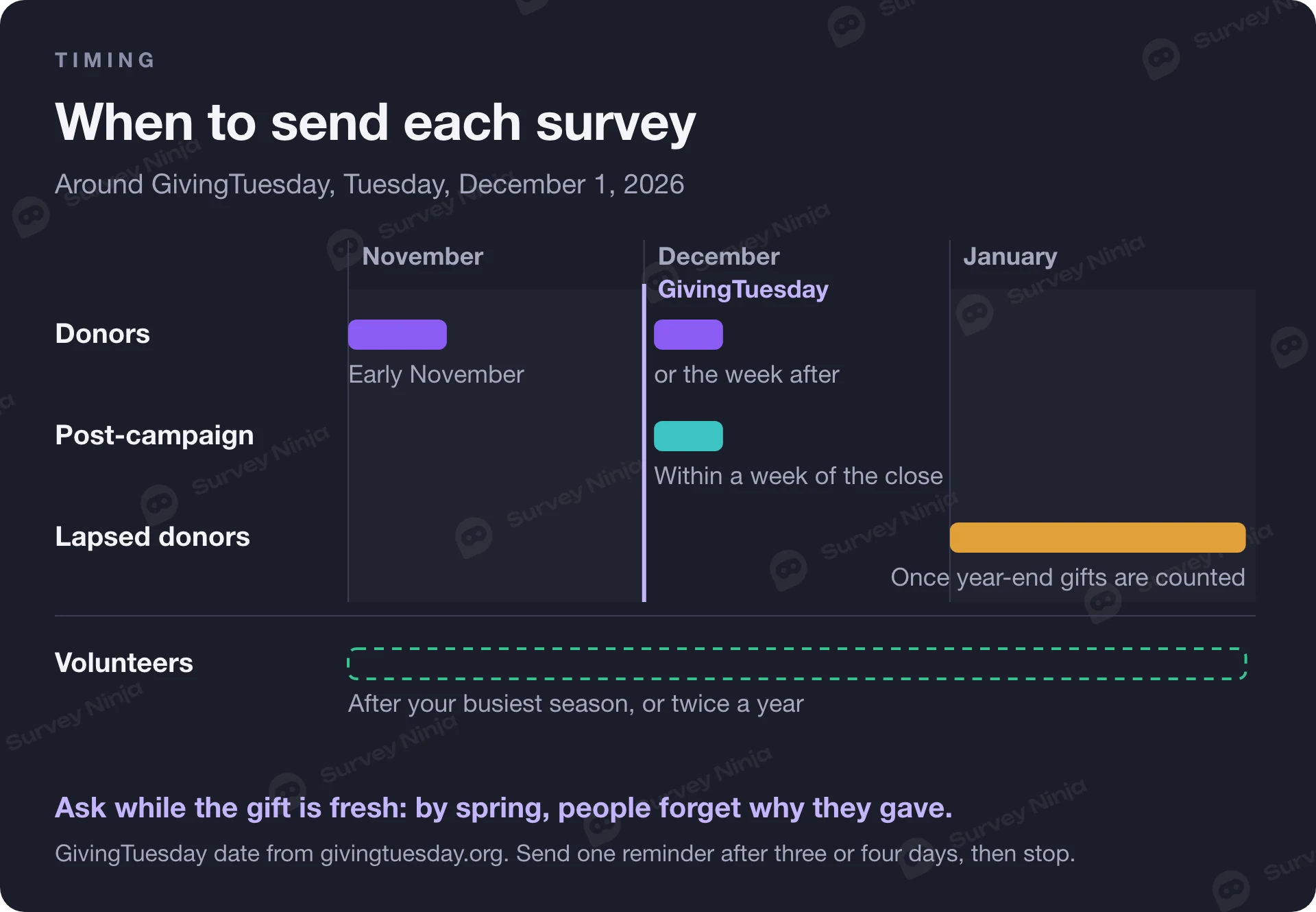
Plan it like this: a donor survey in early November or right after GivingTuesday, a post-campaign survey within a week of the campaign closing, a volunteer survey after your busiest season, and a lapsed donor survey in January, when the year-end giving data shows who did not come back.
Donor survey questions
This bank is for current donors: people who gave in the last 12 months. The questions move from motivation to communication to the future, which is also a natural order for the respondent.
| Question | Format | What it tells you |
|---|---|---|
| What made you decide to give to [organization]? | Open text | The reasons in donors' own words, ready for your next appeal |
| Which of our causes or programs matter most to you? | Multiple choice, up to 2 | Where to direct restricted appeals and stories |
| How did you first hear about us? | Single choice: friend or family, social media, event, news, search, workplace, other | Which channels bring donors, as opposed to clicks |
| How would you like to hear from us? | Multiple choice: email, text message, mail, social media, phone | The channels to use and the ones to drop |
| How often would you like updates from us? | Single choice: monthly, quarterly, twice a year, once a year, only when there is news | If you write too often or too rarely |
| What would you most like to know about the impact of your gift? | Single choice: stories of people helped, numbers and results, how money is spent, what happens next, other | What to put in reports and thank-you messages |
| How well do our updates show what your donation made possible? | Scale 1–5, from "not at all" to "very well" | Whether your reporting lands |
| How likely are you to give to [organization] again in the next 12 months? | Scale 0–10 | Intent to give again, a leading signal for retention |
| Would you consider giving a smaller amount every month? | Yes, maybe, no | Candidates for a monthly giving ask |
| Is there anything you would like us to do differently? | Open text, optional | Problems you would not think to ask about |
The 0–10 question about giving again looks like a Net Promoter question but measures something else. NPS asks about recommending you to others, and our guide to Net Promoter Score explains how to calculate it if you want to add it. For donors, intent to give again is usually the more useful number, because it ties straight to retention. Track the share of 9s and 10s and compare it year to year.
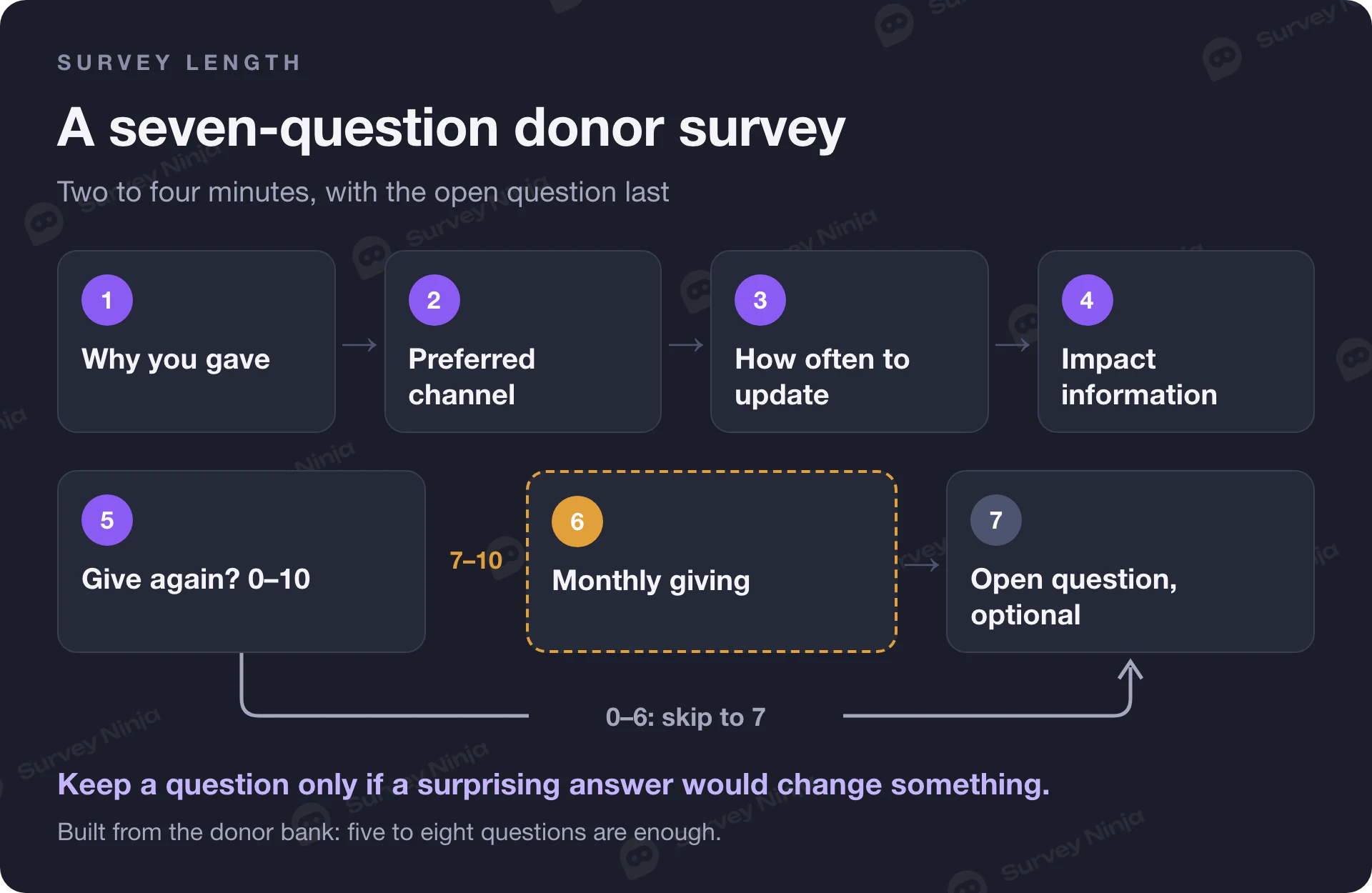
Ask the monthly giving question only of people who answered 7 or higher on giving again. Someone who just told you they probably will not give does not need a monthly ask on the next screen. If you plan to contact the people who say yes, the survey must be confidential and the invitation must say so.
Post-campaign survey questions
A post-campaign survey is shorter and goes to everyone who gave during a specific campaign, GivingTuesday included. It checks how the campaign itself worked: the message, the giving page, the thank-you.
| Question | Format | What it tells you |
|---|---|---|
| How did you hear about this campaign? | Single choice: email, social media, a friend, event, website, other | Which channel drove gifts in this campaign |
| What made you give this time? | Single choice: the cause, the matching gift, the deadline, someone asked me, I always give, other | Which campaign mechanics actually worked |
| How easy was it to make your donation? | Scale 1–5, from "very difficult" to "very easy" | Friction on the giving page |
| Did you receive a thank-you from us? | Yes, no, not sure | Whether acknowledgments reach people |
| How clear was it what your gift would pay for? | Scale 1–5 | Whether the ask was specific enough |
| What, if anything, almost stopped you from giving? | Open text, optional | Doubts to answer in the next appeal |
Send it within a week of the campaign closing. After that, the campaign blends into all the other year-end messages people got.
Volunteer survey questions
Volunteers give time instead of money, and they leave for similar reasons: they feel unused, unsupported or unthanked. This bank covers the volunteer experience from the first day to the reasons someone might stop. Send it to active volunteers and to people who volunteered in the past year.
| Question | Format | What it tells you |
|---|---|---|
| How well did your first weeks prepare you for your role? | Scale 1–5 | The quality of onboarding and training |
| Do you know whom to contact when you need help? | Yes, no, not sure | Whether there is a clear point of contact |
| How supported do you feel by staff and coordinators? | Scale 1–5 | The relationship with the people who manage volunteers |
| Is the time you give about right, too much or too little? | Single choice: too little, about right, too much | Burnout risk on one side, underuse on the other |
| How well do your tasks match your skills and interests? | Scale 1–5 | Whether you place people well |
| Do you feel your contribution is recognized? | Scale 1–5 | Whether thanks and recognition reach volunteers |
| How likely are you to recommend volunteering with us to a friend? | Scale 0–10 | A comparable loyalty score for the volunteer program |
| What might make you stop volunteering with us? | Multiple choice: schedule, travel, tasks, feeling unused, lack of support, personal reasons, other | The exit risks you can still do something about |
| What one change would improve volunteering here? | Open text | Concrete ideas, often cheap ones |
If you also recruit volunteers through a form, keep that separate. A registration form collects contacts, skills and availability; our volunteer registration form template does exactly that. The experience survey above goes to people who are already with you.
Lapsed donor survey questions
A lapsed donor gave in a previous year and has not given since. These people are the hardest to reach, so the survey must be very short and must not read as a disguised appeal. Four or five questions, no ask on the same page.
| Question | Format | What it tells you |
|---|---|---|
| What is the main reason you have not given recently? | Single choice: financial situation, support another cause now, was not asked, unsure how money is used, too many messages, other | Which reasons are in your control |
| How well did we keep you informed about the impact of your gift? | Scale 1–5 | Whether silence after the gift played a part |
| Do you still care about [cause]? | Yes, somewhat, no | Whether the bond is with the cause or was with a moment |
| Would you like to keep hearing from us? | Yes as before, less often, only big news, no | A clean list and permission to stay in touch |
| Is there anything we could have done better? | Open text, optional | The specific failure, in their words |
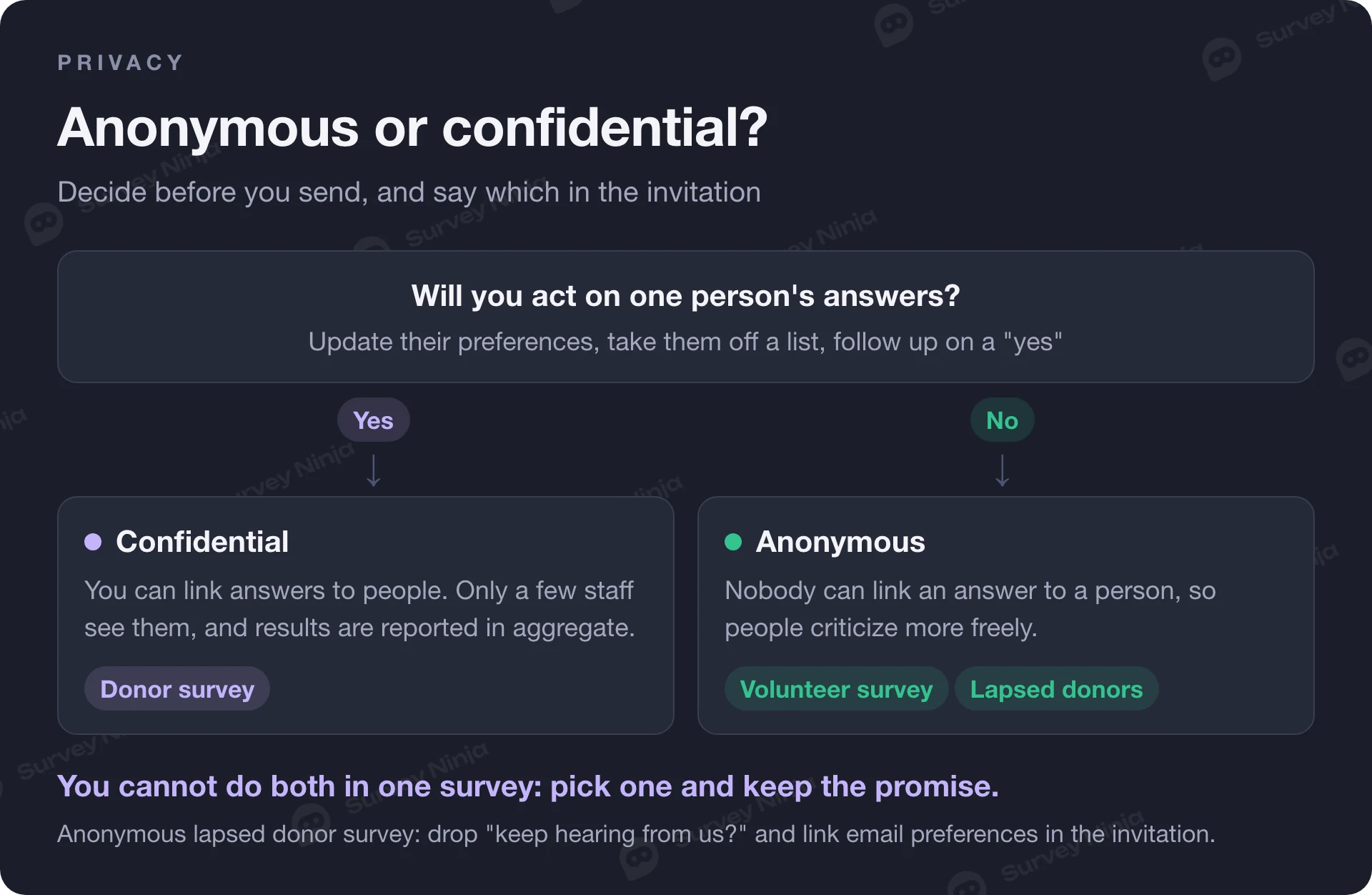
Respect the answer to the fourth question. Anyone who chooses "no" leaves your appeal list. That only works in a confidential survey linked to the donor's record. If you promised anonymity, drop the question and put a link to email preferences in the invitation. Fewer, warmer contacts are worth more than a long list that stops opening your emails.
How many questions should a donor survey have?
Five to eight questions, which take two to four minutes. Donors and volunteers owe you nothing, and each extra question costs answers at the end of the survey. The tables above have more rows than you need on purpose: choose the questions that lead to a decision you can actually make this year.
A simple test for each question: if the answer came back surprising, what would you change? If nothing, cut it. A donor survey built this way might be: why you gave, preferred channel, update frequency, impact information, giving again 0–10, monthly giving (shown only to 7 and above) and one open question. That is seven questions.
Make the open question optional and put it last. Before sending, estimate how many answers you will get from your list with the response rate calculator. If 400 donors and a modest response rate give you 40 answers, plan to read them all rather than chart them.
When and how to send each survey
| Survey | When | Channel |
|---|---|---|
| Donor survey | Early November or the week after GivingTuesday; once a year | Email to donors from the last 12 months |
| Post-campaign survey | Within a week after the campaign closes | Email or a link on the thank-you page |
| Volunteer survey | After your busiest season or twice a year | Email, volunteer group chat, QR code at the volunteer desk |
| Lapsed donor survey | January, once year-end giving is counted | Personal email from a named person |
| Event feedback | The same day or the next morning | QR code at the venue, then email |
Email reaches the most donors, because you already have their addresses. Write only to people who agreed to hear from you and skip anyone who opted out. Our guide to email surveys covers subject lines, timing and reminders. At galas, food drives and volunteer days, put a QR code on the tables or the sign-in sheet; QR code surveys explains placement and size. For events, the event feedback survey template is a ready starting point.
Send it from a named person's address. "Maria from the food bank" gets opened. Say how long the survey takes and what you will do with the answers. Send one reminder after three or four days, then stop.
Anonymity and consent in nonprofit surveys
Decide before you send whether the survey is anonymous or confidential, and say which one in the invitation. They are different promises. Anonymous means you cannot connect an answer to a person. Confidential means you can, but only a few staff will see it and it will be reported in aggregate.
Volunteer surveys and lapsed donor surveys get more honest answers when they are anonymous, because people criticize coordinators and appeals more freely. Donor surveys are often confidential, since you want to update each donor's preferences in your CRM. You cannot do both in one survey, so pick. Our guide to anonymous surveys covers the trade-offs and how to word the promise.
Consent is simpler than it sounds. At the top of the survey, say who is asking, why, how long it takes, that every question is optional, who will see the answers and how long you will keep them. That is informed consent in a few lines. Use the answers for that purpose only, not for wealth screening or a list to share with partners. If you plan to quote someone in a newsletter, ask for that permission separately and explicitly. Privacy rules differ by country and state, so check the ones that apply to you.
Ask only what you need. None of the banks above asks about age, gender, income, religion or health. If you add such a question, for example to check that you reach every community you serve, make it optional with "prefer not to say", explain why you ask and report only groups large enough that no one stands out. In a small volunteer team, a role plus a shift can already identify someone. Volunteers under 18 usually need a parent's or guardian's consent. People who receive help from you may feel they cannot say no, so tell them that skipping the survey changes nothing in the support they get.
Report back: "you said, we did"
The survey is half done when the answers come in. The other half is telling supporters what you heard and what changed. This step is what makes people answer the next survey, and it is the easiest one to skip.
Keep the report short: three findings and three actions. For example: "You told us you want fewer emails. We now write once a month." "Most of you wanted to see where the money goes. Our next update breaks the budget down by program." "Volunteers said the Saturday shifts were too long. They are now four hours." Put it in the next newsletter, on your website and in the thank-you message for the following campaign.
If a request is impossible, say so and say why. Donors accept a clear "we can't, because" far more easily than silence.
How to run donor and volunteer surveys in SurveyNinja
The quickest start is the charity donor survey template: nine questions on giving habits, trust in how funds are used and the relationship with donors. Copy it, then swap in questions from the banks above. To build from scratch, create a survey for free or describe the survey to Ninja AI in the builder, which drafts the questions and waits for you to apply each change. Skip logic is on every plan, so the monthly giving question can appear only for donors who answered 7 or higher.
Share the link by email, embed the survey on your site, or generate a QR code with your colors and logo for events. Anonymous mode is available on all plans. Exports to CSV and XLSX and a public report link are on every plan. Before you share that link with supporters, check what it shows: open answers can contain names and personal stories, so a short "you said, we did" summary in your own words is often the safer thing to publish. To summarize hundreds of open answers, paste them into the free AI Survey Summary. SurveyNinja also runs a program for non-profits with free access or special terms: tell us about your organization through the contact page. More use cases are on our page for nonprofits.
Frequently asked questions
What questions should I ask in a donor survey?
Ask why they gave, which programs matter most to them, how they heard about you, which channels and how often they want updates, what impact information they want, how likely they are to give again on a 0–10 scale and one optional open question. Five to eight of these are enough.
What are good volunteer survey questions?
Ask how well onboarding prepared them, whether they know whom to contact, how supported and recognized they feel, whether the time commitment is right, how well tasks match their skills, how likely they are to recommend volunteering, and what might make them stop. Add one open question about a single change.
When should a nonprofit send a donor survey?
Once a year to current donors, in early November or the week after GivingTuesday, when giving is fresh in their minds. Send post-campaign surveys within a week of a campaign closing, and lapsed donor surveys in January, after year-end gifts are counted.
How long should a donor survey be?
Five to eight questions that take two to four minutes. Every extra question lowers the number of people who finish. Keep only questions whose answers would change a decision this year, make the open question optional and place it last.
Should donor and volunteer surveys be anonymous?
Volunteer and lapsed donor surveys usually get more honest answers when anonymous. Donor surveys are often confidential instead, so you can update each donor's preferences. Choose one, state it clearly in the invitation and keep the promise in how you handle the data.
How do you ask lapsed donors why they stopped giving?
Send a short, personal email from a named person with four or five questions and no donation ask. Ask for the main reason, whether they still care about the cause and whether they want to keep hearing from you. That last question works only in a survey linked to their record, so say so, then respect the answer.
Published: Nov 6, 2026