
25 Questions for a Travel Agency Customer Satisfaction Survey
Useful  Mike Taylor Oct 22, 2026 Reading time ≈ 17 min

A travel agency customer satisfaction survey helps you understand what happened before, during and after a trip. This guide offers 25 questions, a short post-trip version and a worked example that separates the agency’s service from booked suppliers and counts only relevant answers.
A client can enjoy the destination and still feel that the agency left them unprepared, while another traveller may dislike a hotel but appreciate the agent who explained the alternatives and helped resolve the problem before it spoiled the rest of the trip. A single “How was your holiday?” rating leaves both situations unclear. You need to know what the person is rating before deciding what to change.
The questions below are an original, editable bank for feedback after a completed trip, designed to help an agency choose useful follow-up questions rather than provide a validated assessment or an industry benchmark against which every travel business should be judged. A questionnaire about travel preferences before booking serves a different purpose. SurveyNinja’s page for travel agencies introduces the broader use case; this article supplies a practical questionnaire and reporting approach.
Keep the agency’s service and the trip experience separate
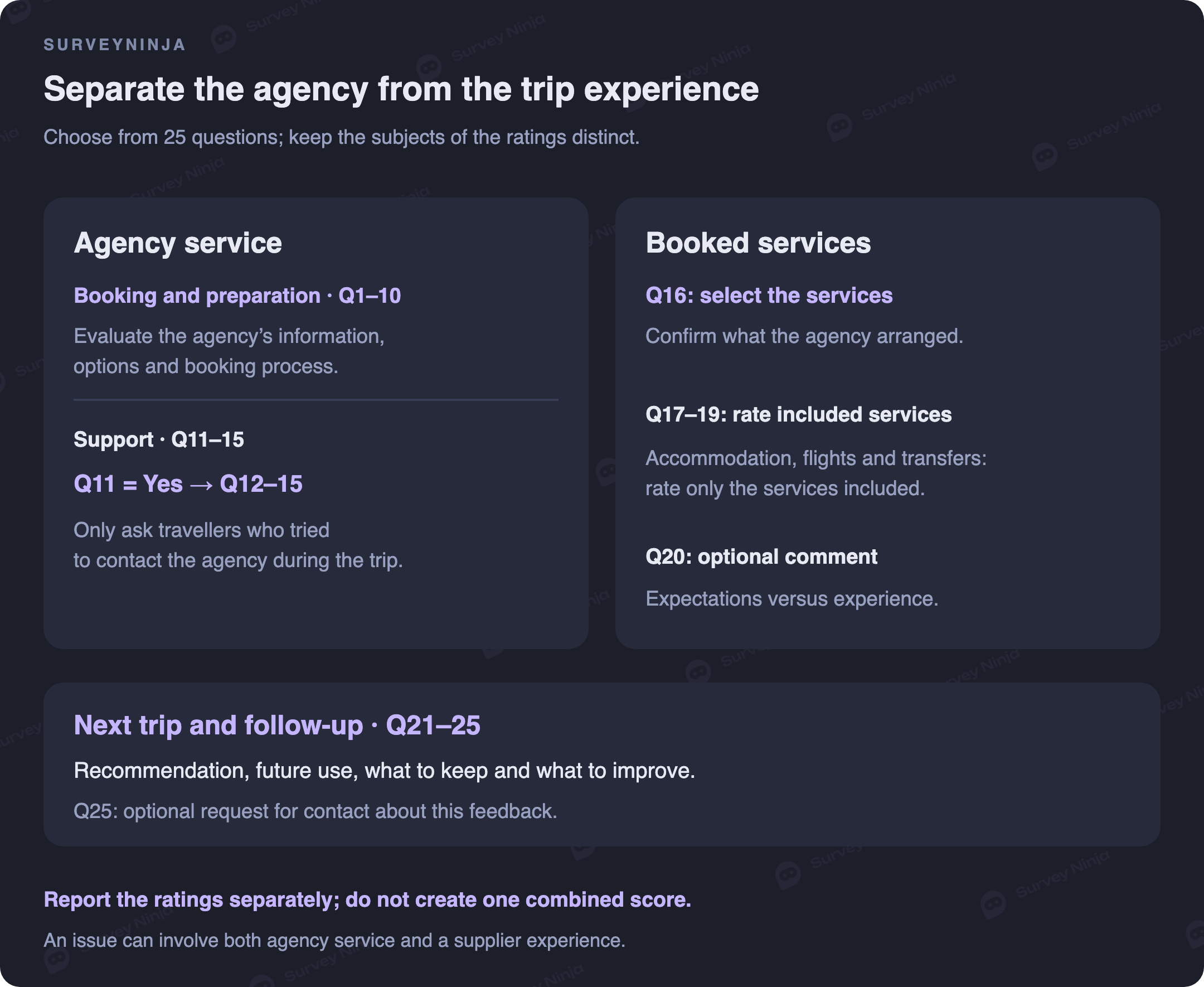
Start with the agency’s overall service. Then ask about planning, confirmation accuracy and explanations so that the answers point to specific parts of the process to investigate. Accommodation, flights and transfers concern services arranged through it. Help during the trip is another experience, relevant only to travellers who tried to contact the agency. These distinctions tell you what to investigate; they do not decide legal responsibility.
Pew Research Center’s questionnaire guidance recommends clear, specific questions about one concept at a time. That supports separating an agent’s communication from a hotel stay rather than asking clients to rate both together.
For example, a room may differ from what the client expected. Read the comment beside the description they received and the assistance offered. The problem could involve the accommodation, the information supplied before booking, or both. A supplier score alone cannot identify the cause. For a questionnaire focused on the property itself, see the separate hotel guest satisfaction survey.
Decide who to ask and when to send the invitation
For a simple booking-level report, invite one nominated lead traveller who took the trip to respond for each completed booking, because a person who paid for somebody else’s holiday may know about the purchase but cannot judge what happened during the stay. Explain which experience you want them to describe. Their response represents their own view, not an exact account of every group member’s experience.
If you need individual traveller feedback, use that design deliberately and keep the shared booking identifier available for analysis, so that five responses from one family are not presented as five independent bookings when a manager compares destinations or reviews how frequently problems occurred. Count returned bookings and returned traveller questionnaires separately. Otherwise, large groups gain more influence simply because more people answered.
As a practical starting rule, send the post-trip questionnaire two to five days after the traveller returns, allowing them to settle in while the experience is still recent enough to discuss, then test whether that suggested operating window fits your clients rather than treating it as a proven optimum. Confirm the actual return date, particularly for long itineraries. Apply the same rule to all eligible completed bookings, including those with complaints. Cancelled trips need a separate cancellation survey; their customers did not experience the completed journey.
Keep the invitation straightforward: “We would like your feedback on the trip arranged through our agency. Please tell us about our service and the parts of the trip you booked with us. Participation is optional. If you request a reply, our team will review your comments and contact you.” Provide your actual assistance and complaints contacts separately. Nobody should have to wait for a survey review to raise an urgent concern.
A booking code can make follow-up possible, but because the team can connect the answer to a particular client and trip, describe the arrangement as confidential and explain who will read the feedback, how it will be used and what happens when somebody requests a reply. If you choose an anonymous design, remove identifying links and provide a separate, unlinked contact route. A request for help with feedback is not permission to send marketing messages.
25 post-trip survey questions to choose from
Select the questions your clients can answer. Use five labelled satisfaction options: very dissatisfied, dissatisfied, neither satisfied nor dissatisfied, satisfied, very satisfied. For clarity, use not at all clear, slightly clear, moderately clear, very clear and completely clear. Both scales run from 1 to 5, but they measure different things. Do not average them together.
Ease questions use very difficult, difficult, neither easy nor difficult, easy and very easy. The future-use question uses very unlikely, unlikely, neither likely nor unlikely, likely and very likely. Recommendation has its own 0–10 scale. Offer “not applicable” and “cannot assess” separately when needed. These choices are not the numeric midpoint. When relevant information or an explanation was not provided, offer a separate “Not received” option and report that count beside the valid ratings. Nonreceipt is not the same as an irrelevant question or a numeric clarity score. The rating scale examples explain other labelled formats.
Agency planning and booking
Question 1 gives an overall agency rating before specific experiences bring particular problems to mind. Questions 2 and 3 use clarity; questions 4 and 5 use satisfaction. Omit question 4 when the agency simply processed choices the client had already made.
- Overall, how satisfied are you with the service provided by our agency?
- How clear was our explanation of what the booking price included?
- How clear was the itinerary information provided before departure?
- How satisfied are you with the options our agency suggested?
- How satisfied are you with the accuracy of your booking confirmation?
Preparation and communication
Question 6 uses clarity, questions 7 and 9 satisfaction, and question 8 ease. Use “not applicable” for document guidance only when it was not relevant to the booking, for changes only when no changes occurred, and for contact only when the traveller did not try to reach the agency. If relevant guidance or an explanation was not received, record that separately. Question 10 is optional free text.
- How clear were our instructions about the travel documents you needed to arrange?
- How satisfied are you with the timing of the information provided before departure?
- How easy was it to reach our agency before the trip?
- How satisfied are you with our explanation of changes made before departure?
- What information, if any, would have helped you prepare for the trip?
Support during the trip
Question 11 is yes/no and includes unsuccessful attempts to reach the agency. Ask questions 12–15 after “yes”: ease, clarity, satisfaction and an optional comment. For question 13, offer “No explanation received” separately. No reply can inform a dissatisfied handling rating in question 14; offer “cannot assess” separately. Do not exclude clients because the team failed to respond.
- Did you try to contact our agency for help during the trip?
- How easy was it to reach our team when you needed help during the trip?
- How clear was our explanation of what we could do about your request?
- How satisfied are you with how our agency handled your request?
- What, if anything, should our agency have handled differently when you asked for help?
Services booked through the agency
For question 16, allow accommodation, flights, transfers, other services or none. Multiple selections are possible, but “none” must stand alone. Ask each satisfaction question only when that service was included. Question 20 is optional; clients can leave it blank when there was no important difference.
- Which services in this booking were arranged through our agency?
- How satisfied are you with the accommodation arranged through our agency?
- How satisfied are you with the flights arranged through our agency?
- How satisfied are you with the transfers arranged through our agency?
- Describe any important difference between the trip you expected and the trip you experienced.
Next trip and follow-up
Question 21 runs from 0, not at all likely, to 10, extremely likely. Question 22 uses the five-point likelihood scale. The comments are optional. Question 25 is an optional yes/no request for a reply, with the contact process explained alongside it.
- How likely are you to recommend our agency to someone planning a similar trip?
- How likely are you to use our agency for another trip?
- What should our agency keep doing?
- What one improvement would be most useful for your next trip?
- Would you like our team to contact you about this feedback?
A three-question version for a quick post-trip check
For routine feedback, start with questions 1, 24 and 25, which ask for overall agency satisfaction, one useful improvement and an optional follow-up request, giving the client a short questionnaire and the agency a clear next step without requiring ratings of every aspect of the holiday. Add the support or supplier module when you have a specific decision to make. A bank of 25 questions is not a reason to send every item after every booking.
Read each result with its own valid base
Imagine 20 eligible completed bookings and 12 returned questionnaires, one per booking. That gives a simple booking return rate of 60%. The eight nonresponding bookings remain unknown. All figures below are invented teaching data. There are no customer records or travel-industry targets in this example.
| Item | Valid | 4 or 5 | Share |
|---|---|---|---|
| Agency | 12 | 9 | 75% |
| Hotel | 8 | 4 | 50% |
| Support | 5 | 2 | 40% |
The agency row uses question 1: nine ratings of 4 or 5 out of 12 valid answers. In this example, accommodation means hotels. Nine bookings included a hotel, eight supplied a question 17 rating and one left it blank. Four of those eight were satisfied. Three bookings had no hotel included and were not applicable.
Six respondents tried to contact the agency during the trip, including any unsuccessful attempts. Five rated request handling in question 14; one left it blank. Two of the five gave 4 or 5. The remaining six respondents did not try to contact the agency, so support handling was not applicable to them. A missing answer and an irrelevant question are different conditions, even though both stay outside the valid rating denominator.
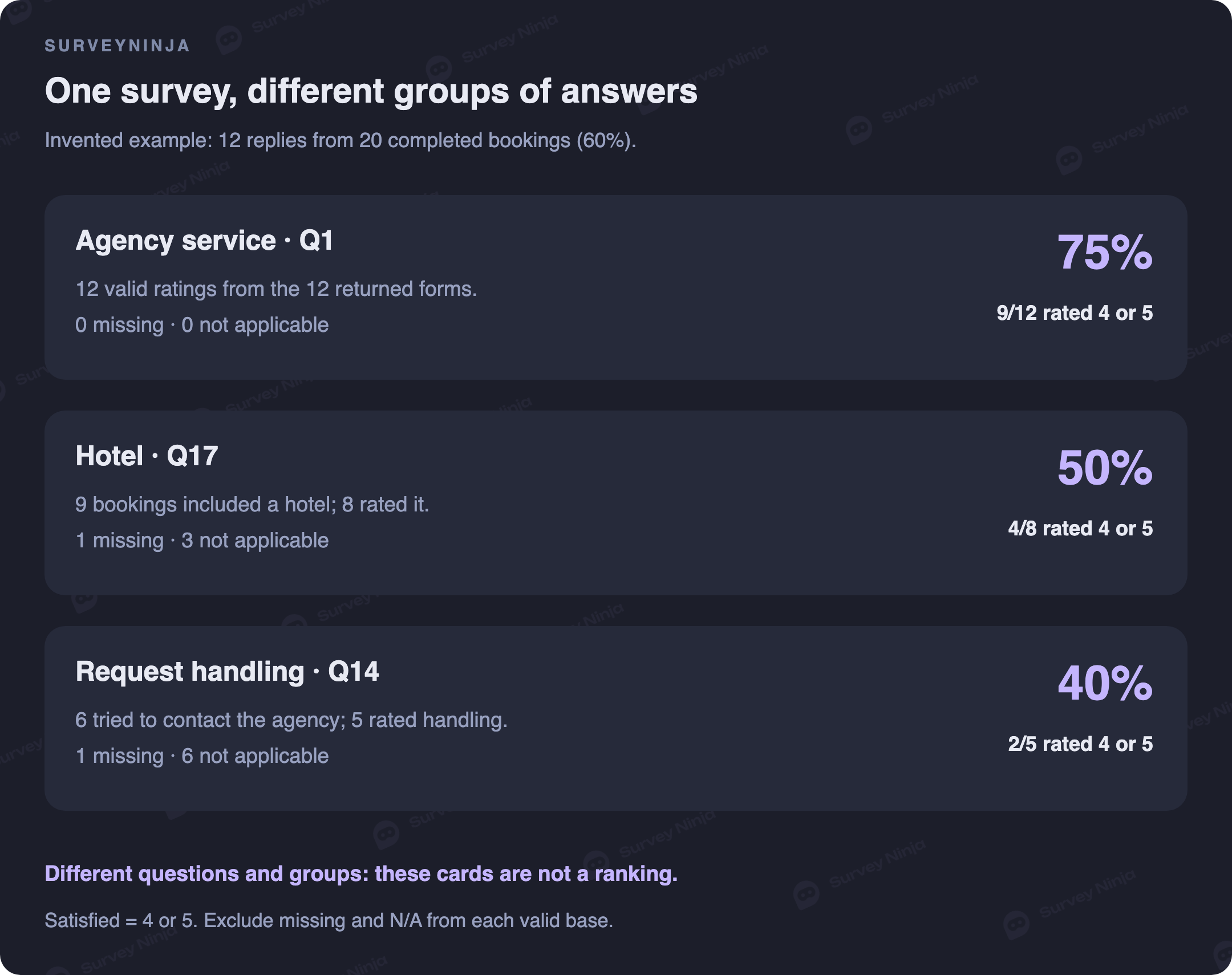
These percentages do not rank the agency, hotel and support team. The questions concern different experiences and groups, and people who tried to reach support already had a reason to call, so the lower figure in that row cannot show that contacting the agency caused dissatisfaction or that every other client would have rated the team differently. Read the request and the response before proposing a remedy. The guide to cross-tabulation in surveys explains how to keep subgroup denominators clear.
Reproduce the fictional example
The complete CSV contains 12 booking responses. Blank cells are missing; NA means not applicable. “Yes” and “no” flag an attempt to contact support and whether a hotel was included. A support attempt includes trying without receiving a reply. Booking codes are invented.
booking,agency_q1,attempted_q11,support_q14,hotel_included_q16,hotel_q17,recommend_q21
B01,5,yes,5,yes,5,10
B02,5,yes,4,yes,4,10
B03,4,yes,3,yes,4,9
B04,4,yes,2,yes,4,9
B05,4,yes,1,yes,3,9
B06,4,yes,,yes,2,9
B07,4,no,NA,yes,2,8
B08,4,no,NA,yes,1,8
B09,4,no,NA,yes,,8
B10,3,no,NA,no,NA,7
B11,2,no,NA,no,NA,6
B12,1,no,NA,no,NA,4
Question 21 has six promoters, four passives and two detractors among 12 valid recommendation answers. NPS is (6/12 − 2/12) × 100 = +33.3, or +33 rounded to a whole number. It is a score, not “33% satisfied.” Moving one passive to promoter changes it by about 8.3 points. Keep the base visible; the NPS guide explains the categories.
Turn comments into a follow-up plan
Give each concern an owner, a next action and an update date. If a client says the hotel did not match the description, check the booking information before assuming which party failed. If the agency’s explanation was unclear, revise the relevant message. Log what you did so that the next review concerns a specific change.
When comparing results over time, keep the wording, the point after return and the booking types as similar as possible, while showing the number of valid answers in each group so that a change involving just one or two travellers remains visible in the report. A few support ratings cannot establish a staff league table, and likelihood of using the agency again is not an observed repeat purchase. Changes in destination or service mix may explain part of a difference.
Keep service recovery separate from review promotion. Do not ask only high scorers for a public review while diverting everyone else to a private channel. Respond to concerns consistently, and ask separately before publishing an identifiable comment. A useful internal result is a documented fix, not simply a better-looking average.
Build and test the questionnaire in SurveyNinja
Start with a blank questionnaire and add the selected items. SurveyNinja’s public feature guide describes general question formats and link sharing. The travel agency satisfaction template is another starting point to inspect. Check its questions and routes before using it for this post-trip design.
Explain the reference booking and confidentiality arrangement at the start, then put the overall agency item before the detailed modules so that clients understand what the survey concerns and can give their broad judgment before being asked to recall a particular flight, hotel or request for assistance. Check that clients can distinguish the scales, skip irrelevant services and leave optional comments blank. Give anyone reading the report enough booking context to investigate, without sharing unnecessary traveller contact details.
AAPOR’s best-practice guidance recommends pretesting with people similar to intended respondents and piloting the survey procedures. Ask a few comparable travellers to explain how they interpret the questions before wider collection.
Also submit a clearly marked internal test on a phone. Try a booking with no hotel and no support attempt, then one with both. Include an unsuccessful attempt to contact the team. Confirm that irrelevant questions are handled as intended and that the report excludes the test. For the general setup process, see how to create an online survey, or start building your survey.
Frequently asked questions
What should a travel agency customer satisfaction survey measure?
Measure booking, preparation, agency support and services arranged for the trip. Keep the agency’s service separate from accommodation, flights and transfers, because each describes a different part of the experience.
When should the survey be sent after a trip?
Two to five days after return is this guide’s practical starting rule, not a proven optimum. Test it with your clients. Keep urgent assistance and formal complaints accessible outside the survey.
Do clients need to answer all 25 questions?
No. Select relevant items from this editable bank. A short version uses overall agency satisfaction, one useful improvement and an optional follow-up request. Support and supplier questions need relevant experience.
Who should respond for a group booking?
For a booking-level report, nominate one lead traveller who took the trip. Their answer describes their own experience. If individual travellers respond, preserve the booking connection and report their answers in a separate traveller-level analysis.
How should missing and not-applicable answers be treated?
Keep them separate and exclude both from that item’s valid denominator. A blank is missing; not applicable means the question does not concern that experience. Report counts and never convert either into zero.
Can hotel and agency satisfaction be combined into one score?
This guide keeps them separate because they concern different services and may have different valid bases. Read comments and booking records before deciding what a rating means or who should act.
Can the survey be anonymous if it uses a booking code?
A booking code can identify a client, so describe that design as confidential. If anonymity is required, remove identifying links and offer a separate, unlinked contact channel for people wanting a reply.
Can these questions be used in SurveyNinja?
Adapt them using formats described in SurveyNinja’s public feature guide. Check current account settings, inspect any template and test the questions and routes before inviting clients.
Published: Oct 22, 2026