


How to Survey Children Without Wasting the Data
Useful  Mike Taylor Aug 27, 2026 Reading time ≈ 27 min

A six year old cannot rank three snacks from memory. A survey that asks her to try gets you noise dressed up as data. What a child can answer changes by the year, and everything in this guide follows from that one fact.
This guide sorts by age because nothing else sorts the problem as cleanly. A four year old and a fifteen year old share a birthday format, and that is nearly all they share: not vocabulary, not memory, not the concept of a rating scale, not patience for more than one question. Design for the age in front of you, not for "children" as a single audience.
Who can actually answer: the child or the parent
Ask the wrong person and the answer is worthless, no matter how carefully the question is written. A four year old can tell you how she feels right now, about this snack, in this chair. She cannot reliably tell you how often she felt that way this month, or whether she liked Tuesday's lunch more than Monday's. Frequency and comparison across time ask a child to hold two memories side by side and judge between them, a skill most four and five year olds have not built yet.
A parent sits on the other side of the same problem: she can report what she saw, how many mornings her son cried before school, whether he finished his homework without help, how long he sat still through dinner. A parent cannot report what the child felt inside that behavior, and guessing at it produces an adult's interpretation wearing a child's name. The two instruments answer different questions. Conflating them is the single most common design error in this whole area. A parent fills out a satisfaction survey about a program the children experienced, and somebody calls the result "kids' feedback."
A teacher is a third option worth naming, especially at school. Teachers see behavior across dozens of children. They can compare one child to typical peers in a way no parent can, which makes a teacher-completed instrument useful for screening, and useless for anything about how a child privately experienced an event. Match the respondent to what the question actually needs: internal, momentary experience goes to the child, in a form scaled to her age, while observable, remembered-over-time behavior goes to the parent or teacher. Never let one stand in for the other because it was easier to reach.
Preschool, ages 4 to 6
Reading is not available yet, so the whole instrument has to run on pictures, faces and pointing. An adult reads the question aloud and the child points to an answer; there is no independent completion at this age. That single fact, an adult voice asking and a child pointing, introduces its own bias, before a single word of the question is even written. Tone, facial expression, even which hand holds out the picture cards, can nudge the answer. Read the same script every time. Keep your own face neutral. Hold picture options at the same distance and angle, no matter which one you privately expect the child to pick.
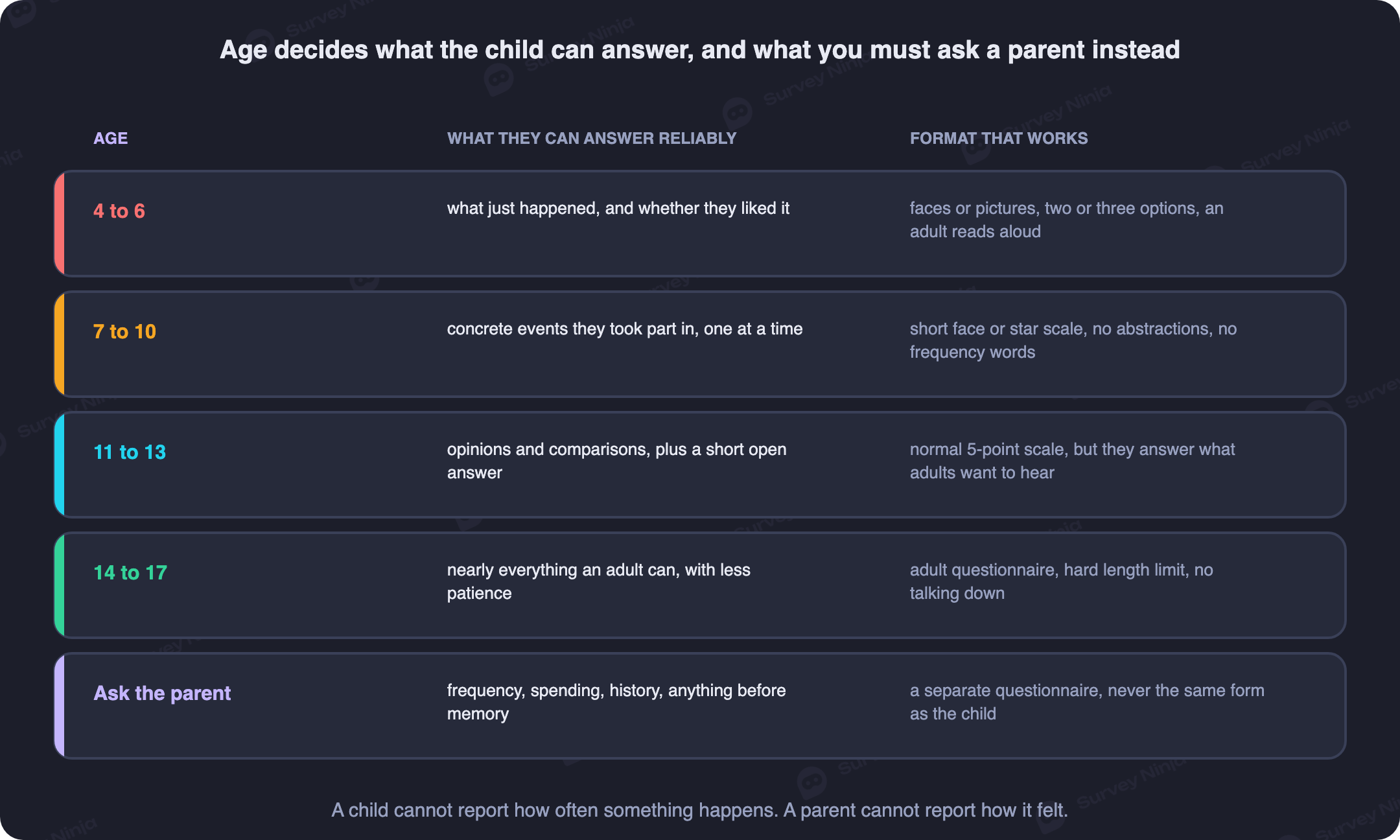
Two options is the safe ceiling for a first project with this age group. Three is workable once you have piloted the wording on an actual four year old and watched her point. A face scale of happy, neutral and sad works well, and so does a simple thumbs up and thumbs down: both cover most of what a preschooler can reliably communicate about a concrete, present experience. Skip the middle face if you cannot find a preschooler who reliably identifies it, since some children read "neutral" as "I don't know" and pick it for everything they are asked.
Run it one child at a time. In a group, the first answer becomes the group answer, and one child says the puppet show was scary, so that by the third child every hand is up. That is not a preteen phenomenon. It happens at four just as easily, only faster.
Early school, ages 7 to 10
Reading works by seven, but slowly, and sounding out an unfamiliar word costs enough effort that a child forgets the start of the sentence by the time she reaches the end. Keep each question to one short sentence, one clause, words a second grader already owns. Print in a large, plain font, and leave room for an adult to help with a hard word, without steering the answer toward what the adult expects.
This age group answers concrete, event-based questions far better than anything phrased as an opinion in the abstract. "Did you raise your hand today" gets an honest answer. "Are you a confident student" gets a shrug, or a guess at what confident is even supposed to mean. Anchor every question to something that happened: pick a specific day, a specific class, rather than a trait the child is supposed to have or not have.
Scales stay visual: faces or stars, three to four points, still no bare number line. A seven year old can count stars easily enough. She has not yet built a stable sense of what "somewhat agree" means, as opposed to plain "agree." Give her something to count instead of something to weigh.
Preteens, ages 11 to 13
By eleven, most children can handle a normal five-point scale and a genuine open question. The temptation is to treat a preteen survey like a short adult one. Resist it halfway. The scale format works. What breaks is honesty, not comprehension.
Social desirability peaks somewhere in this band. An eleven year old has fully learned that adults have preferred answers, and has not yet developed a teenager's willingness to push back on that pressure, so the two combine into the most compliant respondent you will survey all year. Hand this age group a satisfaction question about the class right after the teacher explains why the survey matters, and most will rate everything favorably, regardless of what they privately think. The pattern is well documented as social desirability bias, and it is strongest exactly where the person asking is also the person being rated.
Get the rated adult out of the room before the survey starts. Hand out a real envelope the child seals themselves, even for a paper form. Say plainly, at the top, that individual answers are not shown to the teacher. None of that eliminates the bias. Each piece lowers it, though, and stacking three small changes does more than any single clever question.
Teenagers, ages 14 to 17
Fourteen to seventeen year olds design almost like adults. Give them a real scale, a genuine open text box, branching logic if the tool supports it, and language that no longer needs simplifying for comprehension. Where this age band differs is patience, and tolerance for being condescended to, not capability.
Cut the length hard anyway. A fifteen year old can answer a twenty question survey and will not, especially not one that arrives as a link from a school account on a Tuesday afternoon. Keep it to what a fifteen year old would actually finish on a phone between classes, and put an honest estimate of how long that takes right at the top, not buried in a confirmation email nobody opens.
The other failure mode is tone. Emoji-heavy scales, exclamation marks, a mascot character explaining the instructions: all of it reads as written for someone younger. A teenager who feels talked down to either abandons the survey or answers it sarcastically to make a point, and you will not always be able to tell which responses are which. Use the same visual register you would for an adult instrument, just with shorter sentences and no jargon.
Writing questions a child can actually answer
A handful of wording rules do more for data quality at every age below about twelve than any amount of clever design. None of them are unique to children. Adult survey writers should follow most of them too. A child's tolerance for a badly built question is simply much lower.
- No double negatives. "Isn't it true you don't dislike recess" is unanswerable by an adult, let alone a nine year old.
- No hypotheticals. "If you could change one thing about school" assumes a child can imagine a counterfactual world, then judge it. That skill develops gradually, and it is unreliable before the preteen years.
- No vague frequency words. "Usually" and "often" mean different numbers to different children, and even to the same child on different days. Ask about today or this week and get a real count instead.
- One idea per question. "Was the trip fun and well organized" forces a nine year old to average two different judgments into one tap. Afterward, you cannot tell which one drove the answer.
- Present tense, concrete nouns. "How do you feel about recess" beats "how do you feel about your leisure time." Recess is a place a child has stood in. Leisure time is a category an adult invented.
The same discipline applies to leading questions. A child is, if anything, more likely than an adult to simply agree with whatever the question implies. The general rules on closed and open question design cover this in more depth, for any age.
Scales that work, and the ones that fail
Faces, stars and thumbs cover almost every scale a child under twelve can use honestly. A three-point face scale works from about four. A five-point face or star scale, still visual rather than verbal, works from about seven or eight. That is roughly when a child has enough number sense to place five things in order. Thumbs up, sideways, down is a fast binary-plus-neutral option. It reads instantly at nearly any age past five.
What does not work is the standard five-point agreement scale built for adults: strongly disagree to strongly agree, presented as words with no faces attached. "Agree" is an abstraction. It is a stance the respondent holds toward a statement, and holding a stance is a different cognitive task from reporting how you feel about a snack. Below about ten, it does not measure opinion so much as measure whichever word looked biggest, or came last on the screen. Even adult instruments built entirely around agree-or-disagree statements, like the System Usability Scale, are not recommended for children, for exactly this reason. Adapt the concept, not the wording. Keep the number of points, drop the abstract labels, and hand back faces or stars instead.
The mechanics of a standard agreement scale are covered in the Likert scale guide. Everything in it applies cleanly to teenagers, and stops applying well before that.
How long you actually have
Attention has a real ceiling at every age. Blowing past it does not get you more data. It gets you the last three answers filled in at random, so the child can finish and get their sticker.
A useful working set of limits, tested against real classrooms: one question, under a minute, for preschool, always administered one on one. Early school gets three to five questions, five minutes or so, with an adult still reading anything longer than a short sentence. Preteens can sustain eight to ten questions, roughly eight minutes, as long as the questions stay concrete. Teenagers can go to twelve or fifteen questions on a phone, under ten minutes. They have the cognitive ability to go longer. They rarely have the patience.
Treat every question past that ceiling as a specific decision, not a default. The general mechanics of why length kills completion are in how to reduce survey dropout. The short-form pattern behind most of these limits is exactly what a microsurvey is built to enforce.
The adult in the room, and where the survey happens
Every survey aimed at a child has an adult standing somewhere nearby. Even a self-administered one on a tablet has one, hovering just outside the frame. That adult's presence changes the answer, whether or not anyone intends it to. A teacher walking the room during a class survey gets rosier answers about the class than an anonymous digital form sent home would. A parent sitting beside a child, filling in a form about the child's own mood, gets answers edited too. Some children downplay a bad day, to avoid worrying the parent. Some exaggerate one, to get attention.
Decide on purpose whether the administering adult stays. Say so out loud, before the survey starts. A rule as simple as "I'm going to sit over here and you don't need to show me your answers" measurably changes what gets written.
Where the survey physically happens shapes the sample almost as much as who is standing over the child's shoulder. Four places account for most of it, and each one buys something different. At school, through a teacher, you reach the whole class or grade. Selection bias is close to zero. What you lose instead is neutrality: an institutional setting nudges answers toward loyalty to the school itself.
Sent home through a parent's device, you lose the captive audience. The parent has to remember to hand over the phone. Only the more engaged families reliably return it, which is a real sampling problem disguised as a logistics one. Inside a product with a dedicated child mode, the survey reaches only children already using that product regularly. That is a self-selected group of the most engaged users, not a representative one, the same trade-off any in-app feedback prompt makes for adult users too. On paper, handed out at a school event, completion is often the highest of all. A form in hand at the moment of the event beats a link that arrives by email three days later. Print a QR code on it too, linking to a digital version parents can finish once they get home.
What has to be sorted before you send anything
None of what follows is legal advice. It should not stand in for a lawyer once real consequences are on the table: a survey tied to a research study, a health question, anything a school's ethics process has to sign off on. What follows is the shape of what usually has to be in place before a survey reaches a child. Use it to know what to ask a lawyer, or your institution's review board, rather than finding out afterward.
In the United States, the Children's Online Privacy Protection Act, COPPA, sets a bright line at under 13. Collecting personal information from a child below that age generally requires verifiable parental consent before you collect anything, not after. In the European Union and the UK, GDPR and UK GDPR apply to a child's data at any age. They also add a specific digital consent age for offering an online service directly to a child. Each member state sets that threshold somewhere between 13 and 16, so the actual number depends on which country your respondent is in. The threshold is not the whole story. In Brazil, the LGPD requires specific, highlighted consent from a parent or guardian to process a child's personal data, and it holds the best interests of the child as the standard that processing is judged against.
Underneath the specific thresholds, the obligations tend to rhyme across all three. Consent from a parent or guardian has to be verifiable, not a checkbox nobody actually checks. Collect no more data than the survey needs, a principle usually called data minimisation. Use the data only for the stated purpose, not for anything else later. Give a real path to delete a child's data on request. Do not profile a child, or target them with advertising, off the back of survey responses. Some version of that restriction shows up in every framework named here. Where a survey runs through a school or another institution, that institution's own approval is usually required too. It is often the stricter of the two.
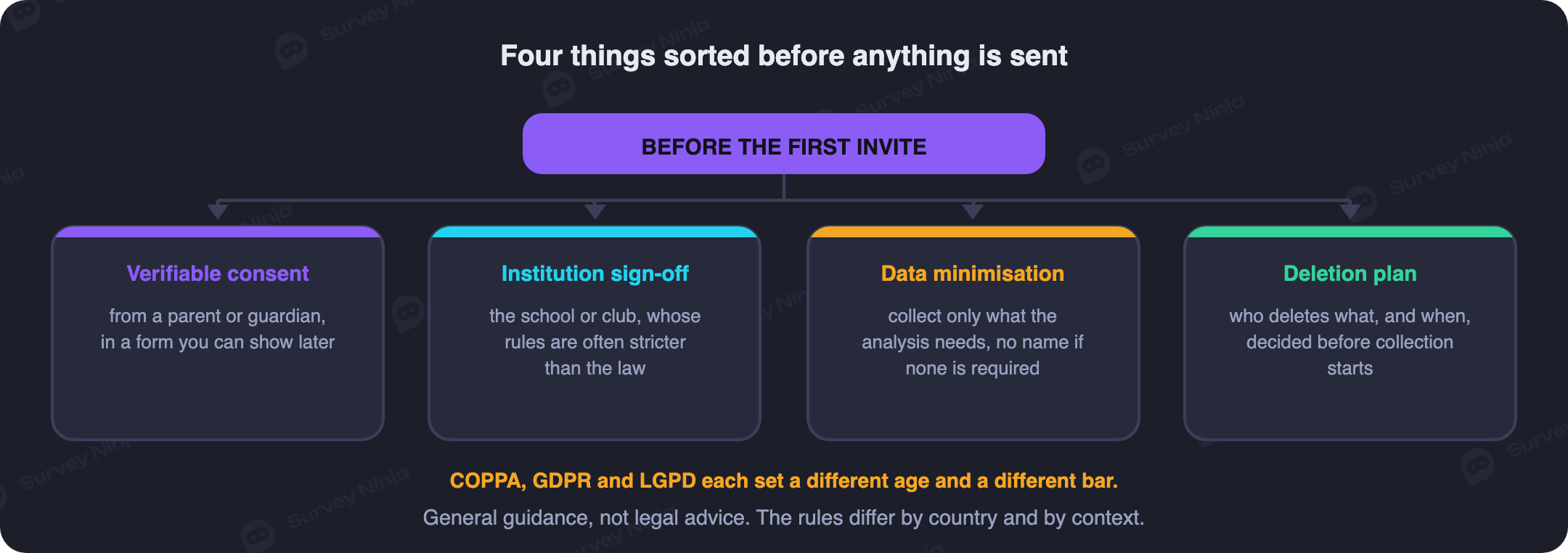
Say this twice, because it matters. The rules differ by country, by the child's age, and by the context the survey runs in. A school's ethics committee, or your own legal team, may set a bar well above what the law technically requires. Research makes this sharper still. A university running a study through a thesis or research project answers to an institutional review process on top of every privacy law already mentioned. That process, not this article, is the actual authority on what a given project requires.
Getting a yes from parents and a finish from kids
A consent request that gets signed and returned says four things plainly, in order: what the child will be asked to do, and what data will be collected. It also says who sees answers, for how long, and how to say no without consequence. A form that buries this in a paragraph of boilerplate gets skimmed and ignored. A rushed parent defaults to no. Worse, a rushed parent often does not return the form at all, which functionally means no anyway.
Incentive design for a child survey is not a smaller version of an adult one. A gift card is a strange thing to hand a nine year old directly. Practically, most nine year olds cannot spend one unsupervised. Ethically, offering a reward straight to a child edges toward pressuring the child, rather than the parent who actually gave consent, and what tends to work instead is a group-level incentive. The whole class gets fifteen extra minutes of recess if enough forms come back signed. A small prize draw gets registered to the parent, not the child. A sticker or certificate goes to everyone, regardless of what they answered, never tied to any particular response.
Getting the child to finish once they start is a different problem from getting the parent to sign. Open with one easy, ungraded practice question. Give it an obvious right answer, like "point to the red ball," so the child understands the mechanic before anything that actually counts. Keep the same warm, unhurried tone through the whole instrument, rather than saving it for the introduction. End on something the child enjoys answering, a favorite color or a silly question. That way the last thing they remember is not the hardest item in the survey. A consent gate is easiest to build as branching logic. Put one screen in front of the parent, which has to be completed before the child ever sees a question, using whatever logic features your survey tool offers.
Reading children's answers honestly
Young children agree. Handed a scale, a surprising number of them pick the positive end almost regardless of the statement. Researchers call this acquiescence bias, and it is strongest exactly in the age bands where a five-point scale first becomes usable. There is one way to catch it, useful from about ten upward: ask two statements about the same thing, one worded positively and one negatively, without resorting to a double negative in either. Then watch for a child who agrees with both. That child is not telling you two contradictory opinions. He is telling you he is agreeing with the shape of the question, not its content.
A second pattern shows up mostly under twelve: extreme responding. Children reach for the biggest smile or the most stars almost as a reflex, since the biggest option is simply the most fun one to pick, not the most accurate. Look at the shape of the whole distribution before trusting an average. A class where every single child rated lunch five stars is not a triumph of the cafeteria. It is a scale that only ever gets used at one end.
Open text from a child needs a human reader, not a keyword count or a sentiment score. A seven year old answering "what was the best part of the trip" might write "the bus." Maybe the bus is genuinely what she remembers. Maybe she ran out of things to say, and the bus was the last concrete noun available. No automated tool tells you which. Read every open response by hand at this age. Where the volume is real, the process for turning short, literal answers into actual themes is the same one covered in thematic analysis, just applied to blunter material than an adult survey tends to produce.
Checklist before you send, and the mistakes that keep happening
Two lists. One to run through before anything goes out, and one built from watching the same errors recur across age bands and settings.
Before you send:
- Consent collected and stored. A parent's consent for anything below the digital consent age in play, plus the school's or institution's if the survey runs through one.
- Question wording tested out loud on one real child at the youngest end of your target age, not just read silently by an adult on the team.
- Scale matched to the age band: faces or a three-point option below seven, a proper five-point option not before about ten.
- Length matched to the attention limits for that age, timed on an actual child rather than estimated from a template.
- A decision made, and stated to the child, about whether the administering adult sees individual answers.
- Data minimisation checked: nothing collected that the survey does not actually need, especially anything that could identify the child indirectly.
- A plan in place for what happens to the data afterward, including who reads open text and when it gets deleted.
Mistakes that keep happening:
- Taking an adult questionnaire and swapping in child-friendly art without touching the questions underneath.
- Asking a seven year old a hypothetical, then treating the answer as if it meant something.
- Letting the rated teacher stand at the front of the room while the class fills in a survey about that teacher.
- Sending home a consent form that never says what data is collected or for how long it is kept.
- Calling a form anonymous when a parent's signature and the child's name are both attached to it somewhere in the chain.
- Rewarding the child directly for participating, rather than the parent who gave consent or the class as a whole.
- Collecting open text from children and never reading it, because nobody budgeted the time a human reader actually takes.
A short, well-piloted instrument beats a long, ambitious one nearly every time at this end of the audience. Starting from nothing? A ready-made template helps, and a free account with no cap on responses gets you to a testable draft faster than building the logic from scratch.
Frequently asked questions
What age can a child reliably answer a survey?
From about four, but only with an adult reading aloud, pictures instead of words, and a maximum of two or three options. Independent reading starts around seven, though slowly, and a standard five-point agreement scale does not become reliable until around ten. Below four, ask the parent or a teacher instead of the child.
Should I survey the parent or the child directly?
It depends on what the question needs. A child's internal, momentary experience, how something felt, has to come from the child, in a form scaled to her age, while a parent or teacher can reliably report observable behavior over time, like how often a child cried before school. Sending a parent survey and calling the results "kids' feedback" is a common and avoidable error.
What scale should I use for young children?
Faces, stars or thumbs, not words. A three-point face scale works from about four. A five-point face or star scale works from about seven or eight. The standard adult agreement scale, strongly disagree to strongly agree, is unreliable below about ten, because "agree" is an abstract stance a young child has not yet learned to hold toward a statement.
How long should a survey for children be?
Roughly one question for preschool, three to five for early school, eight to ten for preteens, and twelve to fifteen on a phone for teenagers, each within a few minutes. Going past the limit for the age band does not add data. It adds random answers from a child who wants to finish.
Do I need parental consent to survey a child?
In most jurisdictions and for most contexts, yes, and it needs to be verifiable rather than a checkbox. In the United States, COPPA sets the threshold at under 13, while in the EU and UK, GDPR sets a digital consent age each country fixes between 13 and 16. In Brazil, the LGPD requires specific, highlighted parental consent. A school or ethics board can require more than the law does. This is general guidance, not legal advice for a specific project.
What is the age threshold under COPPA and GDPR?
COPPA in the United States applies to children under 13. GDPR and UK GDPR set a digital consent age that each member state chooses somewhere between 13 and 16, so the exact figure depends on the country. Both sit alongside broader obligations, like data minimisation and a right to deletion, that apply to a child's data more generally.
How do I stop a child from just agreeing with everything?
You cannot stop it entirely, but you can spot it: from about ten, pair a positively worded and a negatively worded statement about the same topic, without using a double negative. Watch for a child who agrees with both. That pattern signals acquiescence bias rather than a real opinion, and it is worth checking the shape of the whole response distribution rather than trusting a single average.
Can a teacher or parent stay in the room while a child answers?
They can, but it changes the answers, especially anything touching that adult directly. Decide on purpose whether the adult stays. Tell the child plainly whether individual answers will be shown to them. Get the rated adult out of the room for anything evaluating that specific person.
Published: Aug 27, 2026