 Google Forms Limits: Responses, File Uploads, Timers and Logic, With Workarounds
Multiple Choice Questions: Types, Examples and Rules for Surveys and Tests
Survey design  Mike Taylor Nov 21, 2026 Reading time ≈ 19 min
Contents
- What is a multiple choice question?
- Types of multiple choice questions
- Single answer or "select all that apply"?
- How to write answer options for survey questions
- Multiple choice questions for tests and quizzes
- How to score a multiple choice test
- Multiple choice question examples for surveys
- Multiple choice question examples for tests and quizzes
- Common mistakes with multiple choice questions
- How to create multiple choice questions in SurveyNinja
- Frequently asked questions
Multiple choice questions give the respondent a fixed list of answers and ask them to pick one or several. Surveys and tests both lean on them because they are quick to answer and easy to count. This guide covers the seven common types, rules for answer options, how test questions and distractors differ from survey questions, how to score a test when people guess, and ready examples for both.
Key points
- A multiple choice question has a stem (the question) and a list of options; in a test, one option is the key and the rest are distractors.
- Survey options must be mutually exclusive and exhaustive, so every respondent finds exactly one answer that fits.
- In a Pew Research Center experiment, a yes/no question per item gave shares 8 points higher on average than one "select all that apply" list.
- For tests, three good options usually work as well as four or five, and a guessing correction removes the points a blind guesser would get.
What is a multiple choice question?
A multiple choice question is a closed question with a predefined set of answers. It has two parts: the stem, which asks the question, and the options, which list the possible answers. The respondent picks an option instead of writing their own words, which is what separates closed from open questions.
The same format serves two jobs with different rules. In a survey there is no right answer: every person should find the option that describes them, and the list should lean neither way. In a test or quiz one option is correct (the key) and the others are distractors: people who know the material should pick the key, and people who don't should be drawn to a wrong option for a reason you can diagnose. A survey question that tricks people is a bad survey question, and a test question anyone can answer without knowing the subject is a bad test question.
The format has clear advantages and limits. Answers are fast to give, easy to compare across groups and need no coding. The price is that people can only say what you thought of: an option you left out never shows up in the data, and a test answer can be guessed. When you don't yet know the range of answers, run an open question in a pilot and turn the most common answers into options.
Types of multiple choice questions
Most multiple choice questions fall into seven formats that differ in how many answers a person may pick and how the options are shown. Our map of survey and question types covers open, matrix and research formats. Ranking questions, where people put the options in order, are a close relative with their own analysis rules. The table stays with choice formats.
| Type and what the respondent does | When to use it, with an example |
|---|---|
| Single answer (radio buttons). Picks exactly one option. | Options exclude each other. Example: "Which plan are you on?" |
| Multiple answer (checkboxes). Ticks every option that applies. | Several answers can be true at once. Example: "Which of these apps do you use for work?" |
| With "Other (please specify)". Picks an option or types their own. | You can't be sure the list is complete. Example: "How did you hear about us?" |
| Dichotomous (yes/no, true/false). Chooses one of two. | The answer really has two states. Example: "Did you attend the October workshop?" |
| Rating scale. Picks a point on an ordered scale. | Measuring satisfaction, agreement, frequency. Example: "How satisfied are you with delivery?" |
| Image choice. Clicks a picture. | The difference is visual: designs, packaging. Example: "Which cover would you pick up first?" |
| Dropdown. Opens a list and picks one. | Long lists people know by heart. Example: "Which state do you live in?" |
Rating scales have their own rules on labels and length, collected in our rating scale examples. Dropdowns save space but hide the options, so use them only when people already know what they are looking for. Nobody needs to read 50 states to find their own; everyone needs to read five reasons for cancelling.
Single answer or "select all that apply"?
Use a single answer when the options exclude each other, and think twice before a "select all that apply" list. Checklists are fast, but people tend to stop ticking once they have found a few options that fit. A yes/no question for each item takes longer and gives fuller answers.
Pew Research Center tested this on 4,581 U.S. adults in 2018 and published the results in 2019. The same 12 items were asked either as one checklist or as separate yes/no questions, and the forced-choice version gave higher shares, by 8 percentage points on average across the 12 items. In an archive of 21 of its online surveys, moving an option up or down a checklist changed its share by 3 points on average, against 0 for forced-choice questions. Pew now uses forced choice in its online surveys whenever possible.
An earlier experiment by Jolene Smyth, Don Dillman and colleagues in Public Opinion Quarterly (2006) found the same pattern across 16 comparisons: with forced choice, people marked more options and spent longer on the question.
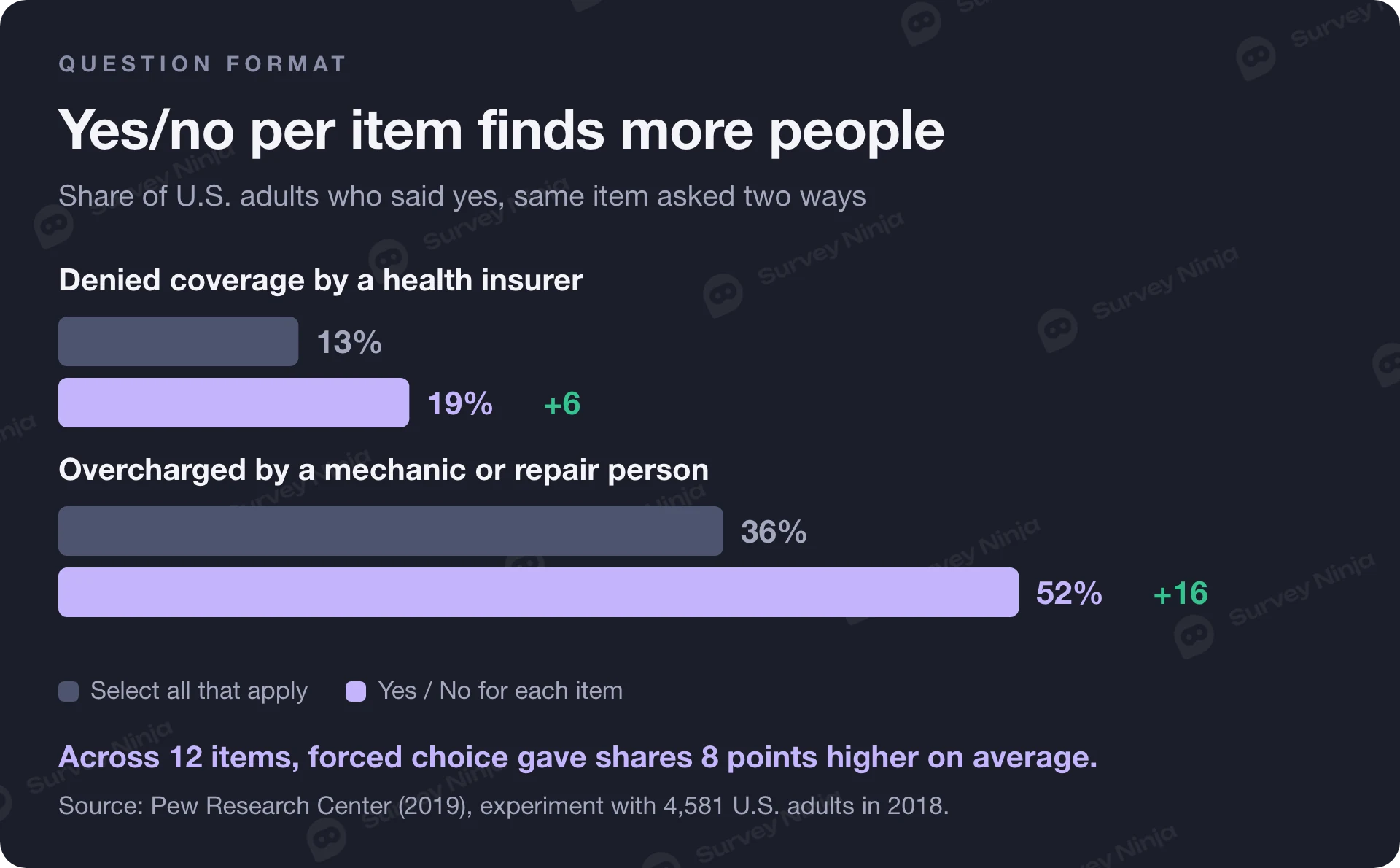
In practice: if you need the share of people who did each thing, ask yes/no per item. If you only need the rank order of items, a checklist is fine, since Pew found the order mostly the same in both formats. If you keep a checklist, show the options in random order and add "None of these" so a blank answer has a meaning.
How to write answer options for survey questions
Good options let every respondent find exactly one answer that describes them, without being nudged. Six rules cover almost every case.
- Mutually exclusive. "18–25" and "25–34" overlap at 25; write "18–24" and "25–34".
- Exhaustive. Add "Other (please specify)", "None of these" or "Not applicable" when you can't list everything.
- Balanced. "Excellent, Very good, Good, Fair" has three positive options and no negative one.
- A sensible order. Ordered options (frequency, amount, agreement) keep their natural order. Unordered lists go in random order, because on screen the first options get picked more often, the primacy effect.
- A way out. "Don't know" or "Prefer not to say" where an honest person may have no answer. Leave it out of questions everyone can answer, or it becomes an easy exit.
- Short and parallel. Options of similar length and grammar, five to seven for a reason or preference list. Longer lists belong in a dropdown.
The stem matters as much as the options. Our guide on how to write survey questions covers leading and double-barreled stems.
Multiple choice questions for tests and quizzes
A good test question has a stem that makes sense on its own, one clearly correct key, and distractors that are wrong for a reason. Thomas Haladyna, Steven Downing and Michael Rodriguez reviewed the research on item writing and condensed it in 2002 into 31 guidelines. The ones that matter most for everyday quizzes:
- Put the question in the stem. "Photosynthesis…" is a topic; "Which gas do plants release during photosynthesis?" is a question.
- Build distractors from real mistakes: a common misconception, a calculation done in the wrong order, a term that sounds similar.
- Keep options alike. The key should not be the longest or the most detailed option. Test-wise students spot such clues.
- Avoid "All of the above" and use "None of the above" with care. A student who sees two correct options can pick "all of the above" without knowing the third.
- Phrase stems positively. If you must ask "Which is NOT…", put NOT in capitals.
- Move the key around, or let the quiz tool shuffle options.
How many options? Michael Rodriguez's 2005 meta-analysis of 80 years of research concluded that three options are usually enough: going from four or five to three hardly changes difficulty or reliability, and you can ask more questions in the same time. A filler option nobody picks only adds reading.
| Weak item | Better item |
|---|---|
| Survey sampling: a) is when you choose people at random from the whole population so everyone has an equal chance b) is good c) uses a list d) all of the above | A researcher draws 400 names at random from the full customer list. What kind of sample is this? a) Simple random sample b) Convenience sample c) Quota sample |
The weak version has no question in the stem, a key much longer than the rest and a defensible "all of the above". In the better one, both distractors are real alternatives that students confuse with random sampling.
How to score a multiple choice test
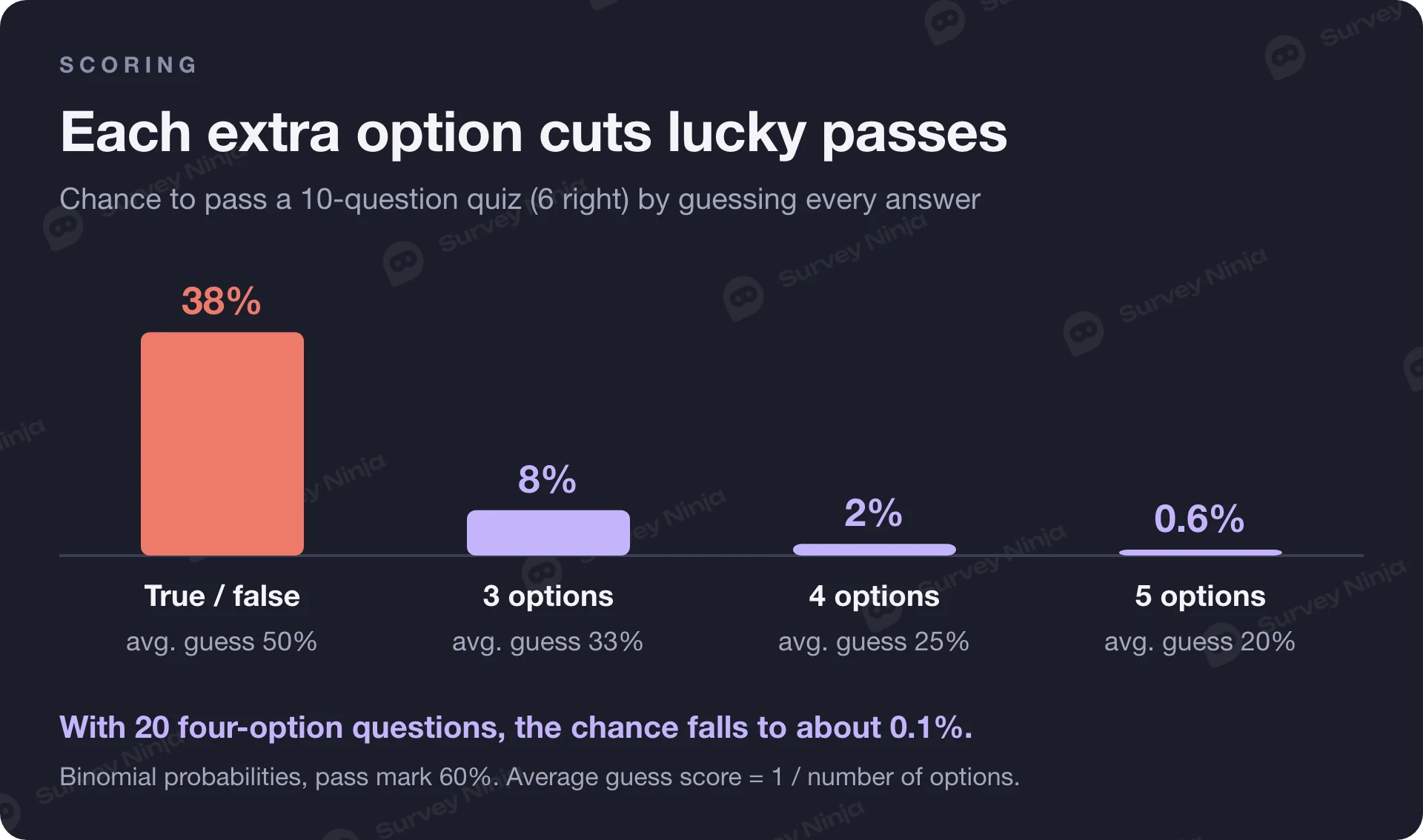
The simplest rule is one point per correct answer and no penalty for wrong ones, which suits quizzes and practice tests. For higher stakes, remember what a blind guesser scores: with k options, the expected score from pure guessing is 1/k. That is 50% on true/false questions, 33% with three options, 25% with four and 20% with five.
The chance of passing by luck drops fast as you add options or questions. On a 10-question quiz with a 60% pass mark, a pure guesser passes about 38% of the time with true/false questions, 8% with three options, 2% with four and under 1% with five. On 20 four-option questions it falls to about 0.1%. These are binomial probabilities, so you can recompute them for your own test.
If guessing worries you, use the classic correction for guessing: corrected score = R − W / (k − 1), where R is right answers, W is wrong answers (blanks don't count) and k is the number of options.
A worked example: 20 questions with four options. A student gets 14 right, 4 wrong and leaves 2 blank. The raw score is 70%. The corrected score is 14 − 4/3 = 12.7, or 63%. A pure guesser would expect 5 right and 15 wrong, and 5 − 15/3 = 0. Tell students about the correction before the test, because it changes whether skipping a question pays.
For "tick all correct options" questions, decide on partial credit. One common rule: split the point among the correct options, subtract the same amount for each wrong tick, never go below zero. With two correct options out of four, both ticked gives 1 point, one correct alone 0.5, one correct and one wrong 0. More on points and result categories in our glossary entry on scoring.
Multiple choice question examples for surveys
Ready-to-copy survey questions grouped by purpose, with the format and options.
| Purpose and question | Format and options |
|---|---|
| Customer. How did you first hear about us? | Single answer: Search engine, Social media, Friend or colleague, Online review, Event, Other (please specify) |
| Customer. How often do you use the app? | Single answer: Daily, A few times a week, About once a week, Less often, I no longer use it |
| Customer. What is the main reason you are cancelling? | Single answer, random order: Too expensive, Missing a feature I need, Hard to use, Switched to another tool, No longer need it, Other (please specify) |
| Product. Which of these features have you used in the past month? | Yes / No for each feature |
| Product. How easy was it to set up your account? | Very difficult, Difficult, Neither easy nor difficult, Easy, Very easy |
| Employees. How often do you get useful feedback from your manager? | Never, Rarely, Sometimes, Often, Always |
| Employees. Which work arrangement would you prefer? | Fully on-site, Mostly on-site, Half and half, Mostly remote, Fully remote |
| Events. Which format would you prefer for the next event? | In person, Online, Hybrid, No preference |
| Students. How many hours a week do you study outside class? | 0–2, 3–5, 6–10, 11–15, More than 15 |
| Students. Which resources did you use to prepare for the exam? | Yes / No for each: Lecture notes, Textbook, Practice tests, Study group, Videos |
| Market research. How much did you spend on books in the past 3 months? | Nothing, Under $20, $20–49, $50–99, $100 or more |
| Market research. Which of these packaging designs would you pick up first? | Image choice: 2–4 designs, random order |
| Demographics. What is your age? | Under 18, 18–24, 25–34, 35–44, 45–54, 55–64, 65 or older, Prefer not to say |
| Demographics. Which country do you live in? | Dropdown |
Ask demographic questions only if your analysis compares groups, and make them optional. For a specific topic, the free AI question generator drafts questions with answer options from a short description, which you can then trim with the rules above.
Multiple choice question examples for tests and quizzes
Test questions need a key and distractors that reveal a specific misunderstanding. This set works as a short quiz on survey methods; the key is in bold.
6 sample test questions with answers
- "How satisfied are you with our prices and delivery?" What is wrong with this question?
a) It asks about two things at once
b) It is an open question
c) It uses a rating scale - Which answer list is mutually exclusive?
a) 1–5, 5–10, 10–15
b) 1–4, 5–9, 10–14
c) Under 5, Under 10, Under 15 - True or false: a larger sample removes bias caused by a bad sampling frame.
a) True
b) False - In which case is a dropdown the better format?
a) Main reason for cancelling, 5 options
b) Country of residence
c) Satisfaction from 1 to 5 - A test has 4 options per question. What score should pure guessing give on average?
a) 0%
b) 25%
c) 50% - A student gets 12 right, 6 wrong and skips 2 on a four-option test. What is the corrected score?
a) 12
b) 10
c) 6
Each distractor targets one confusion: format versus wording, overlapping boundaries, bias versus random error. For building a self-scoring quiz from the first question to the results screen, see how to create an online quiz.
Common mistakes with multiple choice questions
Most problems come from options written in a hurry.
| Mistake | Before | After |
|---|---|---|
| Overlapping ranges | 18–25, 25–35, 35–45 | 18–24, 25–34, 35–44 |
| Missing options | Full-time, Part-time | Full-time, Part-time, Self-employed, Student, Not working, Other |
| Two questions in one | Was the course useful and well organized? Yes / No | One question on usefulness, one on organization |
| Checklist where you need shares | Which of these have you done? (tick all) | Yes / No for each item |
| Vague frequency words | Rarely, Sometimes, Often | Never, Once a month or less, 2–3 times a month, Weekly or more |
| Clue in a test key | The only long, detailed option is correct | All options similar in length |
Before launch, have two or three people from your audience answer aloud. If someone hesitates between two options or says "none of these fit me", the list needs work.
How to create multiple choice questions in SurveyNinja
In the SurveyNinja builder, choice, dropdown list and rating questions work on every plan, and image choice is available from Basic. Any choice question can show its options in random order for each respondent. For a quiz, open the quiz maker, mark the correct options and give each a score: correct answers, scores and personality-test categories work on all plans, including Free. From Basic, the final screen can show a text for each score range and let people see their answers marked right or wrong.
To skip the blank page, Ninja AI in the builder can draft a survey from a short description, a file or an image and set up scores for a test, and every change waits for you to apply it. Its quick actions on a single question (rephrase, shorten, make more neutral, check errors) help with stems that read awkwardly.
Frequently asked questions
What is a multiple choice question?
A multiple choice question is a closed question with a fixed list of answers. The respondent picks one option, or several if the question allows it, instead of writing their own answer. In surveys, the options describe possible opinions or facts; in tests, one option is correct and the others are distractors.
How many options should a multiple choice question have?
For tests, three well-written options are usually enough: a 2005 meta-analysis by Rodriguez found that cutting from four or five options to three barely changes difficulty or reliability. For survey questions, list every realistic answer, typically four to seven, and add "Other" or "None of these" when you cannot cover everything.
What is the difference between single choice and multiple choice?
A single choice question lets the respondent pick one option, usually with round radio buttons. A multiple answer question, often called "select all that apply", lets them tick several boxes. Use single choice when options exclude each other, and consider a yes/no question per item when you need accurate shares for each option.
Should I include "Other" or "Don't know" options?
Add "Other (please specify)" when you are not sure your list covers every answer, and read the write-ins to improve the list next time. Add "Don't know" or "Prefer not to say" when an honest respondent may lack an answer or prefer privacy. Leave them out of questions everyone can answer.
How do you score a multiple choice test with guessing?
The usual rule is one point per correct answer. To remove the effect of blind guessing, subtract the wrong answers divided by the number of options minus one from the right answers. On a four-option test, 14 right and 4 wrong gives 14 minus 4/3, about 12.7 points. Blank answers are not counted.
Are multiple choice questions quantitative or qualitative?
Multiple choice questions produce quantitative data: you count how many people picked each option and compare percentages across groups. Unordered options give nominal data, and ordered options such as rating scales give ordinal data. Text typed into an "Other (please specify)" field is qualitative and needs coding before you can count it.
Published: Nov 21, 2026