 25 Questions for a Travel Agency Customer Satisfaction Survey
Monadic or Sequential Monadic: How to Choose and Run a Concept Test
Useful  Mike Taylor Sep 30, 2026 Reading time ≈ 13 min

A concept test shows people an idea before you build it and measures how they react. The first decision is whether each person sees one concept or several in a row. That choice, monadic or sequential monadic, sets how many respondents you need, which biases you have to fight and what the numbers can tell you.
The term itself is defined in our glossary entry on sequential monadic testing. This guide is about the decision: how the two designs differ, how big the sample must be, how to keep the order of concepts from skewing the results, and how to read what comes back.
What monadic and sequential monadic mean
In a monadic test, each respondent sees exactly one concept. If you have three ideas, you split the sample into three matched groups, or cells, and each group rates one idea in isolation. Nobody compares anything. That is close to how people meet a product in real life: one pack on the shelf, one ad, one landing page.
In a sequential monadic test, each respondent sees two or more concepts one after another and rates each one in full before the next appears. The order is rotated across respondents, so every concept shows up first, second and third equally often. You get ratings for all concepts from the same people. The test is cheaper, and the comparison is sharper.
There is a third, older design, the paired comparison, where people see two concepts side by side and pick the one they prefer. It is very sensitive to small differences but says nothing about whether either concept is good on its own. Combining the two gives the protomonadic design: a monadic or sequential monadic evaluation followed by a direct preference question at the end. The exact meaning of the term varies from one researcher to another, so define it when you use it.
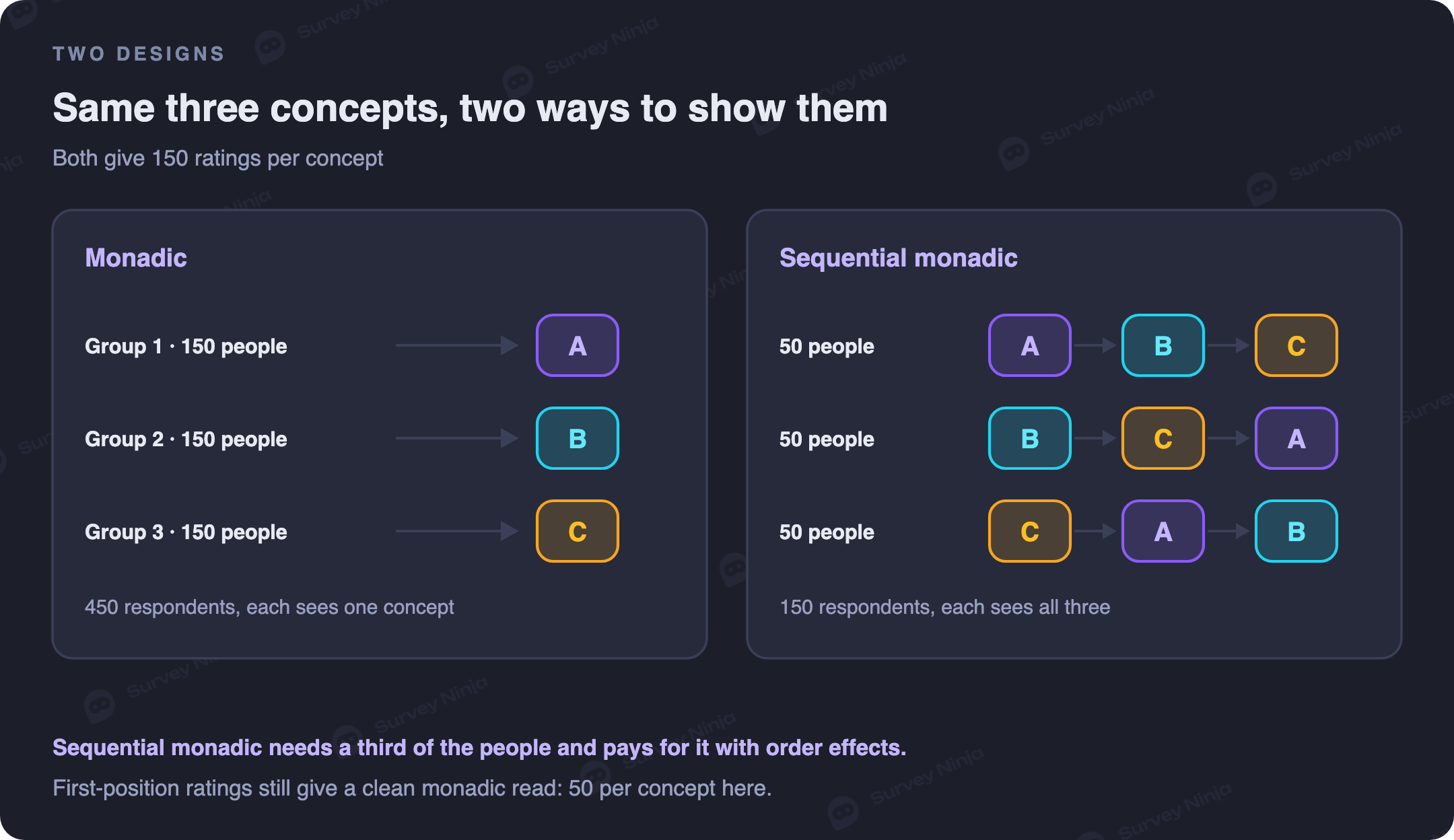
Monadic vs sequential monadic side by side
For three concepts and 150 ratings per concept, the two designs compare like this:
| Monadic | Sequential monadic | |
|---|---|---|
| Each respondent sees | One concept | All concepts, one at a time |
| Respondents needed | 450 | 150 |
| Survey length | Short | Grows with every concept |
| Main strength | A clean, realistic read of each concept on its own | Cheaper, and concepts are compared within the same people |
| Main risk | Cells must be truly comparable, or you compare audiences, not concepts | Order effects and fatigue: each concept colors the next |
| Best for | Final go or no-go, prices, concepts that would contaminate each other | Early screening of several ideas on a limited budget |
The trade is budget against purity. A monadic test costs more because every concept needs its own group, but each score means what it says. A sequential monadic test gets three scores from one group, but the second and third are rated by people who have already seen something else.
How many respondents each concept needs
The question that decides the sample is not "how many people is normal" but "how small a difference do I need to see". Concept tests are usually judged on top-2-box purchase intent, the share who say they would definitely or probably buy. Our glossary entry on the top-box score explains the measure, and the top-box calculator computes it from raw answers.
Suppose the current concept scores 40% and you want to know whether a new one does better. With a monadic design, a standard power calculation at a 0.05 significance level and 80% power gives these cell sizes:
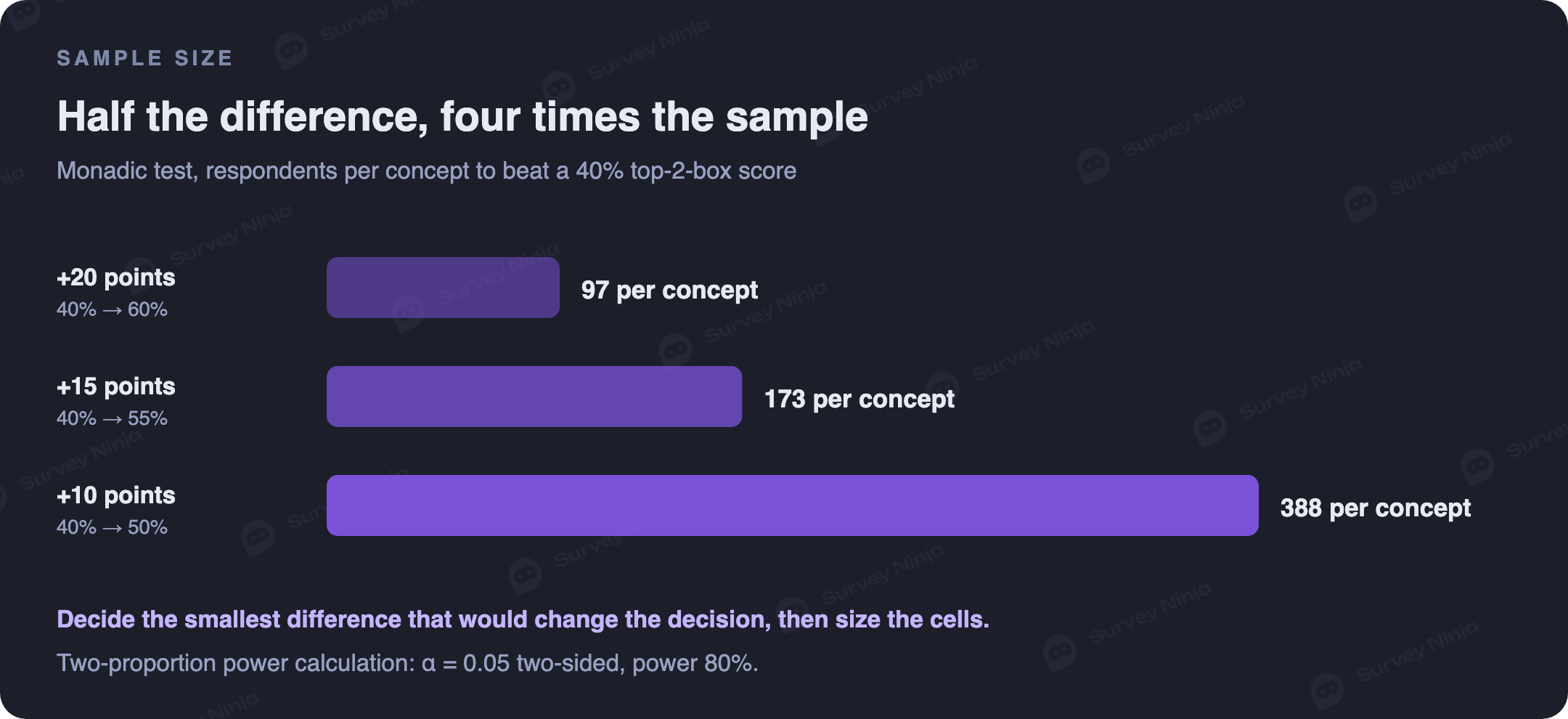
To tell 40% from 60% you need about 97 people per concept. To tell 40% from 50% you need 388. Halving the difference you care about roughly quadruples the sample. Decide the smallest difference that would change your decision before you buy a single response. Our sample size calculator for group comparison runs the same calculation for your own numbers.
A sequential monadic design needs fewer people for the same comparison, because each person rates every concept and the comparison happens within the same respondents. That is the main reason teams choose it. The saving is real, but it comes with the bias described next.
Order bias and how to control it
In a sequential monadic test, the first concept a person sees sets a reference point for everything after it. A strong first concept makes the second look weak. A weak one flatters it. Attention also fades: by the fourth or fifth concept, ratings drift and open answers get shorter. Keep the number of concepts per respondent small.
Two techniques keep this under control. First, rotate the order so that every concept appears in every position equally often. With three concepts, three orders are enough: A-B-C, B-C-A and C-A-B, each shown to a third of the sample. Random order per respondent works too, as long as the sample is large; our glossary entry on randomization covers the options.
Second, read the first position separately. The ratings each concept received when it was shown first were given before any other concept was seen, so they form a clean monadic read. With 150 respondents and three rotated orders, that is 50 first-position ratings per concept: too few for fine differences, but enough to check whether the full results tell the same story. If a concept wins overall but loses when it comes first, order is doing part of the work.
What a concept should look like
A concept is not a finished product. It is a short description, often with one picture, that a respondent can judge in under a minute. Researchers call it a concept board, and most boards follow the same four-part structure.
- The insight: the problem or wish the idea answers, in the customer's words. "I never know what to cook on weeknights."
- The benefit: what the product does about it. "Five-ingredient dinners, ready in 20 minutes."
- The reason to believe: why the promise is credible. A feature, a proof point, a source.
- The details that matter for the decision: format, price if you are testing it, where to buy.
Write every concept to the same template. Same length, same structure, same image style. Keep the brand out unless the brand is what you are testing, because a known name lifts every score it touches. Then read each board aloud to someone outside the team. If they cannot say in one sentence what the product is, the respondents will not either, and you will be testing clarity instead of the idea.
What to ask about each concept
Every concept gets the same block of questions, in the same order and with the same scales. Change the wording between concepts and you compare questions, not ideas. A typical block:
- Purchase intent on a five-point scale, from "definitely would buy" to "definitely would not buy". The top two boxes are the headline number.
- Appeal: how much do you like this idea?
- Uniqueness: how different is it from what is available now?
- Relevance: does it solve a problem you actually have?
- Believability: do you believe it would do what it says?
- Value, if a price is shown: is it worth the price?
- Two open questions: what do you like most, and what would stop you from buying it?
Show each concept the same way, with the same format, length and image quality. A concept with a better picture wins for the wrong reason. If you need a head start, the AI concept test question generator drafts a block around clarity, appeal, credibility and purchase intent that you can then edit.
Reading the results
Start with top-2-box purchase intent for each concept. Then check the gaps. Are they larger than chance? Two concepts at 43% and 47% with 150 ratings each are statistically indistinguishable. Calling one of them the winner is a guess dressed as a finding. The significance calculator for two proportions tells you in a few seconds whether a gap is real.
Look at the whole distribution, not only the top boxes. A concept that splits people into lovers and haters can be a better bet than one everyone finds pleasant. The first has a market. The second has polite interest. The diagnostic questions explain the headline number. High appeal with low believability means the promise is attractive but the proof is missing; high uniqueness with low relevance means the idea is new but solves nobody's problem.
Be careful with benchmarks. Purchase intent levels differ widely between categories and markets, so a 40% that is weak for snacks can be strong for software. The reliable comparison is your own control concept. Test it the same way, at the same time.
Which design to use when
Choose monadic when the decision is final and expensive, such as a launch, a packaging change or a new price. Prices belong in a monadic test. Someone who has just seen a lower price judges every next one against it. Monadic also fits when the concepts are variations of one idea, where seeing one would spoil the reaction to the others.
Choose sequential monadic for early screening, when you have four or five rough ideas and want to know which two deserve more work. It is also the realistic option when the audience is hard to reach, and you cannot afford a separate group per concept.
Add a final comparison question, the protomonadic step, when you need a clear winner. After all concepts have been rated, ask which one the person would choose. The preference share is easy to present and catches small differences that the ratings miss.
Common mistakes in concept testing
- Monadic cells that differ in age, region or customer status, so the test compares audiences instead of concepts.
- No rotation in a sequential monadic test, so the first concept wins or loses by position.
- Too many concepts per respondent, with tired ratings at the end.
- Different questions or scales for different concepts.
- Concepts shown at different quality, one polished and one rough.
- A winner announced on a gap that falls inside the margin of error.
- Several prices shown to the same person in a price test.
How to run a concept test in SurveyNinja
Upload each concept as an image or text, build the question block once and reuse it for every concept. For a sequential monadic test, turn on randomization of the concept order. For a monadic test, send each respondent to one concept at random and use quotas to keep the cells equal in size and profile. You can send the survey to your own list or to a respondent panel, then export answers with scores and comments to CSV. If you are unsure where to find the right people, our guide on where to find survey respondents compares the sources. The concept testing page shows the setup, our page for marketers covers message and campaign tests, and you can start building for free.
Frequently asked questions
What is monadic testing?
It is a concept test in which each respondent sees and rates only one concept. The sample is split into comparable groups, one per concept, and the groups are compared with each other.
What is sequential monadic testing?
It is a concept test in which each respondent rates two or more concepts one after another, each in full before the next. The order is rotated across respondents so that no concept always appears first.
Is monadic or sequential monadic better?
Neither in general. Monadic gives the cleanest read of each concept and suits final decisions and price tests. Sequential monadic is cheaper and suits early screening of several ideas, at the cost of order effects.
How many respondents do you need per concept?
It depends on the smallest difference you need to detect. In a monadic test against a 40% top-2-box score, a 20-point difference needs about 97 respondents per concept and a 10-point difference about 388, at a 0.05 significance level and 80% power.
What is protomonadic testing?
It usually means a monadic or sequential monadic evaluation followed by a direct comparison, where respondents say which concept they prefer. The exact definition varies between researchers.
How do you avoid order bias in a sequential monadic test?
Rotate the order so every concept appears in every position equally often, keep the number of concepts small, and compare the results with the ratings each concept received when it was shown first.
Published: Sep 30, 2026