


Team Effectiveness Survey: Questions, Scoring and What to Do Next
Useful  Mike Taylor Oct 14, 2026 Reading time ≈ 14 min
A team effectiveness survey asks the people on one team how well the team is set up, how it works together and what it delivers. Below are 28 ready statements in seven blocks, the research they come from, and how to score and discuss the answers when the team has eight people, not eight hundred.
This is not an engagement survey. Engagement is about how people feel about their work and the company, and our guide to the employee engagement survey covers it. It is not a 360 either, because a 360 looks at one person. Here the unit is the team, so every statement says "this team" or "we", and the results go back to the team itself. If you would rather start from a ready form, the team effectiveness questionnaire template can be edited to match the questions below.
What makes a team effective, according to the research
The organizational psychologist J. Richard Hackman judged a team on three criteria. First, does its output meet the standards of the people who receive it? Second, does the way it works build its ability to work together next time? Third, does being on the team add to members' learning and well-being, rather than wear them down? A team that ships on time but burns out half its people fails the third test. Hackman, Ruth Wageman and Erin Lehman later built the Team Diagnostic Survey around the conditions that support those outcomes, such as clear direction, sound structure and organizational support. Their 2005 paper tested it on 2,474 members of 321 teams.
Google ran its own study, Project Aristotle, on 180 teams, 115 in engineering and 65 in sales, and rated each team's effectiveness four ways: by executives, by team leads, by team members and by sales against quota. Five dynamics came out, listed in order of importance: psychological safety, dependability, structure and clarity, meaning, and impact. Several factors showed no significant link to effectiveness at Google: sitting in the same office, consensus decisions, extroversion, individual performance, workload, seniority, team size and tenure. Google's own guide adds a fair caveat. Other organizations may find something different.
The first dynamic has a longer history. In 1999 Amy Edmondson defined team psychological safety as "a shared belief that the team is safe for interpersonal risk taking". Her study covered 427 members of 51 teams in a manufacturing company. Teams with more safety showed more learning behavior, such as asking for help and discussing errors, and learning behavior was in turn linked to performance.
Put together, the research points to three things worth asking about: what the team is given, how it works, and what it produces. The questionnaire below follows that order.
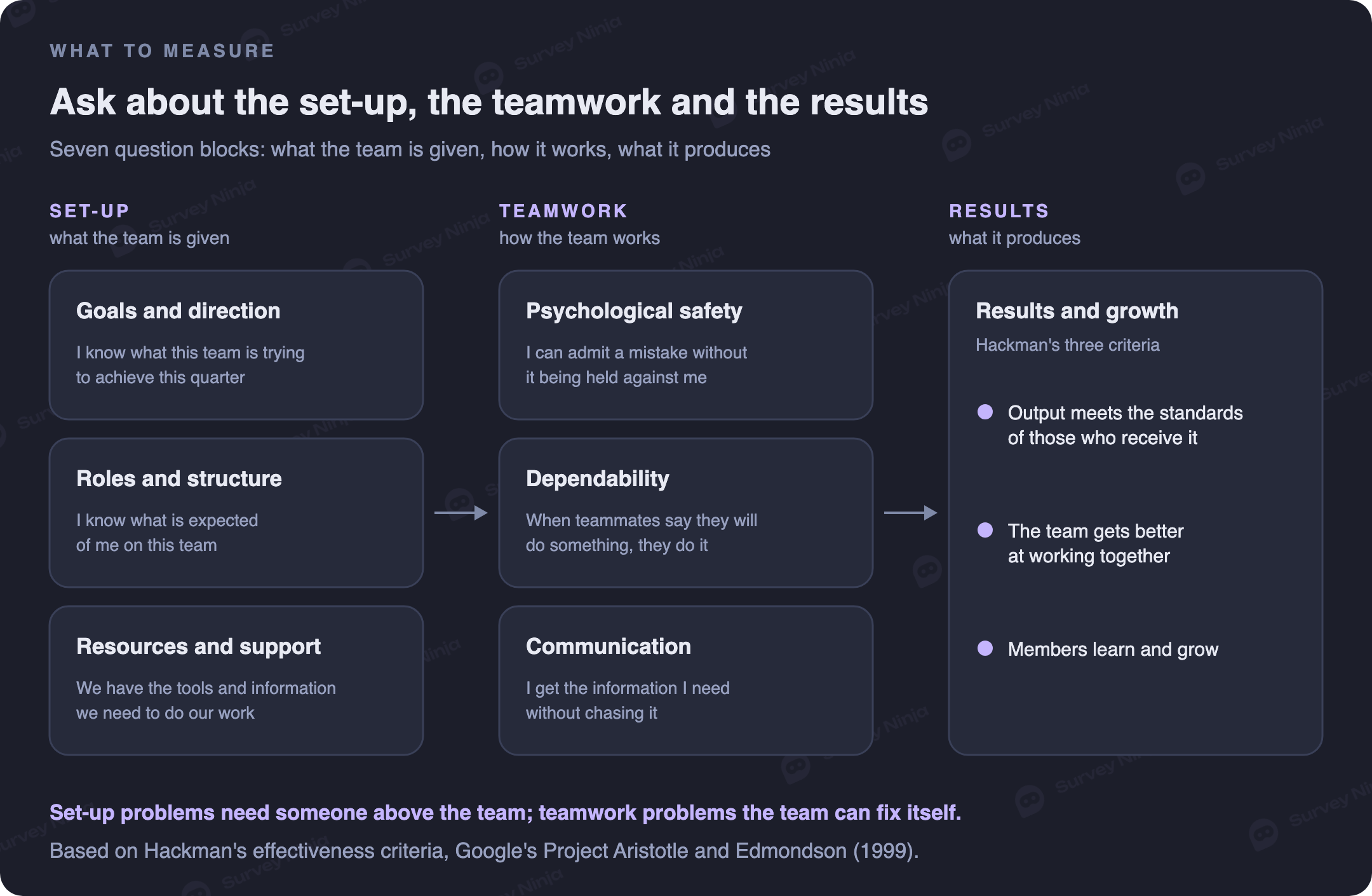
Team effectiveness survey questions
Each statement is answered on a five-point agreement scale, from strongly disagree to strongly agree, with a word on every point. Our page of rating scale examples has the labels ready to copy. Four statements per block are enough to cover a topic without asking the same thing twice.
1. Goals and direction
- I know what this team is trying to achieve this quarter.
- Our goals are specific enough to tell whether we met them.
- Team members agree on what matters most right now.
- I understand how our work connects to what the company needs.
2. Roles and structure
- I know what is expected of me on this team.
- It is clear who decides what.
- The team has the people and skills its work requires.
- Work is divided fairly among team members.
3. Resources and support
- We have the tools and information we need to do our work.
- When we need help from other teams, we get it in time.
- Our workload is realistic for the time we have.
- Our manager removes obstacles we cannot remove ourselves.
Low scores in this block are rarely the team's own doing. Budgets, tools and other teams' priorities sit above it, which is why the block needs its own place in the survey.
4. Psychological safety
- I can admit a mistake on this team without it being held against me.
- It is safe to disagree with the team lead in a meeting.
- Members of this team can bring up problems and tough issues.
- It is easy to ask other members of this team for help.
The first, third and fourth statements are adapted from Edmondson's seven-item scale, which used a seven-point response from very inaccurate to very accurate. Her survey mixed positive and negative wording to reduce response set bias. If you turn some statements negative, reverse their scores before you average anything.
5. Dependability
- When teammates say they will do something, they do it.
- Work I receive from teammates is good enough to build on.
- We usually meet the deadlines we set for ourselves.
- Problems in someone's work are raised early, not at the deadline.
6. Communication and coordination
- I get the information I need from teammates without chasing it.
- Our meetings end with clear decisions and owners.
- We resolve disagreements instead of avoiding them.
- I know what my teammates are working on this week.
7. Results and growth
- The people who receive our work are satisfied with it.
- This team is getting better at working together.
- Working on this team helps me learn and grow.
- I would like to keep working with this team.
The last block follows Hackman's three criteria. It keeps the survey from turning into a mood check, because a team can feel great and still deliver work nobody wants.
Three open questions to add
Close the survey with two or three open questions. The scores show where to look. The open answers show what actually happened, and those examples are what the debrief runs on.
- What is one thing that would help this team work better?
- What should this team stop doing?
- What does this team do well that we should protect?
In a small team, people recognize each other's writing style. Say so before the survey, and share themes in the debrief rather than verbatim quotes. Our note on open and closed questions covers how to code the answers into themes.
How to run it in a small team
Everyone on the team answers, including people who joined recently. The team lead answers too, but separately. A gap between the lead's view and the team's view is often the most useful finding of the whole exercise.
Anonymity is the hard part, because teams are small. A common working floor is five to seven responses: below that, a reported result is close to naming people. Our guide to anonymous surveys explains the rule and how it breaks. For a team of four, skip the numbers and run a facilitated discussion instead, or combine the team with a neighbouring one. Do not ask for role, tenure or location either. In a team of eight, two such questions are often enough to point at one person.
Pick a quiet moment. A survey in the week of a big deadline, or right after a reorganization, measures the week, not the team. A natural point is the end of a project phase, and then again about three months after the debrief, with the same statements.
Keep the length to the 28 statements and three open questions. If you need something extra, cut a block rather than add one.
How to score team effectiveness survey results
Start with counts, not percentages. In a team of eight, one person moves the share that agrees by 12.5 points, so "5 of 8 agree" is more honest than "62.5%". For each statement, count how many people agreed (4 or 5), stayed neutral (3) or disagreed (1 or 2). For each block, average the four statements for every person, then average across the team.
Here is a worked example with one question from each block, answered by a team of eight.
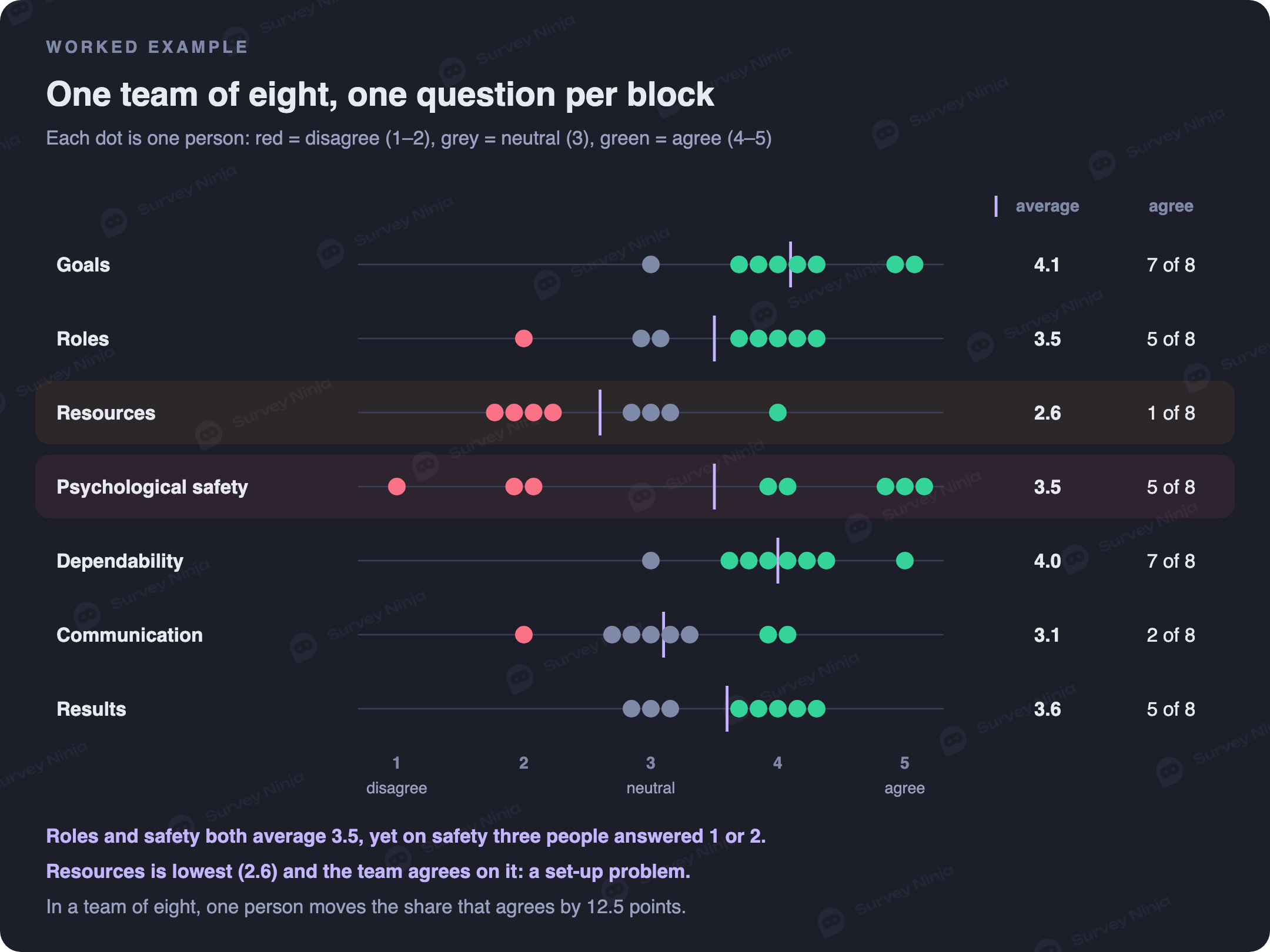
Three things stand out. Resources is the lowest block at 2.6, with only one person of eight agreeing, and four people answered 2. The team agrees with itself here, which makes it a set-up problem: the fix sits with whoever controls tools, budget or the other team's priorities. Communication sits at 3.1 with five neutral answers. A neutral cluster usually means people are unsure, so the debrief should ask what is missing rather than what is wrong. Roles and psychological safety both average 3.5 and both have five people agreeing. They are not the same result, though, and the next section explains why.
Same average, different team: reading a split
On roles, one person answered 2 and the rest clustered around 3 and 4. On psychological safety, three people answered 1 or 2 while three answered 5. The averages match, but the second row describes two different experiences of the same team, and an average describes neither.
A split like this is the most delicate finding a team survey can produce. Do not try to work out who answered 1. In a team of eight, guessing is easy and always damaging. Show the distribution. Say plainly that part of the team does not feel safe to speak up. Then ask for examples in a form that stays anonymous, such as a short follow-up with one open question. If the lead is part of the problem, a facilitator from outside the team should run that conversation.
Comparing teams and tracking change
Compare a team with itself first. The same statements, the same scale and a similar time of year give a fair comparison, and a change smaller than one person's weight is noise. Comparing teams is possible when several teams answer the same survey, and our guide to cross-tabulation in surveys shows how to set the table up. Apply the minimum group size to every cell.
If you run the survey across many teams, check that each block's statements measure one thing. Cronbach's alpha does this, but it needs a decent number of answers. With the eight answers of a single team, the estimate is too unstable to tell you much.
The debrief: turn scores into two changes
Share the results with the team within two weeks, while people still remember answering. Show the block averages and the distribution chart, then spend the meeting on two things only: the lowest block and the most split one.
Agree on no more than two changes, each with an owner and a date. For a set-up problem, the owner is often someone outside the team, so the lead's job is to take the result upstairs and come back with an answer. A team-building day does not fix a resources problem. Three months later, run the same survey and check whether the two blocks moved.
Team effectiveness survey vs engagement survey vs 360
| Survey | What it measures | Who sees the results |
|---|---|---|
| Team effectiveness | How one team is set up, how it works and what it delivers | The team and its lead |
| Employee engagement | How people feel about their work and the company | HR and leadership, by group |
| 360-degree feedback | One person's behavior as colleagues see it | That person and their manager or coach |
The three surveys answer different questions, so running one does not replace another. For the individual view, see our guide to 360-degree feedback.
Common mistakes
- Statements about "the company" in a survey about one team.
- Reporting results for a team of three.
- Asking for role and tenure, which identifies people in a small team.
- Using the answers in individual performance reviews.
- Reporting only the average and missing a split.
- Answering a resources problem with a team-building day.
- Running the survey once and never repeating it, so nobody knows whether the changes worked.
How to run a team effectiveness survey in SurveyNinja
Start from the team effectiveness questionnaire template, or build the survey from the 28 statements above. Use the Scale element with five labeled points for the statements and add the open questions at the end. You can also draft a first version with the HR survey generator and edit it. If several teams take the same survey, add a closed question for the team name and use report filters to view one team at a time, but only for teams that clear your minimum group size. Export the answers when you want to compare blocks or rounds. For distributed teams, our page on surveys for remote teams has more ideas. You can start building for free.
Frequently asked questions
What is a team effectiveness survey?
It is a questionnaire answered by the members of one team about how well the team is set up, how it works together and what it delivers. The results go back to the team and become the agenda for a discussion about what to change.
What questions should a team effectiveness survey include?
Statements in seven blocks: goals, roles, resources, psychological safety, dependability, communication, and results and growth. Each is rated on a five-point agreement scale, and two or three open questions at the end collect examples.
How many questions should a team effectiveness survey have?
Around 28 statements and three open questions is a workable size. Four statements per block cover a topic without repeating it. If you need to shorten the survey, drop a whole block rather than thinning all of them.
Should a team effectiveness survey be anonymous?
Usually yes, but anonymity in a small team is fragile. Report only groups above a minimum size, often five to seven responses, skip questions about role and tenure, and share themes from open answers instead of quotes.
How do you score a team effectiveness survey?
Count how many people agreed, stayed neutral or disagreed with each statement, average each block, and look at the spread as well as the average. In a team of eight, one person is worth 12.5 points, so report counts like 5 of 8.
How often should you run a team effectiveness survey?
Run it again about three months after the debrief, once the agreed changes have had time to work. Keep the same statements and scale each round, so the results can be compared.
Published: Oct 14, 2026